
The Most Overlooked Touring Motorcycle That Will Last A Lifetime
Touring motorcycles exist to devour miles — and the best ones do it with enough comfort, technology, and all-weather capability to make the journey genuinely enjoyable. The big names in the segment are well-earned: BMW’s GS series, the Honda Gold Wing, and Harley-Davidson’s touring lineup (the Street Glide, Road Glide, and their kin) have all built their reputations over decades of real-world proof. They also carry price tags to match.

But not every great touring motorcycle arrives with a celebrity endorsement. Some fly quietly under the radar, asking for less money while delivering more longevity than their obscurity might suggest. We combed through every touring motorcycle on the market today and landed on one standout: the most overlooked touring motorcycle that will last a lifetime.
The Honda NC750X DCT Will Be Your Companion For Life
Price: $9,499
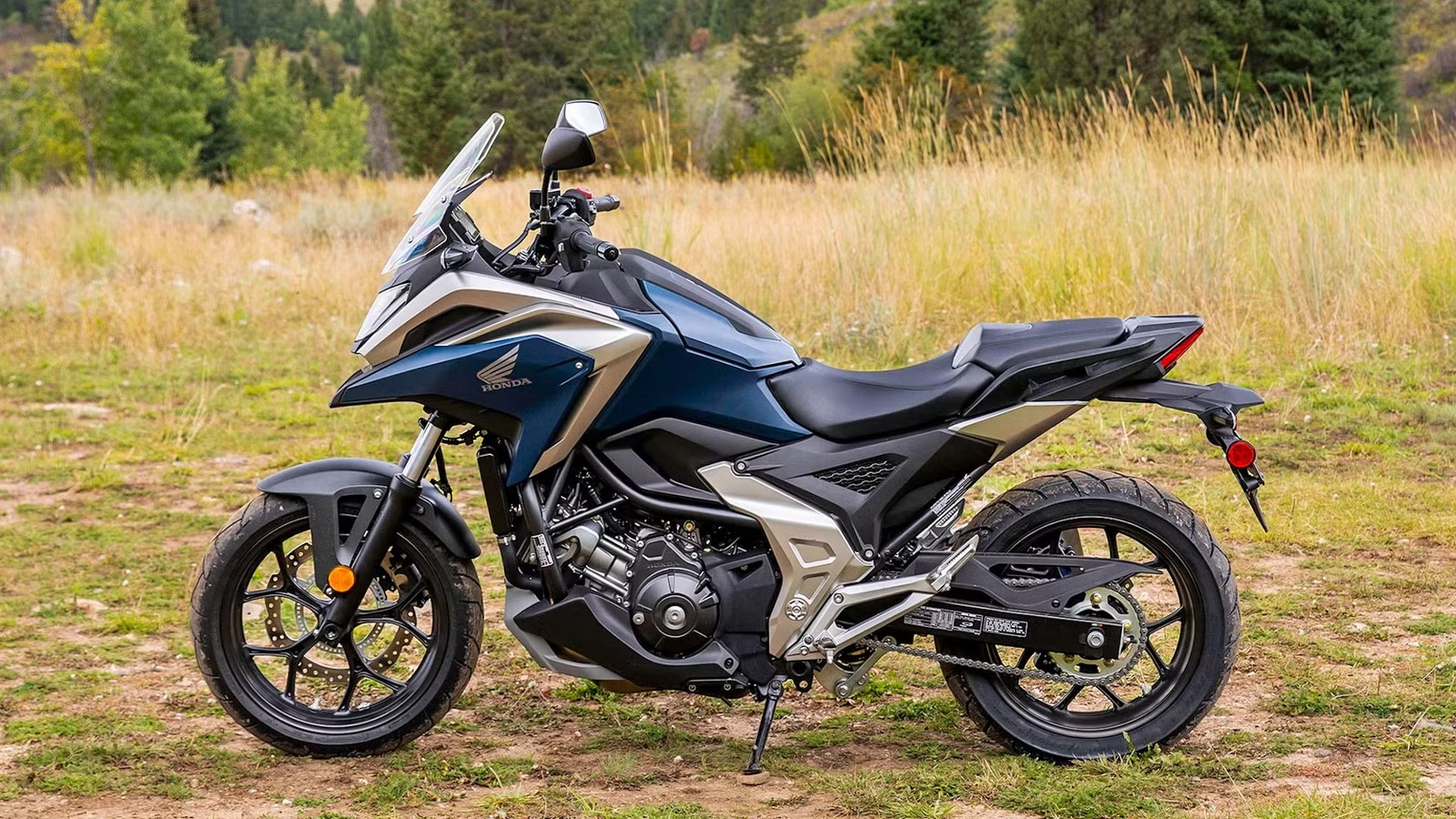
The NC750X flies under the radar for a number of reasons, not least of which is the fact that it is a motorcycle unlike any other. It looks like an adventure bike, functions as a tourer, and carries enough practical features to double as a capable city commuter. It is also remarkably frugal, offering low running costs and a generous tank range. Beneath the bodywork sits an unstressed engine, a proven automatic transmission, and just enough electronics to keep the rider safe without overcomplicating things. That combination delivers exceptional longevity — and it’s exactly why this is the most overlooked touring motorcycle that will last a lifetime.
Honda NC750X DCT Highlights

- Standard automatic gearbox
- ‘Fuel tank’ is actually storage space
- Fuel tank is housed inside rear subframe
- Unstressed engine
- Uncomplicated electronics

A Unique Driveline To Enable Easy Riding
The Engine Is Unique To The NC750

The NC started out life as a 670 cc engine, but over the generations it has grown to 745 cc. There are a number of very interesting features in the driveline. Unlike most modern bikes, this is a long-stroke engine — one that prioritizes torque over outright power, as the figures confirm: 57.8 horsepower and 50.9 pound-feet of torque. The redline sits at a modest 7,500 RPM, but the engine delivers a broad, accessible spread of torque that suits its touring brief perfectly. A useful clue to its character: the architecture is derived from one half of the Jazz/Fit’s four-cylinder mill.
A ride-by-wire throttle unlocks selectable ride modes, HSTC traction control, and adjustable engine braking levels. In the US market, only the DCT variant is offered. It uses the same intelligent dual-clutch transmission found across Honda’s DCT motorcycle range, automatically adjusting shift points based on how hard you’re riding in automatic mode. A sport mode holds gears longer and lets you chase the redline, while manual mode puts gear selection in your hands via paddles on the left handlebar.
Honda NC750X DCT Engine Specifications

|
Engine Configuration |
270 degree parallel twin, liquid cooling, Unicam SOHC, 4 valves per cylinder |
|
Displacement |
745 cc |
|
Bore x Stroke |
77 x 80 mm |
|
Compression Ratio |
10.7:1 |
|
Power |
57.8 HP @ 6,750 RPM |
|
Torque |
50.9 LB-FT @ 4,750 RPM |
|
Fuel System |
PGM-FI Electronic Fuel Injection |
|
Transmission |
6 speed dual clutch automatic transmission with manual control |
|
Final Drive |
Chain drive |
The Chassis Is As Unique As The Engine
Unusual But Purposeful

Squint and the NC750X’s steel diamond frame almost looks like an underbone chassis, because Honda has worked hard to maximize the space where a conventional fuel tank would normally sit. The engine is canted 55 degrees from vertical — similar in approach to a BMW K 1600 — and the actual fuel tank has been relocated beneath the seat. The result is a low center of gravity and a genuinely low seat height, both of which make the NC750X an approachable choice for riders stepping up to their first full-size motorcycle.
The suspension setup is straightforward: Showa dual bending valve forks up front and a preload-adjustable Pro-Link shock at the rear. Braking hardware follows the same pragmatic theme, with wave discs at both ends and a conventional two-piston floating caliper at the front — a spec that trails entry-level KTMs. An updated version of the NC750X adds a second front brake disc, though that revision has not yet reached the US market.
In summary, this is a competent chassis that inspires confidence in newer riders, though it will protest if you push it hard. The 17-inch wheels do open up a wide selection of aftermarket tires if you want to sharpen the handling. Its mechanical simplicity is also a major longevity asset — fewer things to go wrong, and when something does, it won’t be expensive to put right.
Honda NC750X DCT Chassis Specs And Dimensions

|
Chassis |
Steel Diamond Frame |
|
Front Suspension |
41mm telescopic forks; 4.7 inch travel |
|
Rear Suspension |
Pro-Link single shock withi preload adjustment; 4.7 inch travel |
|
Front Tire And Wheel |
120/70 ZR17 |
|
Rear Tire And Wheel |
160/60 ZR17 |
|
Front Brakes |
Single 320mm wavy disc with two-piston floating caliper |
|
Rear Brakes |
240 mm wavy disc with single piston floating caliper |
|
Length/Width/Height |
87/33.3/52.3 inches |
|
Fuel Tank Capacity |
3.8 Gallons |
|
Wheelbase |
60.4 inches |
|
Rake |
27 degrees |
|
Trail |
4.3 inches |
|
Seat Height |
31.5 inches |
|
Ground Clearance |
5.7 inches |
|
Curb Weight |
493.8 LBs (ready to roll with full tank of fuel) |
As Basic As Things Can Be In Terms Of Features

The NC750X DCT gets overlooked partly because it doesn’t arrive with flashy, attention-grabbing features. The instrument display is a no-frills LCD unit — not even a reverse LCD — that prioritizes legibility over wow factor. What the NC750X chases, even in its feature set, is practicality. The space where you’d expect to find a fuel tank is, in reality, a 6.1-liter storage compartment — large enough to swallow a full-face ADV helmet.
Another standout feature is its fuel economy. Honda claims 67.2 MPG on the WMTC cycle in D mode, and multiple respected publications have confirmed that 50-plus MPG is achievable in real-world riding. Rounding out the package are full LED lighting and self-canceling turn signals that use wheel speed differential to cancel automatically — a small but genuinely useful touch.
No Real Direct Competition To The DCT

There are no other automatic tourers available at a comparable price point and in a similar style to the NC750X. A handful of rivals do offer a quickshifter, which takes some of the effort out of a manual gearbox, but that’s not quite the same thing. It’s also worth noting that the NC750X omits cruise control despite its ride-by-wire throttle — an oversight that would have made it a more complete long-distance machine, and one that some competitors use to strengthen their own case.
The Transalp ($9,999) sits at nearly the same price as the NC750X and adds a quickshifter, though it’s hardly an overlooked machine. Also worth considering is the Suzuki V-Strom 800 ($10,109), which shares a similar parallel-twin layout and displacement class. Others worth a look include the Kawasaki Versys 650 LT ABS (a well-rounded midsize adventure-tourer), the Suzuki V-Strom 650 (an authentic V-twin experience), and the Triumph Tiger Sport 660 (which brings inline three-cylinder character to the class).
Honda NC750X DCT vs. Rivals

|
Model |
Honda NC750X DCT |
Kawasaki Versys 650 LT ABS |
Suzuki V-Strom 650 |
Triumph Tiger Sport 660 |
|
Price |
$9,499 |
$10,099 |
$9,299 |
$9,695 |
|
Engine |
270-degree parallel twin, Unicam SOHC |
270-degree parallel twin, DOHC |
90-degree V-twin, DOHC |
Inline three-cylinder |
|
Displacement |
745 cc |
649 cc |
1,086 |
660 cc |
|
Power |
57.8 HP @ 6,750 RPM |
67 HP @ 8,500 RPM |
69 HP @ 8,000 RPM |
81 HP @ 10,250 RPM |
|
Torque |
50.9 LB-FT @ 4,750 RPM |
44.8 LB-FT @ 7,000 RPM |
51 LB-FT @ 6,400 RPM |
47 LB-FT @ 6,250 RPM |
|
Transmission |
6-speed dual-clutch automatic |
6-speed manual |
6-speed manual |
6-speed manual, standard quickshifter |
|
Curb Weight (Wet) |
494 LBs |
483 LBs |
470 LBs |
456 LBs |
Sources: Honda Powersports, Kawasaki, Suzuki, Triumph

Related posts
Latest Post


No Comments