
This Forgotten Charger Beat The Hellcat To Factory Boost By Three Decades
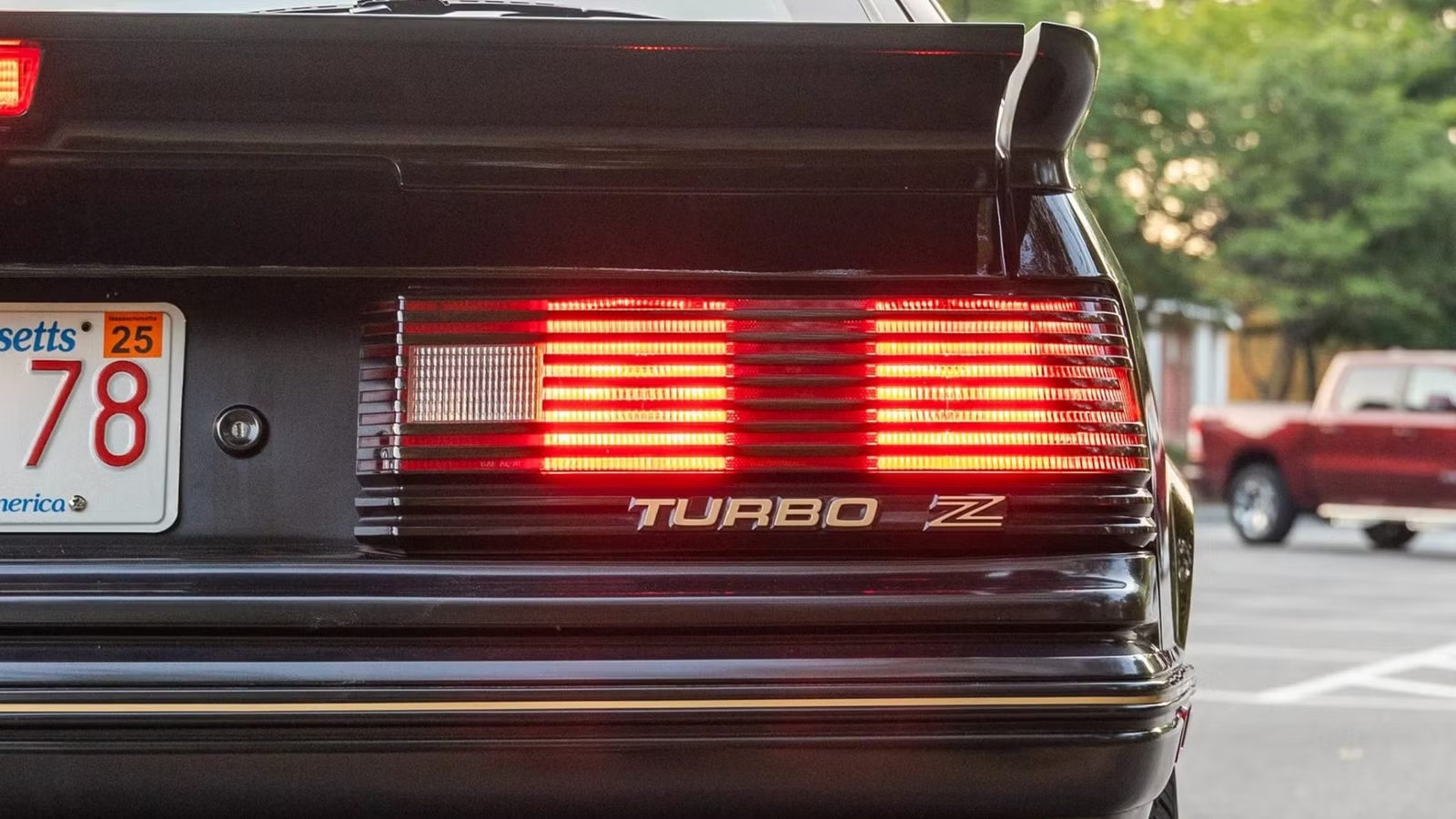
Long before Dodge discovered that 707 horsepower made an excellent cure for sensible transportation, it faced a much harder problem. America still wanted fat cars, but the old recipe of a huge engine, a big carburetor, and cheap gasoline no longer fit the times. The company needed another way to make horsepower, and in 1984, it found one with a small four-cylinder, electronic fuel injection, and a turbocharger. The result looked almost nothing like the Hellcat era that followed, but it showed that Dodge had learned the value of factory boost more than 30 years earlier.
The Muscle-Car Formula Was Broken By The Early 1980s

American performance entered the 1980s carrying a nasty hangover from the previous decade. The 1973 oil crisis sent fuel prices soaring, while federal emissions rules forced automakers to rethink how their engines burned fuel and cleaned their exhaust. Congress also created the first federal fuel-economy program in the 1970s. By 1981, oxygen sensors, electronic engine controls, and three-way catalytic converters had started becoming common. Those technologies eventually helped horsepower recover, but Detroit first had to survive an awkward transition period. The great muscle-car method of solving every problem with another cubic inch had become much harder to sell.
The familiar performance badges never completely disappeared. Mustang and Camaro still mattered, and Ford and Chevrolet still relied on the basic layout that enthusiasts understood: engine up front, driven wheels out back, and a V8 available under the hood. The numbers showed how much the world had changed, though – the 1983 Mustang GT’s 5.0-liter V8 made 175 hp, while the high-output Camaro Z28 produced 190 hp. Those figures could still move relatively light cars with useful urgency, but they looked very different from the massive outputs attached to earlier muscle machines.

Chrysler had an even stranger hand to play. Its recovery strategy increasingly revolved around compact, front-wheel-drive cars and families of models that shared basic engineering. The K-car architecture became central to that turnaround, and its front-drive layout also supported Chrysler’s groundbreaking minivans. That made financial sense, but it created an obvious performance problem – a company with names such as Charger in its history now had to figure out how to make excitement from smaller engines mounted sideways. Building a fresh rear-drive V8 performance platform would have pulled against the direction Chrysler had spent years moving toward. So the company went hunting for horsepower inside the hardware it already had.

Chrysler Found Horsepower Hiding Inside A 2.2-Liter Four-Cylinder

The unlikely answer started with Chrysler‘s 2.2-liter four-cylinder. In normal form, it was useful rather than exotic with 98 horsepower and 119 lb-ft and simple throttle-body fuel injection. The turbo version received a much more serious treatment – Chrysler fitted electronically controlled multi-point fuel injection, lowered the compression ratio, revised the camshaft, strengthened the valvetrain and piston rings, increased oil-pump capacity, and added a Garrett turbocharger. At roughly 7.5 psi of maximum boost, the little 2.2 jumped to 142 hp and 160 lb-ft. That represented a power increase of roughly 45 percent without adding a single cubic inch.
The clever part went deeper than the peak number. Positive manifold pressure from about 1,200 rpm and 7.2 psi by only 2,050 rpm at full throttle gave the engine strong response for an early turbo setup, rather than making the driver wait through a long lag for boost to arrive. Chrysler also used liquid cooling around the turbo bearing housing. After shutdown, a thermosiphon effect kept coolant moving through the hot turbo and reduced the oil-coking problem that could punish early boosted engines. Chrysler’s engineers even built safeguards into the electronics that could cut boost or restrict full-power operation when the system detected trouble.
The company wanted to challenge America’s established sporty coupes with its new turbo unit. Turbocharging let it chase that goal while staying faithful to the smaller, lighter, front-drive engineering that increasingly defined Chrysler’s passenger-car lineup. Even the driveline received special attention – equal-length half-shafts helped control torque steer, while a hydraulic engine mount helped keep wheel hop under control when the driver used all 160 lb-ft at once.

But the truly odd part was the body around it. Chrysler had put its new performance engine in a front-wheel-drive hatchback coupe, then pointed the car straight at the Mustang GT and Camaro Z28. Someone in Highland Park had clearly decided that convention was optional.
The 1984 Dodge Daytona Turbo Z Was Dodge’s Boosted Performance Car Three Decades Before The Hellcat

The car was the 1984 Dodge Daytona Turbo Z, and its spec sheet reads like the photographic negative of a modern Dodge muscle car. A 2.2-liter turbocharged inline-four produced 142 hp and 160 lb-ft, while maximum boost sat around 7.5 psi. A five-speed manual transaxle sent the power to the front wheels. The car weighed roughly 2,650 pounds.
The new Dodge was regarded as America’s first serious front-wheel-drive muscle car. Dodge estimated 0–60 mph sprint in 8.2 seconds, a 16.4-second quarter-mile, and a 128-mph top speed. None of those figures would frighten a current family sedan, but that misses the point by four decades. This was a four-cylinder Dodge making only 33 hp less than the Mustang GT and doing it from less than half the Ford’s displacement. The 160 lb-ft torque peak also arrived low enough to give the engine useful midrange shove. More importantly, the Daytona combined that engine with a chassis that could actually use it.

One MotorTrend comparison made Chrysler’s intention impossible to miss. It placed the new Daytona against the Mustang GT and Camaro Z28, and on paper, the Dodge looked outgunned. The Camaro had 190 hp and the Mustang had 175. At Laguna Seca, however, the 142-hp Daytona turned a 1:28.8 lap, beating the Mustang’s 1:29.9 despite driving the wrong wheels according to traditional muscle-car scripture. The magazine also recorded 0.83 g on the skidpad for the Dodge against 0.77 g for the Mustang. The Camaro remained quicker, but the important result was that Chrysler’s small, turbocharged front-driver belonged in the conversation. The magazine called it the best-handling production front-drive car it had tested at the time.

That makes the Daytona an interesting counterpoint to the Charger SRT Hellcat that arrived 31 model years later. The 2015 Hellcat used a supercharged 6.2-liter Hemi V8 to produce 707 hp and 650 lb-ft. It attacked performance with displacement, cylinders, noise, rear-wheel drive, and enough power to make a tire shop owner grin from across town. The Daytona used nearly the opposite set of ingredients – its engine displaced four liters less and had half as many cylinders. But both cars leaned on the same basic tool: forcing more air into an ordinary production engine to create something much less ordinary.
The Daytona Helped Turn Turbo Fours Into Chrysler’s Performance Weapon

Chrysler kept developing the turbo four. The Daytona’s Turbo I rose from 142 hp in 1984 to 146 hp for 1985. The bigger jump came with the intercooled Turbo II. By 1987, the Daytona Shelby Z used that version of the 2.2 to make 174 hp, with Dodge advertising 12 psi of boost. Then things became properly strange – the 1992 Daytona IROC R/T arrived with the Turbo III, a 2.2-liter development using a 16-valve DOHC cylinder head designed with Lotus involvement. It produced 224 hp and 217 lb-ft through the front wheels. In less than a decade, Chrysler had found another 82 hp in the basic 2.2-liter idea.
The Daytona also belonged to a much bigger turbo-Mopar story. Versions of Chrysler’s boosted four appeared in cars that looked as though they had been chosen by pulling names from a hat. The Dodge Omni GLH received Turbo I power, and so did the Shelby Charger. Turbocharged 2.2s appeared in cars such as the Dodge 600 and Chrysler New Yorker, while hotter Shelby products kept pushing the formula. Later came the variable-nozzle Turbo IV and the 224-hp Turbo III.

That widespread use helped create the cult around 1980s turbo Chryslers: ordinary-looking front-drive cars with boost gauges, electronic engine controls, and far more straight-line punch than their economy-car family trees suggested. The automaker had effectively discovered that turbocharging could turn platform sharing into something enthusiasts might actually brag about.
None of this makes the Daytona’s 2.2 a mechanical ancestor of the Hellcat engine. The connection is philosophical. One chased performance while Chrysler counted every pound, gallon, and development dollar. The other arrived in an age when Dodge could sell outrageous horsepower as part of its identity. Their hardware had almost nothing in common, but their answer to the horsepower question did: add air under pressure and deal with the consequences afterward.
The Hellcat Made Factory Boost Famous, But The Daytona Got There First

Time has not treated the Daytona Turbo Z like a traditional Dodge performance icon. It lacks nearly every ingredient that makes an old Mopar easy to romanticize. There is no V8 under the hood, the rear wheels merely follow along, and its 2.2-liter displacement sounds closer to an economy-car specification than a muscle-car boast. An 8.2-second run to 60 mph now looks leisurely, too. Even its hatchback body and electronic dashboard place it firmly inside the angular, digital world of the early 1980s.
The Daytona belonged completely to its own decade with its electronic multi-point injection when the V8 Mustang and Camaro still relied on four-barrel carburetors. It used a turbocharger to stretch a small engine, front-wheel drive to fit Chrysler’s new platform strategy, equal-length half-shafts to tame torque steer, and electronic systems sophisticated enough to monitor faults and protect the powertrain. Some cars preserve old formulas, but the Daytona showed what happened when Detroit had to invent a different one.

Thirty-one years later, the Charger SRT Hellcat made forced induction part of Dodge mythology with a 707-hp supercharged V8. The Daytona Turbo Z needs no “mini Hellcat” label to matter because its achievement stands on its own. In 1984, Dodge took a humble 2.2-liter four, fed it boost, and sent it hunting for Mustangs and Camaros. That was strange, clever, and very much a product of its moment. Most of all, it proved that Dodge’s appetite for factory boost was already alive decades before anyone heard a Hellcat supercharger whine.
Source: Chrysler, Dodge, MotorTrend

Related posts


Latest Post


No Comments