
Our 2028 Mercury Cougar Eliminator Doesn’t Care That Mercury’s Dead
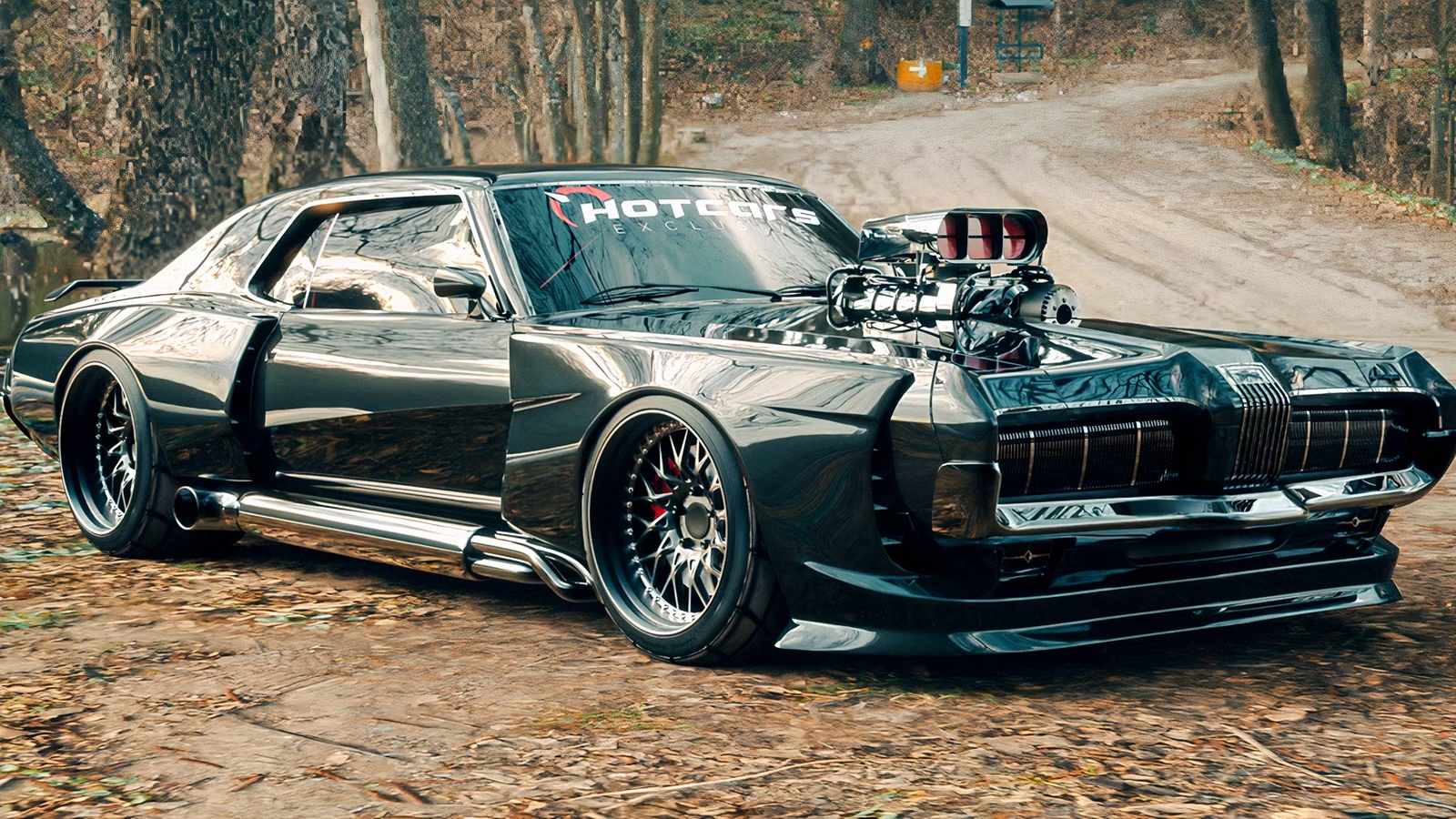
Somewhere in an alternate Detroit, Mercury still has the lights on, its designers have lost all sense of restraint, and the Ford Mustang has a very uncomfortable family reunion ahead. Our 2028 Mercury Cougar Eliminator restomod render imagines a muscle car returning with enormous fenders, a hood-mounted supercharger, and the kind of attitude usually reserved for cars that eat their own tires.
The Original Cougar Eliminator Was More Than A Fancy Mustang

When Mercury introduced the Cougar for 1967, it gave Mustang buyers a more sophisticated way to enjoy Ford‘s formula. Hidden headlights, sequential taillights, and quiet confidence made sense for buyers wanting V8 performance without shouting. But by 1969, Detroit’s muscle car competition had become a shouting match. Mercury answered with the Eliminator, effectively exchanging the Cougar’s dinner jacket for a racing helmet.
The 1970 Mercury Cougar Eliminator carried the idea further with a blacked-out grille, aggressive hood treatment, front spoiler, rear wing, and performance-tuned suspension. Its standard 351 Cleveland V8 was rated at 300 horsepower, while people could order the 290 hp Boss 302 or the 335 hp 428 Cobra Jet. That last engine delivered a factory-rated 440 lb-ft of torque, which challenged the Cougar’s upscale reputation. A four-speed manual was available for hands-on drivers.
Here’s the part that makes a 2028 Mercury Cougar Eliminator restomod especially interesting: the original was genuinely scarce. Mercury built just 2,268 Eliminators in 1970, including 469 Boss 302 examples and 374 equipped with a 428 Cobra Jet. The package disappeared after that model year. The Mustang became an American institution while the Eliminator became the car you might spend years trying to spot at a show. Who knew shared DNA doesn’t ensure equal attention.

Our 2028 Cougar Eliminator Render Has Absolutely No Indoor Voice

The render keeps the recognizable 1970 Cougar nose and long-hood profile, then stretches almost everything else to massively threatening proportions. Huge boxed-out fenders swallow deep-dish wheels and huge rubber. The front splitter sits alarmingly close to the pavement, while vents behind the wheel arches suggest the bodywork has been designed for more than cruising. The circular halo headlights give its traditional hidden-lamp face a distinctly unfriendly stare. Dressed in near-black metallic paint, the entire car resembles a shadow that’s decided to become a traffic violation.
As for the engine hardware, a giant polished blower rises through the hood, topped by a three-opening intake with a red interior. The original 1970 Cougar Eliminator could be ordered with some formidable factory V8s, but this made up 2028 restomod clearly wants to skip subtlety entirely. We’d give it a supercharged Ford 5.0-liter Coyote V8 targeting around 750 horsepower, with a six-speed manual and an LSD. Why not, right?
Rooted In Fiction

An independent rear suspension, upgraded brakes, and properly engineered chassis bracing would be essential if a real Mercury Cougar restomod were to approach that output. The render already suggests serious stopping power through its large wheels and red brake calipers. Side-exit exhaust pipes are an excellent theatrical touch, although keeping them away from expensive shoes and unsuspecting ankles might be its greatest day-to-day engineering challenge.
Around back, a full-width red taillight treatment nods to the Cougar’s famous sequential lamps, accompanied by a substantial wing and a chunky diffuser. There are some questionable choices here. The fender extensions look wide enough to require their own ZIP codes, and the hood-mounted blower makes forward visibility a matter of faith. Still, those exaggerations help the car feel like a proper muscle car fantasy rather than a familiar Mustang wearing a Mercury grille. Besides, nobody opens an article like this hoping to see sensible wheel offsets.
A Rare 1970 Eliminator Makes This Fantasy Surprisingly Expensive

The most awkward part of recreating a 2028 Mercury Cougar Eliminator might be finding the right classic to start with. A recent collector-market snapshot of 1969-1970 Eliminators shows an average value of about $72,000 with the highest reaching $170,000. These aren’t disposable project cars, particularly when a genuine Boss 302 or Cobra Jet example comes with rarity that a widened fender can’t replace.
That’s also why we’d rather see a build inspired by the Eliminator than watch someone cut up a numbers-matching survivor. Starting with a more ordinary first-gen Cougar could preserve a significant piece of muscle car history while allowing a custom chassis, modern V8, giant brakes, and outrageous bodywork. It wouldn’t have the collectible identity of a factory Eliminator, but it could give you something arguably more enjoyable on the road. The rear tires might dispute that after their first enthusiastic launch, though.
A Case To Be Made

Mercury itself was discontinued in 2011, so there’s obviously no 2028 Cougar Eliminator waiting in a showroom. The render arguably piles on too many mods for a car that originally succeeded by being a slightly classier Mustang alternative. But maybe that tension’s just what’s needed. Under the supercharger, flares, and improbable ground clearance is a reminder that the Cougar was once a legit American performance contender. If any forgotten muscle car deserves another shot at stealing the Mustang’s thunder, this one makes a persuasive, gloriously antisocial case.

Related posts




Latest Post


No Comments