
How Most Americans Missed Out On The Rarest Hemi Drop Tops
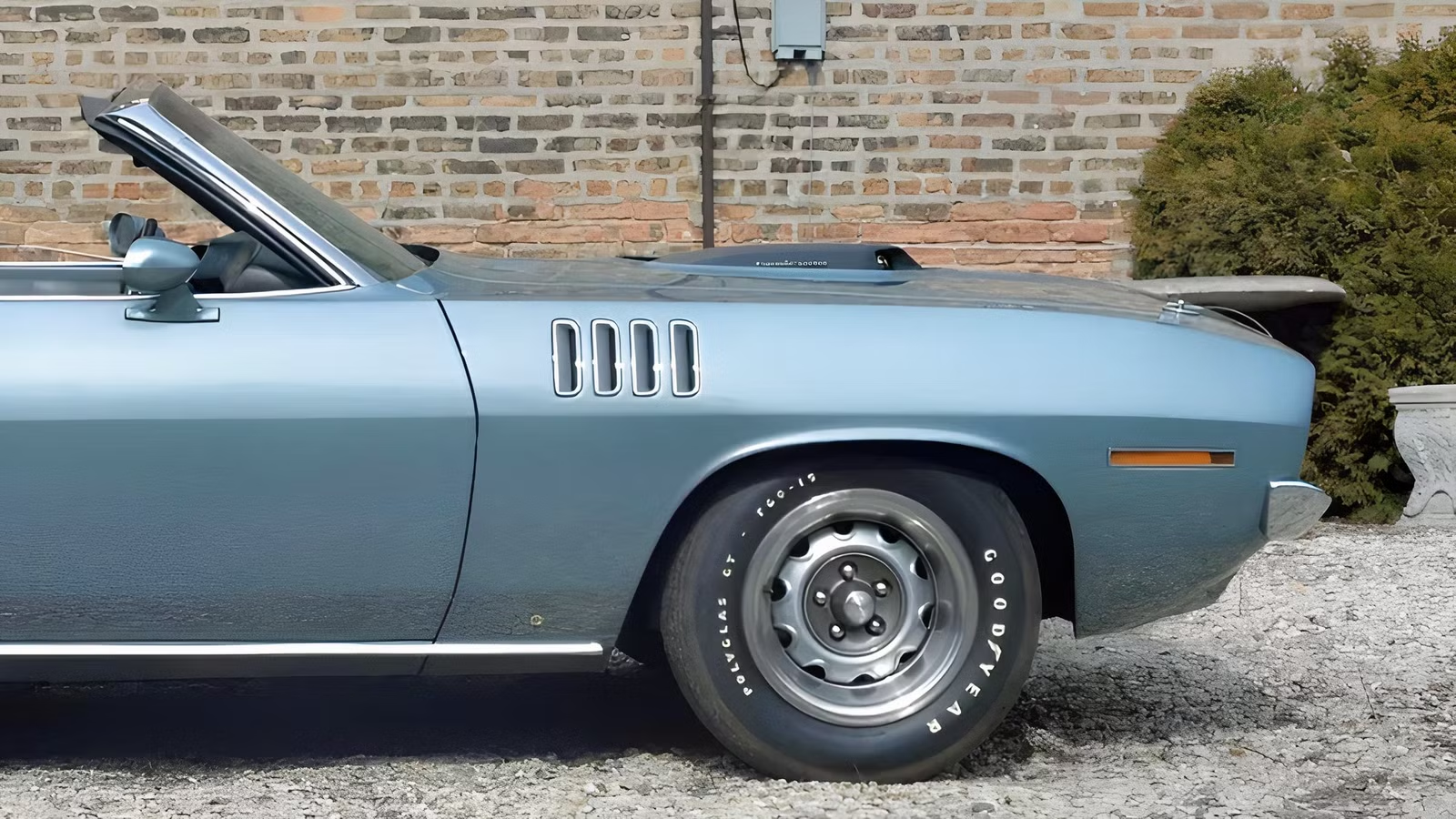
It’s kind of hard to say anything about the holy grail of Mopar muscle that hasn’t been said a million times before, usually by people who claim to know more about all things Mopar than you with pride in their chests. No harm to them, but the unsolicited lectures do get old after a while. Yet, we bet most of them never knew it had variants most of us never knew existed. Mostly, it’s because they were produced in so few numbers that hardly anyone saw one. It doesn’t help that many of them shipped out of the country to lands elsewhere. Why? Well, that’s where the real meat and potatoes of this deep dive come from.
1970 and ‘71: Peak Mopar? Very Possibly

Sadly, the end of the muscle car wars was right around the corner at the turn of the 1970s. You all know the story: geopolitical turmoil plays out all the way across the world, a global oil crisis, and the EPA steps in to regulate exhaust emissions right around the same time a global oil crisis hits North America. Yet, right before that point, around 1970 and 1971, the Chrysler/Mopar family was producing standout model after standout model in a way we’ve seldom seen from an OEM since.
Right before federal regulators stepped in, Mopar was free to pursue high-compression powertrains, free of restrictions that would soon reduce gigantic big-block motors to a fraction of their true potential. The 440 Six-Pack, with its three two-barrel Holley carburetors, was a low-end torque monster with nearly 500 lb-ft to its name, and it also happened to make 390 horsepower at the crank. Meanwhile, the 426-cubic-inch Hemi motor was the exact opposite—a high-RPM screamer of a machine that had no qualms churning and burning up to 6,000 revs per minute while it pushed cars to sub-12 quarter-mile times.

Even the exterior styling and paint options were out of this world, with sleek, curvaceous facelifts applied across the range to let customers know Mopar was the most aggressive OEM in the game. Iconic paint colors like Plum Crazy, Sublime, Go Mango, and Lemon Twist made the fleet stand out against offerings from GM and Ford. It wouldn’t last long, as compression ratings lowered and outrageous performance drivetrain packages were largely discontinued after 1972, but right before those years, the Mopar formula worked wonders for one platform in particular over all the others.

The E-Body: Mopar Perfection Personified

The Chrysler E platform might not ring a bell if you’re not a huge Mopar nerd, but it really ought to. In effect, it was Chrysler’s attempt to take the pre-existing B-body platform, shorten it down just a bit, and make it compete with the first generation of what we now call pony cars. You know, your Ford Mustangs and Mercury Cougars, plus the Chevy Camaro and Pontiac Firebird. To make it happen, Chrysler altered the front suspension and subframe architecture of the B-body by widening the cowl and the front track, giving the impression that it was far larger than it actually was.
There were two distinct wheelbases among the E-body as well, one at 110 inches with slightly more subdued road manners, and another at 108 inches, far more aggressive and twitchy in its handling. The move was genius, and it let Mopar tailor-make distinct platforms for both Plymouth and Dodge, tasked with catering to two similar yet separate sections of the pony car and muscle car markets. In truth, these were the only two cars to ride the E-body during the early ‘70s, but it was enough to cement a legacy that’s still talked about today.

Better still, the wider track allowed the engine bay to be truly cavernous, easily big enough to accommodate the biggest and baddest Mopar engines with room to spare. That raises the question: does any of this—the American car with rear drum brakes and a live rear axle—sound like something Europeans driving Jaguars and Porsches would enjoy driving? Well, no, if you ask us. Yet, that didn’t stop Chrysler from trying to market its flagship Plymouth overseas. When they did, Chrysler accidentally sent perhaps the most desirable Mopar of the ’70s to a market that would never appreciate it, while leaving Americans in the dark. What makes it so special? It’s simple: it was a convertible, and Americans hardly so much as caught a glimpse of it.
1970/71 Plymouth Hemi ‘Cuda Convertible: A True Unicorn in Every Sense

The E platform diverged into two distinct camps in the early ‘70s. One was the Dodge Challenger, and the other was the Plymouth ‘Cuda/Barracuda. The Challenger was always defined by its sweeping hardtop roofline that almost looked chopped from the factory. Most of the time, the ‘Cuda was the same. Except, Plymouth was a little bit bolder in the direction it hoped to take the ‘Cuda line. For an exceptionally short period of time, just long enough for 18 units to roll off the production line in 1970 and 12 in 1971, Plymouth built a drop-top Hemi ‘Cuda with the hopes of selling some of them internationally. It sounds absurd, but Plymouth did build just under 300 convertible ‘Cudas in all different trim configurations before the plug was pulled on the E body altogether.
Only that small group of 30 units had Hemis, and many were taken right off the line, loaded onto cargo ships, and sent across the Atlantic to France, north of the border to Canada, and way down south to South America. Clad in Winchester Gray or Sno-White paint and black convertible tops, and packing metric speedometers and radio deletes, one can only imagine what the locals must have thought seeing these ‘Cudas unloaded from the ship in places like Calais. In a country packed with rural back roads, small highways, and tight parking spaces, the Hemi ‘Cuda convertible must have been a fish out of water. Modern listicles tend to conflate this limited run of convertibles with a separate one-of-one red hardtop sold to the Classic Car House in Copenhagen, Denmark. But make no mistake, the two were separate.

With its relatively primitive suspension compared to the hydraulically assisted independent rear suspension of a Citroën DS, the ‘Cuda really was like an alien spaceship to the locals. Three Hemi ‘Cudas found their way to France in 1971, one made its way to Guatemala in 1970, two went to other European markets, while seven of them stayed in the US as obscure collector’s items. If you were lucky enough to see one roll by at the time, you would have been forgiven for thinking you’d started hallucinating. That’s how unheard of these rare convertibles were. Given the time period, a fear of one’s drinking water being spiked with psychedelics was not as outrageous a thought as it sounds now. Given how rare these Plymouths were, you could be forgiven for thinking so.
Multi-Million Dollar Dream Cars

Just imagining how valuable and sought-after these rare convertible ‘Cudas are is enough to get the heart racing. But rest assured, the true value of a genuine French export when it rolls across the auction block may come as a surprise. One French example, painted in Winchester Gray with four-on-the-floor, a Hurst pistol-grip shifter, the A33 Track Pak, and a Dana 60 rear end, survived for 50 years in Europe, racking up 98,553 kilometers before it made its way back to the US for the 2021 running of Mecum Auctions at Indianapolis.
There, the car failed to meet its reserve price,with the highest bid reaching a staggering $4,800,000. The reserve? That would be a staggering $6,500,000. That’s early ’30s Bugatti Royale or 1957 Ferrari 625 TRC racer money for an early ’70s muscle car. Then again, it is a fairly special one.
Source: Mecum, Plymouth

Related posts





Latest Post


No Comments