
The New Audi SQ9 Is An RS SUV Wearing A Slightly More Sensible Badge
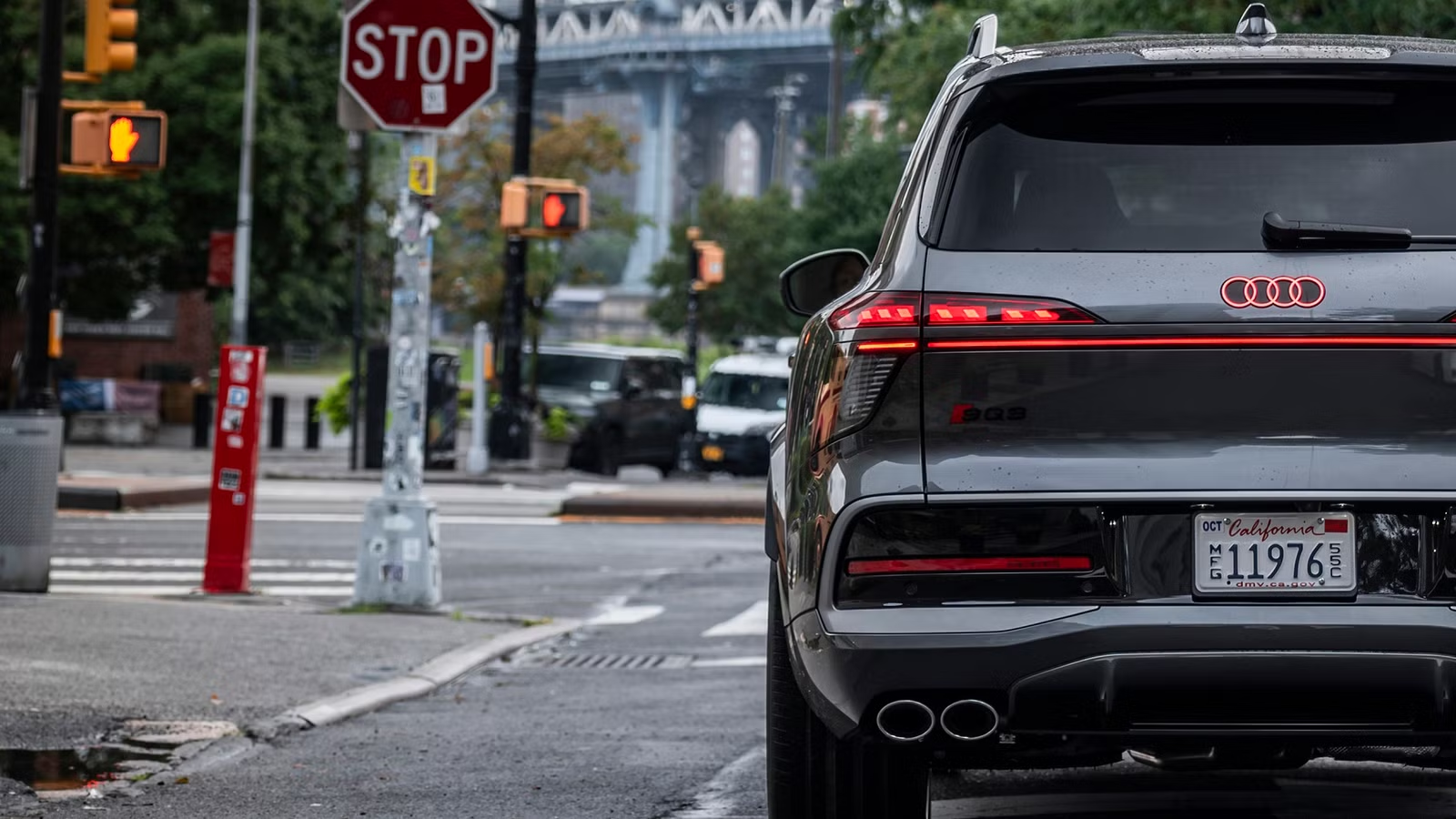
Audi has given its biggest SUV the performance treatment, and the result looks far more serious than the badge suggests. The new SQ9 sits at the top of the brand’s three-row SUV range, pairing flagship luxury and family-friendly space with the sort of chassis hardware usually reserved for the brand’s most aggressive models. Yet there is no RS badge on the tailgate. That makes the SQ9 especially interesting, because it may show just how close Audi’s S models can now get to full RS territory without crossing the line on paper.
Audi’s S Badge Isn’t Supposed To Be The Wild One

Audi has long used the S badge as the middle step between its regular cars and the models developed around maximum performance. An S model normally gets a stronger engine, sharper chassis tuning, bigger brakes, quattro all-wheel drive, and more serious styling without throwing everyday comfort into the nearest trash can. Then an RS version can sit above it as the louder, faster, more focused flagship. Audi still describes the RS Q8 performance as the top model of its SUV family, with 631 horsepower in U.S. specification and a harder focus on outright pace.
That tidy hierarchy gets messy with big SUVs. A heavy luxury SUV already needs serious power simply to feel effortless. It also needs large brakes because physics remains annoyingly unwilling to accept a premium-brand loyalty card. Adaptive suspension, active differentials, rear-wheel steering, and huge tires can start as tools for making a large SUV easier to drive, then become performance hardware with a few changes to software and calibration. The line between “comfortable but quick” and “high-performance” gets thin surprisingly fast.

Audi has already pushed its S SUVs deep into territory that once looked exotic. The latest SQ7, for example, uses a 591-hp twin-turbo V8 and can reach 60 mph in 3.7 seconds, some 91 hp more than the outgoing model. The RS Q8 Performance makes just 40 more horsepower and reaches 60 mph in a claimed 3.4 seconds in U.S. specification. Those remain meaningfully different machines, but the gap no longer resembles a canyon.

The Upcoming Flagship That Looks Far More Serious Than Its Badge Suggests

Audi has now entered a part of the market it spent years leaving to BMW, Mercedes-Benz, Range Rover, and the big American luxury brands. Its new flagship measures 5.31 meters, or about 209 inches, long, stretches across a 3.14-meter wheelbase, and offers six- or seven-seat layouts. Audi calls it the largest vehicle the company has ever built. The company also says it developed the model with U.S. buyers specifically in mind, which explains the generous dimensions and the available V8 muscle.
Building a fast version of something this large presents a very different problem from building a hot compact sedan. The vehicle still needs a useful third row, a quiet highway ride, and enough towing ability for the sort of owner who considers a 22-foot boat a weekend accessory. Audi rates the flagship family to tow up to 7,700 pounds, yet the performance derivative also needs to feel like more than a leather-lined airport shuttle that accidentally found launch control.
Audi attacked that problem with hardware rather than badges and stickers. The performance model gets a rear-biased version of Quattro, an electronically controlled rear differential, brake torque vectoring, staggered tires, standard rear-wheel steering, and adaptive air suspension. Buyers can move up to 23-inch wheels, while an available S sport package adds a firmer performance-oriented air-suspension setup. Quad exhaust outlets and S-specific bumpers complete the visual warning. Taken together, those changes point toward a serious driver’s SUV, even before the V8 enters the conversation.
The Audi SQ9 Could Essentially Be An RS SUV In Disguise

That SUV is the Audi SQ9, the performance version of the new Q9 and the new king of Audi’s three-row lineup. U.S. pricing starts at $118,000 before destination and options, compared with $87,700 for the regular Q9, and Audi plans U.S. deliveries for the fourth quarter of 2026. The SQ9 arrives at launch rather than appearing years later as a token performance trim.
Its badge creates the interesting part. An RS Q9 would seem like the obvious name for the most powerful version of Audi’s biggest SUV. Instead, Audi chose SQ9 and then gave it a revised 4.0-liter twin-turbo V8 producing 591 horsepower and 590 lb-ft of torque. An eight-speed automatic sends that output through rear-biased quattro. Audi claims 60 mph arrives in 3.8 seconds. That is only four-tenths behind the lighter, five-seat RS Q8 performance, despite the SQ9 carrying three rows and enough overall length to make some garages nervous.
The chassis makes the RS comparison more convincing. The SQ9’s all-wheel-drive system favors the rear axle, while its electronically controlled rear differential helps distribute power where it can best help the SUV rotate. Brake torque vectoring adds another tool for controlling the vehicle through a corner. Rear-wheel steering works in the opposite direction to the front wheels at low speeds to improve agility, then helps stability as speeds rise. Wider rear tires add mechanical grip. These are the sorts of details that matter when more than 500 horsepower has to change direction instead of merely winning an argument at a stoplight.

That distinction is important because an RS badge has never been only about horsepower. An RS model needs the response, steering behavior, braking confidence, body control, sound, and sense of intent to support the engine number. The SQ9 appears to chase many of those goals while keeping a broader comfort brief. Audi of America senior vice president Filip Brabec even described the SQ9 as reaching near-RS performance territory and noted that Audi sees its current balance as appropriate for this kind of vehicle. The company has no immediate RS Q9 plan, although Brabec left the door open for Audi to reconsider later. For now, the SQ9 appears to occupy much of the space an RS flagship SUV normally would.
Still, Audi May Actually Be Better Off Calling It An SQ9

There is some logic behind keeping the S, though. A full-size flagship has more jobs than a dedicated performance model. It needs to make 591 horsepower feel exciting on a back road and almost boring on an interstate. It needs to carry six or seven people, tow up to 7,700 pounds, absorb ugly pavement, and justify six-figure money through refinement rather than lap-time trivia. Standard adaptive air suspension and rear-wheel steering help widen that range, while the Q9 family’s giant cabin, available individual second-row seats, and comfort-heavy equipment make clear where Audi placed its priorities.
That mission arguably suits an S badge better. Plenty of flagship-SUV buyers want absurd speed, but they may not want the compromises required to make a giant three-row behave like an oversized track toy. A slightly softer edge has value when the third row contains children rather than a pit crew. Audi can give the SQ9 real performance hardware while leaving enough compliance in the suspension, enough quietness in the cabin, and enough sanity in the responses for a 500-mile family trip.

There is also a neat bit of product strategy hiding here. At $118,000, the SQ9 starts more than $20,000 below Audi USA’s $139,700 starting price for the RS Q8 performance, while offering 591 horsepower against the RS Q8’s 631. Those vehicles serve different purposes, but the numbers show how much performance Audi can sell under an S badge. Calling the big SUV an SQ9 also preserves some headroom: if Audi ever decides the world desperately needs a wider, louder, stiffer 600-plus-horsepower RS Q9, the badge remains available. Apparently humanity has not yet reached its legal limit for violently quick luxury SUVs.
The SQ9 May Prove Audi No Longer Needs An RS Badge To Build An RS-Level SUV

The SQ9 therefore says something bigger about Audi’s performance hierarchy. Modern luxury SUVs require so much engineering just to manage their size that the ingredients of an S model can overlap heavily with those of an RS. Add nearly 600 horsepower, rear-focused torque delivery, an active rear differential, brake-based torque vectoring, staggered performance tires, four-wheel steering, and sport suspension tuning, and the familiar ladder starts to compress. Forty horsepower between the SQ9 and RS Q8 performance looks almost trivial next to the more important differences in mission and calibration.

That may turn out to be the SQ9’s best trick. Audi has built the Q9 family around space, comfort, towing, technology, and long-distance travel, then given the SQ9 enough serious chassis hardware to make its performance more than a straight-line party trick. Even the rear-biased Quattro setup hints at a change in character. The company could have made its biggest SUV merely secure and brutally fast. Instead, it has tried to make the thing turn, too.
That restraint could make the SQ9 more appealing than an RS version for the job it actually has to do. It offers most of the numbers that once would have demanded Audi Sport’s loudest badge, but it keeps the promise of an S model: huge pace without sacrificing the ability to live with it every day. An eventual RS Q9 could always turn the dial further, but it may not need to.
Source: Audi

Related posts
Latest Post


No Comments