
This Touring Motorcycle Strikes The Perfect Balance Between Power And Versatility
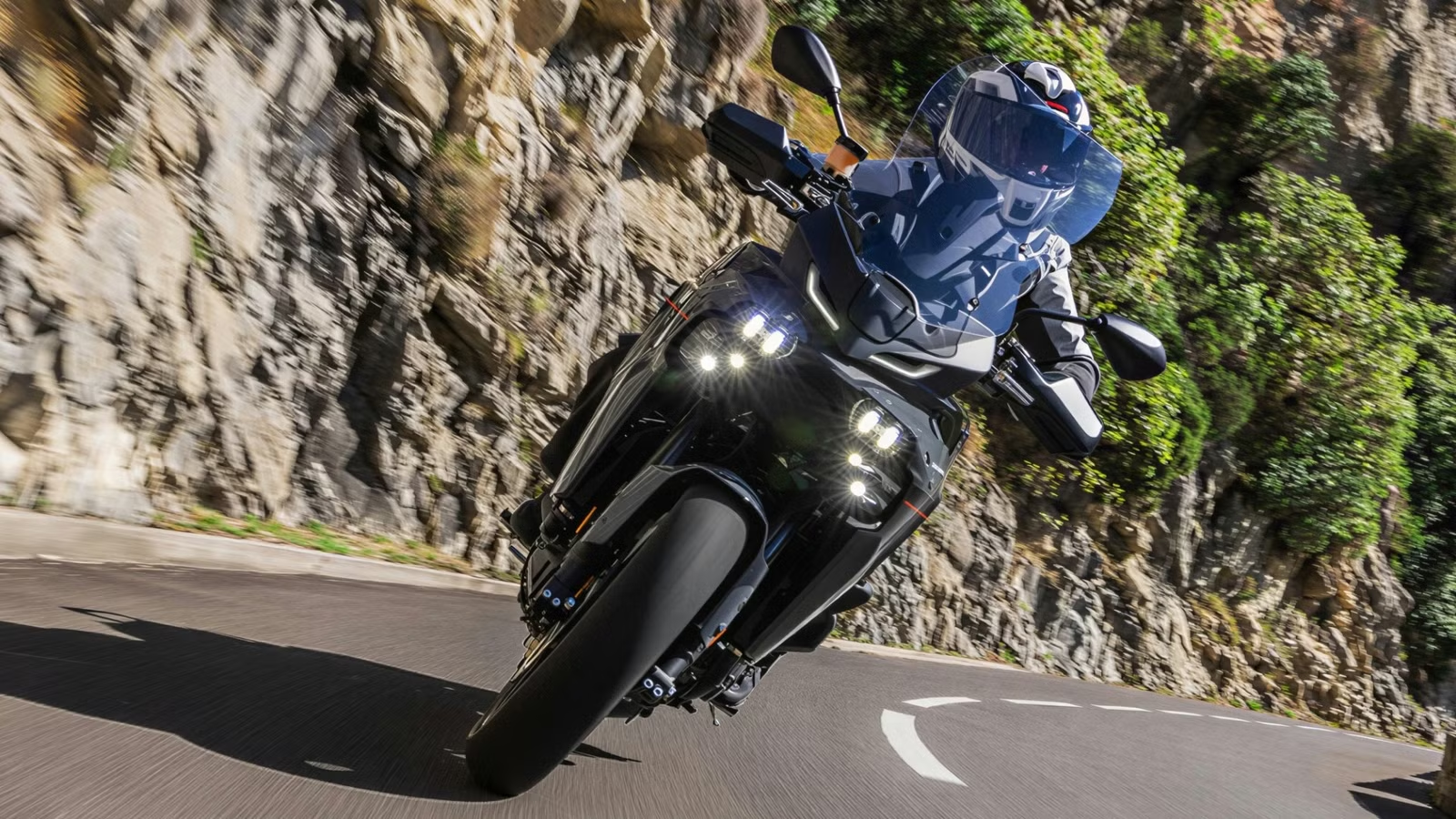
Finding a touring motorcycle that genuinely does it all — comfortable enough for long-haul miles, agile enough for city streets, and priced so it doesn’t require a second mortgage — remains one of motorcycling’s great challenges. Adventure-touring bikes have come closest to cracking that code, which explains why the ADV segment continues to dominate showroom floors. Riders want a single machine that can handle a weekend canyon run, a cross-country slab session, and a weekday commute without complaint. Delivering on all three counts is hard enough; doing it at a genuinely accessible price is harder still.

One Yamaha quietly rises to that challenge — and largely flies under the radar doing it. This middleweight adventure tourer is powered by a three-cylinder engine shared with one of the brand’s most celebrated streetfighters. Its chassis uses thin-section aluminum construction to shed weight without sacrificing rigidity. It offers adjustable wind protection and is entirely at home holding triple-digit highway speeds for hours on end.
The 2026 Yamaha Tracer 9 Is A Versatile Touring Motorcycle
Starting Price: $12,599
The Yamaha Tracer 9 is an underrated bike in the Japanese manufacturer’s lineup. Currently, there are just two touring bikes in its portfolio, and the spotlight is mostly occupied by the dune-bashing Ténéré 700, which has quite the fan following worldwide. However, the humbler and road-focused Tracer 9 deserves serious attention for its impressive ability to be both powerful and practical. For under $13,000, this Yamaha is loaded with technology, convenience, and comfort features.

Its compact form factor also makes it a natural urban runabout. At its bang-for-buck price point, the 2025 Tracer 9 comes standard with lockable side cases, each of which can easily swallow a full-face helmet — leaving ample room for a cozy weekend getaway. With a 5-gallon fuel tank and a fuel economy rating of around 48 MPG, the Tracer 9 is a comfortable touring machine capable of a maximum riding range of approximately 240 miles. There’s a lot of motorcycle for the money here. No wonder this middleweight Yamaha adventure tourer is the underdog that makes its closest rivals sweat (more on that later).
Powered By The Popular CP3 Inline-3 Engine
The Price-To-Power Ratio Is Unmatched
The characterful CP3 engine is celebrated for its flexibility. That versatility is evident from the fact that the 890 cc inline-3 also powers the Yamaha MT-09 streetfighter and the XSR900 classic roadster. On the Tracer 9, this engine is tuned for linear power delivery and strong low-end torque. According to Cycle World, roughly 70–80 percent of its peak torque of 68.6 pound-feet is already on tap at just 3,000 RPM.
This gives the Tracer 9 the momentum to hustle through urban traffic, while that meaty low-down torque also provides confident overtaking power on the freeway. Power builds steadily from around 1,800 RPM all the way to 10,000 RPM, which reinforces this Yamaha’s touring credentials and makes it approachable for newer riders as well. Drive reaches the rear wheel through a 6-speed manual gearbox equipped with a slip-and-assist clutch.
Engine Specs
|
Engine Configuration |
Inline-3; Liquid-Cooled |
|
Displacement |
890 cc |
|
Bore x Stroke |
3.0708 X 2.4448 in. (78 x 62.1 mm) |
|
Compression Ratio |
11.5:1 |
|
Power |
117 HP |
|
Torque |
68.6 LB-FT |
|
Fueling |
Electronic Fuel Injection |
|
Transmission |
6-speed; Final Chain Drive |
A Dynamic Chassis And Slim Proportions Ups The Ante
Makes It Capable Of Both Urban And Winding Roads

Complementing the flexible nature of its three-cylinder engine is a playful chassis setup that makes the Tracer 9 both a composed straight-line tourer and an athletic corner-carving sprinter on demand. Yamaha’s famed Deltabox chassis incorporates a lightweight diamond main frame with a bolt-on sub-frame. It also features a lightweight, high-rigidity aluminum swingarm. All major chassis elements are aluminum, striking a balance between rigidity and weight savings — even the wheels are aluminum to reduce unsprung mass.
Suspension duties are handled by 41 mm inverted front forks and a rear monoshock, both offering preload and rebound damping adjustability. Braking comes from dual discs up front and a single disc at the rear, with fixed calipers at the front and a floating caliper at the rear. Despite being a tall-riding long-distance tourer, the Tracer 9’s dimensions also suit congested urban environments. The wheelbase is compact at under 60 inches, and the seat height is low by adventure-touring standards.
Hardware Specs And Dimensions
|
Main Frame |
Diamond ‘Deltabox’ Aluminum Frame |
|
Front Suspension And Travel |
41mm Inverted KYB Front Forks; Adjustable Preload, and Rebound Damping; 5.1 inches Of Travel |
|
Rear Suspension And Travel |
Monoshock, Adjustable Preload, and Rebound Damping, 5.2 inches Of Travel |
|
Front Tire And Wheel Size |
120/70 ZR17 Wrapped Around A 17-inch Aluminum Wheel |
|
Rear Tire And Wheel |
180/55 ZR17 Wrapped Around A 17-inch Aluminum Wheel |
|
Front Brakes |
Dual 298 mm Discs With Radially Mounted 4-piston Fixed Calipers; Nissin Radial Master Cylinder |
|
Rear Brakes |
267 mm Disc With A Single-piston Floating Caliper |
|
Length |
85.6 inches |
|
Wheelbase |
59.1 inches |
|
Rake |
24.4 degrees |
|
Trail |
4.2 inches |
|
Seat Height |
33.3 inches |
|
Ground Clearance |
5.3 inches |
|
Curb Weight |
483 pounds |
The three-cylinder engine and aluminum construction keep the wet weight under 490 pounds — a genuinely impressive figure for the class. All of these elements help the Tracer 9 function as a comfortable urban runabout that’s easy to lean into corners. Yamaha has also refined the rider triangle and elevated overall comfort to broaden the Tracer 9’s versatility. A larger, manually adjustable windscreen provides better wind protection, while a revised handlebar angle, a more comfortable seat, and less aggressively positioned footpegs all contribute to a more relaxed riding posture.
Technology Features Are Aplenty On The Tracer 9
A Long-Haul Yamaha That Surprises Us With MotoGP-Derived Tech

Yamaha has equipped the Tracer 9 with a generous suite of electronics — one of the key reasons it represents such strong value for money. Three integrated riding modes (Sport, Street, and Rain) are included as standard, along with two fully customizable modes the rider can tailor to their preferences. Ride-by-wire sharpens the character of each mode, while a six-axis IMU underpins a range of advanced rider aids: lean-angle-sensitive traction control, a slide control system, a back-slip regulator to reduce rear wheel lock-up under aggressive engine braking, and a front-wheel lift control system. Notable technology features are summarized below.
- Full LED lighting with cornering lights
- Variable speed limiter
- 7-inch TFT
- Six-Axis IMU
- Back Slip Regulator
- Lift Control System (LIF)
- MotoGP-Derived Slide Control System (SCS)
- Lean Angle-Sensitive Traction Control System
- Ride-by-Wire With Accelerator Position Sensor Grip (ASPG)
- Five ride modes
We Hope The Sophisticated New Tracer 9 GT+ Re-enters America

It is a genuine shame that the U.S. market misses out on the even more tech-laden Tracer 9 GT+. This top-spec model was on sale in America for 2024 but was subsequently discontinued. For 2025, the GT+ has been upgraded further with impressive new technology. It gains a forward-facing radar linked to adaptive cruise control, plus a rear-facing radar that detects vehicles in blind spots and alerts the rider via interactive rearview mirrors.
A front camera system also assists the sophisticated matrix headlamp in functioning intelligently. Comfort features are equally impressive, with highlights including 10 levels of heated grips, an electronically adjustable windscreen, keyless ignition, and Vehicle Hold Control. Across the pond, the Tracer 9 is sold in three trim levels: Tracer 9, Tracer 9 GT, and Tracer 9 GT+. The GT trims are also available with an automated gearbox.
A Tough Package For Its Rivals To Topple

Even without the GT models in the American market, the Tracer 9 puts up a fierce fight against both new and established rivals. In this competitive set, the Tracer 9 offers the best power-to-price ratio, with 119 horsepower at its $12,599 asking price. The Honda NT1100 DCT is notably affordable at under $12,000 but is also the least powerful of the group at 100 horsepower. Its DCT transmission adds rideability, though it sacrifices some of the engagement that clutch-equipped manual gearbox fans crave.
2026 Yamaha Tracer 9 vs. Rivals
|
Yamaha Tracer 9 |
Honda NT1100 DCT |
BMW F 900 XR |
Triumph Tiger 900 GT |
|
|
Price |
$12,599 |
$11,999 |
$12,695 |
$16,495 (Aragón Edition) |
|
Engine Configuration |
Inline-3; Liquid-Cooled |
Parallel-Twin; Liquid-Cooled |
Parallel-Twin; Liquid-Cooled |
Inline-3; Liquid-Cooled |
|
Engine Displacement |
890 cc |
1,084 cc |
895 cc |
888 cc |
|
Power |
117 HP |
100 HP |
105 HP |
108 HP |
|
Torque |
68.6 LB-FT |
82 LB-FT |
68 LB-FT |
66.4 LB-FT |
|
Seat Height |
33.3 inches |
32.3 inches |
32.2 inches |
32.23-33.07 inches (adjustable) |
|
Curb Weight |
483 pounds |
547 pounds |
476 pounds |
483 pounds |
The BMW F 900 XR is the Tracer 9’s closest rival when it comes to balancing performance and practicality, but it trails on outright power and relies on a parallel-twin that can’t match the drama of an inline-three. The Triumph Tiger 900 GT shares a broadly similar formula — and even uses a three-cylinder engine — but its performance numbers are less compelling and its price climbs to close to $15,000.
Sources: Yamaha, Honda Powersports, BMW Motorrad, and Triuph Motorcycles

Related posts


Latest Post


No Comments