
The America Superbike That Beat Every Japanese Literbike To 60 MPH
The 2000s were a wild time to be into sport bikes. While the 1990s laid the groundwork for the direction motorcycles were going, the new millennium shifted things into higher gear. Overall, the time period had an obsession with speed. Chase scenes in movies were becoming ridiculous; just look at classic examples like Mission: Impossible II and the infamous motorcycle version of Fast and the Furious, Torque. Suzuki, Kawasaki, and Yamaha were fighting a public horsepower war on showroom floors, and riders lined up at drag strips every weekend to see who held the quickest time slip.

In 2004, bikes were the fastest thing on the road by almost every acceleration metric. Bugatti changed that narrative when the Veyron dropped in 2005, marking a huge shift in the top-speed wars against heavyweights like the Suzuki Hayabusa and Kawasaki Ninja ZX-12R. Motorcycles continued to dominate on a dollar-for-dollar basis in nearly every acceleration category, but launching an open-class bike revealed that chassis physics have hard limitations. When an unexpected battery-powered machine arrived out of Silicon Valley with verified timing slips, it bypassed those limitations entirely and beat every traditional production motorcycle off the line.
The Benchmark That Defined Gas-Powered Supremacy
The early to mid-2000s produced the rawest production sport bikes to ever roll on public roads. Manufacturers were still using physical throttle cables, catalytic converters were minimal, and traction control systems were basically nonexistent outside of factory Grand Prix paddocks. If you bought an open-class bike during this window, you were entirely responsible for managing wheelspin and front-end lift. A skilled rider on a 1,000cc machine could out-accelerate exotic supercars costing twenty times as much, provided they could keep the front tire on the pavement.

Getting these bikes to launch cleanly, however, was an ongoing mechanical struggle. Heavyweight hyperbikes like the Honda CBR1100XX Super Blackbird and the Hayabusa managed to post sub-3-second sprints to 60 mph largely because of their long wheelbases and 500-plus-pound curb weights keeping the nose planted. Dedicated literbikes like the Yamaha YZF-R1 and Kawasaki Ninja ZX-10R had the opposite problem: they were under 400 pounds with wheelbases under 56 inches. Launching them at full throttle meant feathering a smoking clutch to prevent looping the bike, leaving 0-60 numbers stuck at around the 3-second mark.
The Legendary Suzuki GSX-R1000 K5 Set The Gold Standard

Standing at the very top of the analog sport bike pyramid was the 2005 to 2006 Suzuki GSX-R1000, known to everyone in the paddock simply as the K5 or the Gixxer to everyone else. Suzuki gave the K5 a long-stroke 999cc inline-four that produced 162 rear-wheel horsepower and 80 lb-ft of torque on an independent dyno. Combined with a dry weight of just 166 kg, or roughly 366 pounds, the power-to-weight ratio made it an immediate favorite for club racers and drag racers alike. It delivered an unfiltered rush of midrange torque that caught even experienced road testers off guard.
Despite all that muscle, testing showed that getting the K5 from zero to 60 mph took 3.10 seconds on street rubber. Dumping the clutch at high revs instantly brought the front wheel up, forcing riders to roll off the throttle or tap the rear brake to save the run. The Suzuki had the top-end stamina to run through the quarter-mile in under 10 seconds, but its standing-start sprint was held back by the limits of human clutch control and chassis geometry.
The Lightning LS-218 Rewrote Acceleration Physics

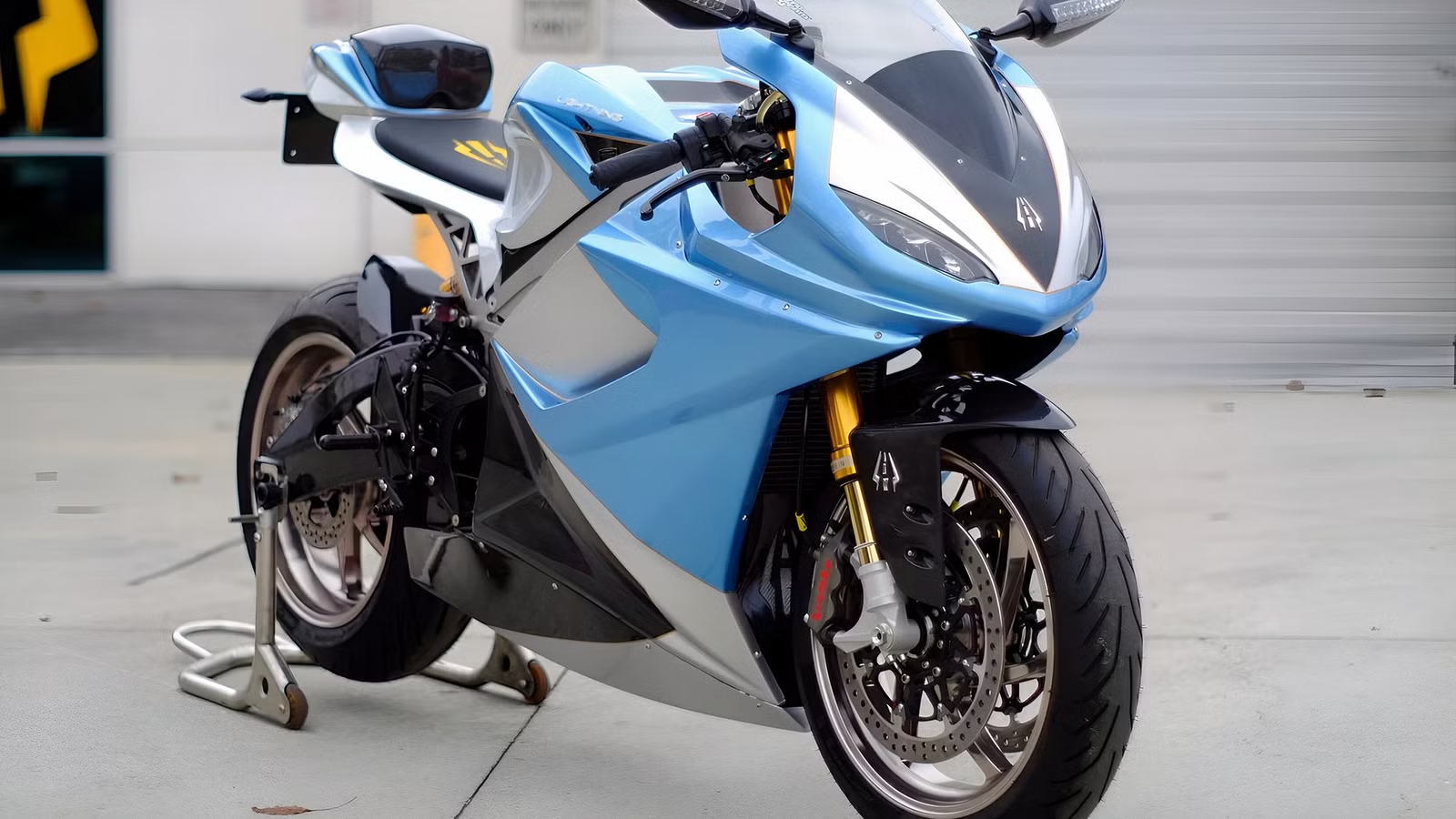
Those physical limits were finally shattered in 2014 when a small boutique outfit called Lightning Motorcycle, based out of San Carlos, California, rolled out the production-intent LS-218. Instead of trying to wring more power out of a high-revving four-cylinder, founder Richard Hatfield built a platform around a high-output liquid-cooled electric motor. The machine completely eliminated the traditional mechanical hurdles that plagued gas-powered sport bikes off the line.
What made the machine such an anomaly was its status as a boutique American build taking direct aim at the Japanese and European motorcycle establishment. Hand-assembled in tiny numbers, it bypassed the conventional wisdom of the sport bike paddock by prioritizing direct torque delivery over traditional gas tuning. The platform was equipped with a IPM liquid-cooled motor, delivering full power the instant the throttle cracked open. It proved that an electric powertrain could out-sprint every combustion-powered production motorcycle on earth without needing an extended swingarm to keep the bike straight.
A Verified Sub-Two-Second Sprint To 60 MPH

The metric that caught the motorcycle industry completely by surprise was the LS-218’s verified 0-60 mph acceleration time. Testing logged the bike at 2.0 seconds flat, with some instrumented runs dipping just below the 2-second mark. That performance made it the quickest-accelerating production motorcycle in history, putting a full second between itself and benchmark literbikes like the GSX-R1000 K5. It was a level of acceleration that combustion engines could only achieve on prepped drag strips running slick rear tires.
One of the secrets to the success was the absence of drivetrain lash and shifting delays. Because the electric motor routed power directly to the rear wheel without a transmission, the bike accelerated in one linear pull. The power did not hit with the wheelie-inducing snap of a four-cylinder, but rather a continuous wave of forward thrust.
218.637 MPH On The Bonneville Salt Flats Sealed Its Name

Straight-line acceleration was backed up by legitimate, certified top speed on the most brutal salt in North America. In 2011, Lightning brought a road-legal production prototype to the Bonneville Salt Flats during Speed Week to see what it could do unrestricted. Running through the official Southern California Timing Association timing traps, the bike laid down an official two-way average speed of 218.637 mph. That pass officially made it the fastest production-intent motorcycle in the world, eclipsing unrestricted gas superbikes.
The 218 MPH run gave the bike its name, but also stopped critics from dismissing electric bikes as low-speed urban runabouts. The timing ticket proved the bike could manage aerodynamic drag and sustained high-voltage discharge beyond what anyone expected at the time and established a production record that stood completely unchallenged by any major factory for over a decade.
Boutique Race Hardware Matched To Unhinged Electric Output

Backing up that straight-line capability required a chassis that could handle real asphalt. While early versions of the motor kicked out 200 horsepower, current-generation builds produce up to 263 horsepower. Even more staggering is the torque output, which registers at roughly 1,100 lb-ft at the rear wheel through its direct reduction drive. Holding that much twisting force together required an aluminum twin-spar frame engineered with the structural rigidity of a dedicated road racer, keeping the chassis from flexing under extreme electrical loads.
The LS-218 uses a liquid-cooled inverter to regulate current and keep the motor within its operating limits. The rider does not have a clutch lever or foot shifter to work, leaving throttle and brake control as the main inputs. That makes passing traffic at 60 mph straightforward: roll on the throttle and the motor responds immediately, without a downshift. There is no need to wait for the engine to reach a stronger part of its rev range because an electric motor does not deliver power in the same way.
Top-Shelf Running Gear Designed For True Track Duty

To prove the LS-218 was an actual road racer rather than an expensive straight-line gimmick, Lightning built the rolling chassis with top-tier World Superbike components. The front suspension runs fully adjustable Öhlins FGRT inverted forks, paired with an Öhlins TTX36 piggyback shock controlling the aluminum swingarm. This suspension setup kept the tires planted over pavement heaves and high-speed bumps, giving the chassis the damping control required to settle down quickly through corners.
Braking duties were handled by dual radial-mount Brembo GP4-RX four-piston calipers clamping 320mm floating rotors, providing two-finger stopping power that resisted fade under track abuse. The chassis rolls on forged Marchesini magnesium wheels to reduce rotational inertia and unsprung mass, speeding up side-to-side transitions. By using proven race hardware instead of budget parts-bin pieces, Lightning ensured the bike could turn, brake, and track through sweepers just as well as its gas-powered competition.
Why The Mainstream Motorcycle Industry Refused To Follow

In the car world, an independent startup building an electric vehicle that beats established supercars off the line forces the big brands to scramble. When the LS-218 posted a verified 218 mph top speed and a sub-2-second sprint, industry watchers assumed the Japanese Big Four and European powerhouses would fire back with their own high-voltage superbikes. Instead, total silence followed. Kawasaki, BMW, and Ducati took a hard look at the commercial realities of building an electric superbike and chose to completely ignore the challenge.
The primary obstacle came down to battery chemistry and the resulting weight penalty. Packing a high-capacity battery pack that could supply triple-digit speeds pushed the LS-218’s curb weight close to 500 pounds, running directly counter to the lightweight engineering that defines modern sport bikes. Cost was another massive hurdle; the bike initially launched at $38,888 before climbing toward roughly $79,000 for current bespoke builds. That price point took the motorcycle completely out of reach of the blue-collar riders who buy $15,000 showroom literbikes, trapping it in an ultra-wealthy niche.
Kawasaki, BMW, And Ducati Chose To Look Away

Legacy motorcycle manufacturers also had to think about their global retail networks. Franchised dealers in North America and Europe were not set up with high-voltage charging bays, specialized battery diagnostic tools, or the technician training needed to safely service 380-volt electrical systems. On top of the service headaches, customer surveys consistently showed that sport bike buyers still prioritized the sound, vibration, and mechanical engagement of an internal combustion engine. Squeezing four-cylinder engines past 14,000 rpm remained a core selling point that a silent electric motor simply could not duplicate.
Lightning was also a tiny operation that faced recurring production and delivery bottlenecks, assembling bikes in extremely limited runs out of California. The major factories realized that while the LS-218 was a technical marvel that held undeniable records, it posed zero threat to their dealer sales numbers or bottom lines. Major brands chose to invest their research and development money into variable valve timing, sophisticated IMU electronics, and aerodynamic winglets on their gas bikes.
A Forgotten Anomaly That Left Big Factories Unscratched

Over a decade after its Bonneville run, the Lightning LS-218 remains an isolated chapter in modern motorcycle history. It did what no gasoline production bike could do by officially breaking the 2-second 0-60 barrier and validating 218 mph on salt with calibrated timing equipment. It proved that electric drivetrains could solve the traction and launch problems that had frustrated motorcycle engineers for generations. Yet, despite setting the bar for standing-start acceleration, it never sparked the electric sport bike revolution that early advocates predicted.
Instead, the LS-218 survives as a rare, hand-assembled proof of concept that exists alongside an industry that chose not to follow its lead. The big factories continue to sell high-revving four-cylinder and V4 superbikes to riders who want engine noise, light curb weights, and sub-$25,000 price tags. The American electric superbike won the acceleration war on the stopwatch, but internal combustion kept the showroom floor.

Related posts

Latest Post


No Comments