
Stellantis’ Secret Patent Trail Reveals A Gas-Turbine EV Range Extender
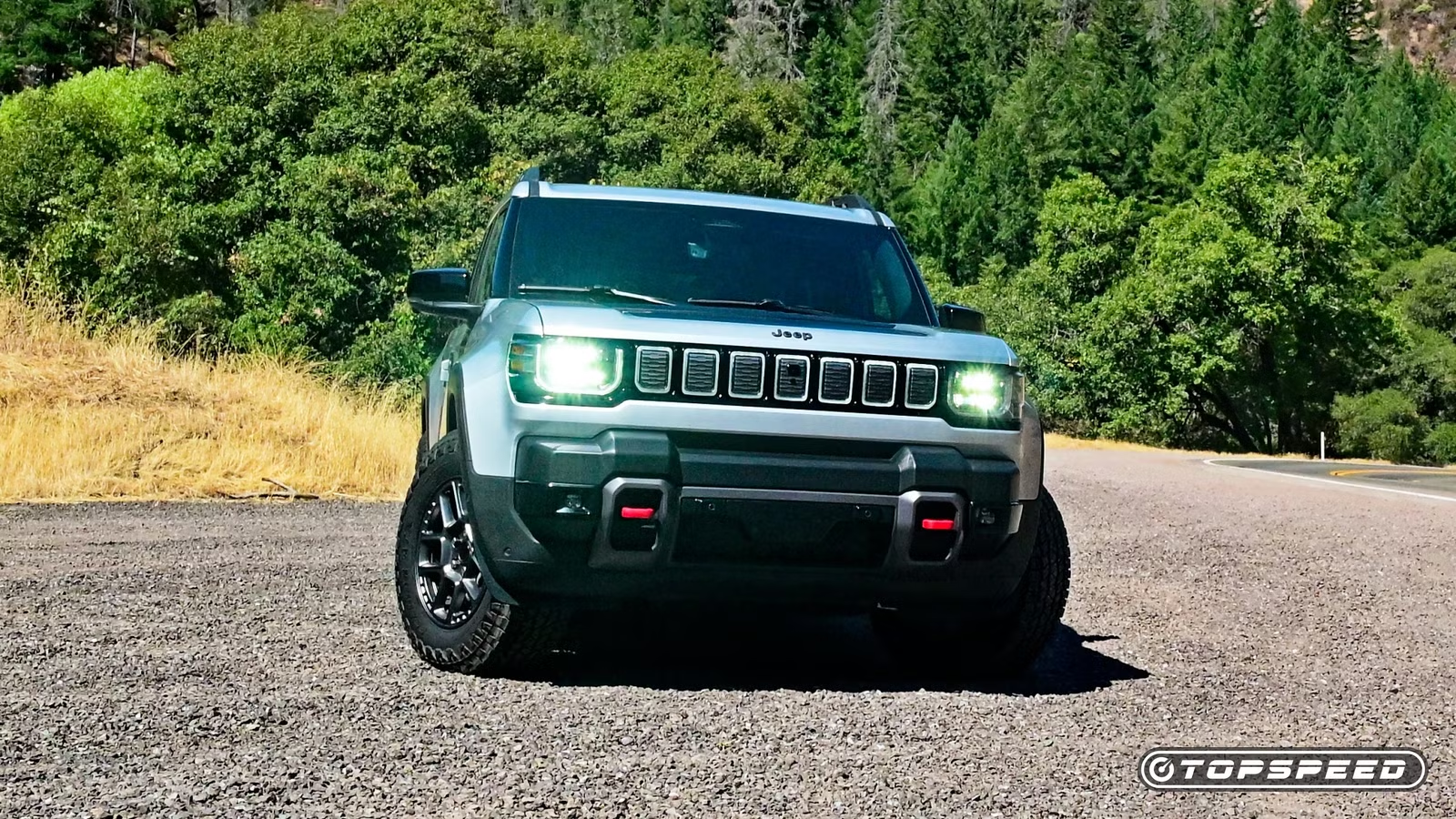
A new patent published September 17, 2026, adds the latest chapter to a quietly growing body of Stellantis intellectual property built around an unusual idea: replacing the conventional piston-engine range extender with a compact gas turbine. Filed by FCA US LLC under PCT/FR2026/000028 and published as WO2026190425, the application describes a stand-alone turbogenerator system for energy transformation.

Taken alone, the filing could be dismissed as speculative IP housekeeping. But it isn’t alone. Stellantis and its subsidiary brands have returned to this technology repeatedly across multiple filings spanning 2024 through 2026, each one patenting a different piece of a sophisticated gas-turbine electrical-generation system. Together, they tell a more deliberate story — one that connects directly to the company’s September 2025 decision to walk away from full-size battery-electric trucks entirely.
A Patent Trail That Spans Multiple Years and Filings
The clearest link between Stellantis’ turbine research and electric vehicles appears in WO2025083344A1, an international application filed in September 2024 and published in April 2025. Its title leaves little room for interpretation: “Electric Motor Vehicle Comprising A Range Extender Device Comprising A Gas Turbine.” The filing describes an EV whose traction battery and electric motor draw energy from a fuel-powered turbogenerator — the architecture Stellantis calls an IRReGT, or Intercooled Recuperative Reheat Gas Turbine.

A related French patent, FR3154438A1, assigned jointly to PSA Automobiles and FCA US and published in April 2025, goes further in describing the system’s design. It details low- and high-pressure compressor and turbine stages, intercooling, exhaust-heat recuperation, and additional waste-heat recovery loops. Some embodiments incorporate an Organic Rankine Cycle or steam Rankine Cycle to convert otherwise wasted thermal energy into additional electricity.
The activity continued into 2026. A filing published in May of that year, WO2026099551A1, focuses on vaporizing fuel inside a recuperating heat exchanger before it reaches the combustion chamber — a refinement aimed at efficiency and packaging rather than a broad conceptual claim. A separate January 2026 application describes a multi-stage turbomachine with multiple generators, combustion chambers, an intercooler, a recuperator, and control logic tied to generator speed, pressure, and airflow. The newest filing, WO2026190425, extends the series further. This is not one patent protecting one idea — it is a sustained, iterative engineering program.
Why a Turbine Makes Engineering Sense Here

In a range-extended EV, the combustion unit has a fundamentally different job than in a conventional car. The electric motors drive the wheels; the combustion system exists primarily to generate electricity. That distinction matters for turbines, which generally perform better under stable, relatively high-load conditions than when constantly accelerating and decelerating with driver inputs.
A 2020 study published in Applied Thermal Engineering experimentally investigated a micro-gas-turbine EV range extender and reported a power-to-weight ratio of roughly 0.48 to 0.8 kW/kg, with calculated thermal efficiency of approximately 35% for one recuperated configuration under specified design conditions. The researchers concluded that microturbines were technically feasible in this role.
The same body of research, however, flags real limitations. A 2021 Applied Thermal Engineering study found that while a microturbine range extender could achieve low regulated emissions, its specific fuel consumption was considerably higher than a comparable piston engine at similar power output. Rapidly changing power demands also required more sophisticated control strategies than a turbine naturally accommodates.
That context makes Stellantis’ engineering choices look deliberate. The recuperation, intercooling, reheating, and waste-heat recovery systems detailed across the patent series address precisely the efficiency weaknesses that have historically kept microturbines out of production vehicles.
The Business Context Behind the R&D

Stellantis’ turbine patent work does not exist in a vacuum. In September 2025, the company abandoned its full-size battery-electric Ram pickup program as demand for large BEV trucks slowed. Simultaneously, it renamed the range-extended pickup previously known as the Ramcharger as the Ram 1500 REV, signaling a clearer commitment to the range-extender path for its truck lineup.
The patents stop short of confirming what powertrain will ultimately reach production, and the filings themselves make no claims about launch timing or specific vehicle programs. What they do reveal is that Stellantis has invested engineering resources in turbine range-extender technology across multiple years and multiple distinct technical problems — efficiency, fuel delivery, thermal management, and control systems. For a company that has publicly pivoted toward range-extended powertrains for its largest vehicles, that pattern of R&D is worth watching closely.

Related posts




Latest Post


No Comments