
10 Most Reliable Sport Bikes That Won’t Punish You At The Repair Shop
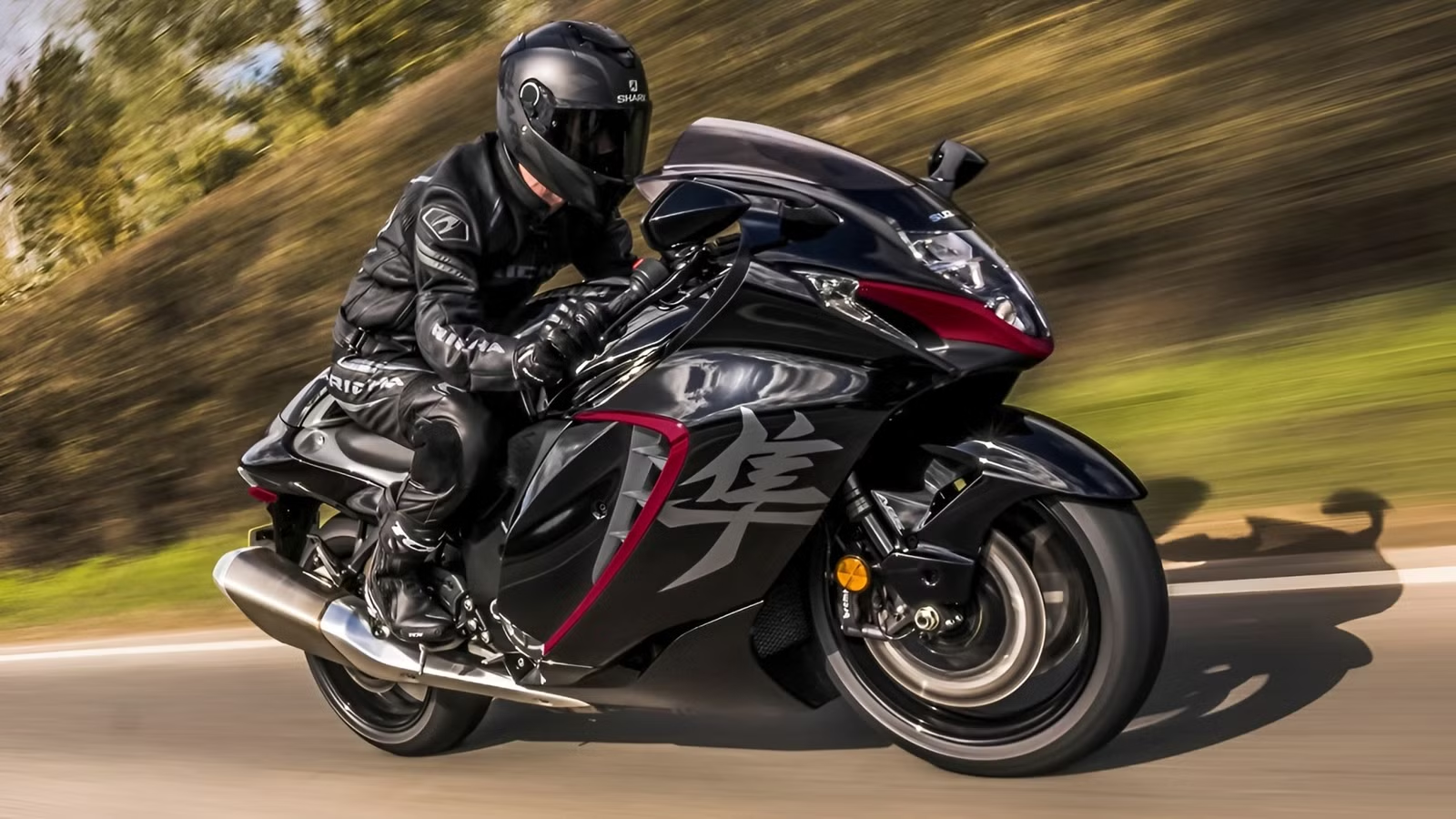
Sportbikes aren’t known for reliability. We buy them for speed, for looks, and for the feeling of warping time as we open the throttle wide. Still, few things sting quite like a sportbike spending more of its time in the garage than out on the road. It’s one thing to crash the bike and need repairs, but it is another thing entirely to have to deal with an electrical gremlin or an eye-watering valve service. Weekends on a sportbike are meant for pushing lean angles and engine revs, not for being spent in the garage watching your bank account dwindle.
The good news is manufacturers have taken note of this and provided us with products that are dependable yet offer grin-inducing performance. These aren’t exotic track weapons, but sportbikes that can work in the real world while still managing to further your skills at a racetrack without having to worry about ownership costs. These are a wide variety of sportbikes, from entry-level examples to some of the fastest examples of a two-wheeler on the planet. These 10 sportbikes prove that bulletproof reliability and performance that makes your heart race aren’t mutually exclusive.
Models are listed in ascending order based on starting price, from the lowest to the highest.
Kawasaki Ninja 500
Price: $5,399

The Ninja 500 is quite an impressive motorcycle. For one, it makes the most power in its class from its 180-degree parallel twin; it manages to extract 51 horsepower and 31.7 pound-feet from its 451 cc, and yet manages to be one of the most reliable as well. It uses a six-speed gearbox with an assist and slipper clutch. Look carefully, and you’ll notice that its base price is lower than that of the Yamaha YZF-R3 below as well, which is a smaller-displacement motorcycle.

Kawasaki does this by intelligently splitting the Ninja 500 into a base version with a very low entry point. ABS is a $400 option, and if you want the full shebang with the TFT instrument cluster, LED indicators, pillion seat cowl, USB-C charging socket, and a large windshield, it will cost you $6,499 for the SE variant. Still, for something in the beginner segment, offering features like keyless ignition is impressive, and the features aren’t even its strong point because this is the kind of beginner sportbike that even experienced riders secretly love.
Yamaha YZF-R3
Price: $5,499

The YZF-R3 has been around for a while, and although it got a major facelift recently, under the skin the mechanicals remain the same proven components. That includes the light diamond frame made out of steel and the 180-degree parallel-twin engine; it displaces 321 cc and generates 41.5 horsepower and 21 pound-feet of torque. This is paired with a six-speed gearbox with an assist and slipper clutch.

The new styling has given it the cyclops look with a single projector LED headlamp, fang-like DRLs, and an impressive-looking negative LCD instrument cluster that displays all the information neatly and has smartphone connectivity. Dual-channel ABS and a USB-A charging port make it a sportbike that can do it all, to go along with its reputation for dealing with borderline abuse with nonchalance.
Honda CBR650R E-Clutch
Price: $9,199

The CBR650R was always intended to be a sportbike riders ride daily rather than a high-performance one dedicated to a racetrack. Its inline-four engine has been tuned more for daily rideability than for outright power, which means that it develops just 93.8 horsepower and 46.4 pound-feet from 649 cc. It also makes sense that it is now available exclusively with the semi-automatic gearbox as standard.

The E-Clutch system can be switched off and the CBR650R used as a normal fully manual motorcycle, too. It has a relatively upright riding position, the five-inch TFT instrument cluster has Bluetooth and navigation, and it isn’t an aggressive, sharp-steering supersport. Its laid-back attitude helps contribute to its reliability, although being a Honda, that was never in question.
Yamaha YZF-R7
Price: $9,399

The CBR650R leans all the way into practicality, whereas traditional 600 cc supersport motorcycles are designed for the racetrack; the Yamaha YZF-R7 straddles this line with ease and quietly rewrites what an everyday sportbike should be. It does this with a really low curb weight of 417 pounds and pairs this with an enthusiastic 689 cc parallel-twin engine with a 270-degree crank. The engine churns out 74.8 horsepower and 50 pound-feet of torque and puts it down via a six-speed gearbox with an assist and slipper clutch.

It has always had fully adjustable KYB suspension and a Brembo radial master cylinder. For 2026, it got a massive update that added a by-wire throttle and a six-axis IMU, equipping it with Yamaha’s full electronics suite. It includes wheel lift mitigation, rear slide control, and launch control. Rounding things off is a five-inch TFT instrument display with Bluetooth and navigation, a latest-generation two-way quickshifter, and cruise control. What hasn’t changed is its ability to rack up miles with no trouble at all.
Honda CBR600RR
Price: $11,499

It might feel a little odd to find an old-school inline-four 600 cc supersport on this list, but the fact remains that the CBR600RR available in the US market is a previous-generation one, and as such it is dead reliable. In fact, this particular generation has been around since 2013, and it is a Japanese motorcycle that redefines sportbike durability.

It offers a 599 cc screamer of an inline-four engine that generates 113 horsepower at 13,500 RPM and 47 pound-feet of torque at 11,250 RPM. This is as old-school as it gets with a mechanical cable throttle, but it does have an electronic steering damper and combined ABS – the ABS is a $1,000 option. The instrumentation consists of a last-generation analog tachometer paired with an LCD screen displaying all the other information.
Kawasaki Ninja ZX-6R
Price: $11,599

The Ninja ZX-6R belongs to the same school of thought as the CBR600RR—that is, the old school. Like the Honda, it has an inline-four engine that displaces 636 cc and generates 127 horsepower at 13,000 RPM and 52.1 pound-feet at 10,800 RPM. The extra displacement helps offer a little extra torque across the rev range, and this is an engine that is so reliable that it is still in production after decades.

It is a little more modern than the Honda, though, with a 4.3-inch TFT display, traction control, a quickshifter, ride modes, and Bluetooth connectivity. Like the Honda, ABS is a $1,000 option, but it is Kawasaki Intelligent ABS, so it is well worth the money. If you had to pick an old-school 600 cc supersport to put lots of miles on, the Ninja ZX-6R is probably the most worthy candidate because of its combination of plentiful torque and reliability.
Yamaha YZF-R9
Price: $12,499

The YZF-R9 ostensibly belongs to the same segment as the 600 cc supersports above, but it offers a slightly more modern take on the segment. It utilizes an 890 cc inline-three-cylinder engine with a crossplane crankshaft to generate a lot more torque than you could get otherwise with an inline-four engine. It doesn’t do too badly with the power figures either, generating 117 horsepower at 10,000 RPM and 68.6 pound-feet at 7,000 RPM. This is paired with a six-speed gearbox with a two-way quickshifter and an assist and slipper clutch.

The feature set is also where it proves its youth. It has a five-inch TFT instrument cluster that can be configured in many ways, including a racetrack mode where it can show lap times and even receive communications from the pit wall. At the same time, the riding position isn’t truly aggressive, which means daily use is very possible. Since it is based on the MT-09, which has proved its reliability time and time again, the YZF-R9 is the best midweight sportbike for riders who want it all.
Suzuki GSX-R750
Price: $13,549

The GSX-R750 has a lot of history. It is one of the bikes that changed the face of motorcycling, and it is still on sale 40 years later. The current generation has been on sale for a chunk of that time; it was launched for the 2011 model year and has had no fundamental mechanical or electronic changes since. This makes it one of the Suzuki motorcycles with the lowest running costs and highest reliability.

The fact that it does not have a bunch of electronics also means that you need to be on top of your game to extract the most out of it. The 749 cc inline-four-cylinder engine generates 148 horsepower and, more importantly, 64 pound-feet of torque, which makes it very useful not just on the racetrack, but out in the real world. It has enough performance to put a smile on your face no matter where you are, and there is a lot of satisfaction to be had in being the David to the modern liter-sportbike’s Goliath.
Honda CBR1000RR
Price: $17,099

The Fireblade sometimes gets an undeserved reputation for being a docile motorcycle, as if anything with a power-to-weight ratio of over 2.2 pounds per horsepower could ever be that. Its 1,000 cc inline-four engine generates 183 horsepower and 76.7 pound-feet of torque, making it one of the fastest things on wheels on the planet. The base CBR1000RR sold in the US market is the SC77-generation Fireblade, which was originally introduced globally in 2017; nearly a decade later, it is one of the most reliable liter sportbikes despite its high specific output.

The deal is especially sweet when you realize that it has pretty much everything that you would want from a modern motorcycle, including a by-wire throttle and a five-axis IMU. It has Honda’s full electronic suite, including selectable power modes, riding modes, engine braking, HSTC, wheelie control, rear lift control, and an electronic steering damper. ABS is a $300 optional extra and gives you access to cornering ABS. The five-inch TFT display, all-LED lighting, and programmable LED shift light only help prove that this is the Honda sportbike that is worth every penny.
Suzuki Hayabusa
Price: $19,699

The Suzuki Hayabusa is known more as a performance icon than a pillar of reliability. That doesn’t change the fact that this is, without doubt, one of the more reliable sportbikes you could buy; all the turbocharged ‘Busas running around are a testament to that. In stock form, though, Suzuki claims its 1,340 cc inline-four engine makes 187 horsepower, with a massive 110 pound-feet of torque. This is then put through a six-speed gearbox with an assist and slipper clutch and a two-way quickshifter to the rear wheel. A simple ECU remap will have you pushing 200 horsepower and 200 miles per hour easily on one of these.

It has an electronics suite that is the equal of any modern sportbike, with a six-axis IMU and by-wire throttle, and true to its reputation as a drag-strip killer, it has a launch control system as well. It has one of the more interesting instrument binnacles, with a combination of analog dials and a TFT screen; the display can show real-time lean angles, front and rear G-force, and brake pressure percentages, among other things. Despite all this, the jewel in the crown is undoubtedly the engine, which allows it to do 200,000 miles without complaining.
Sources: Kawasaki, Honda, Yamaha, Suzuki

Related posts
Latest Post


No Comments