
The Most Reliable Toyota V6 Ever Built And Where To Find It
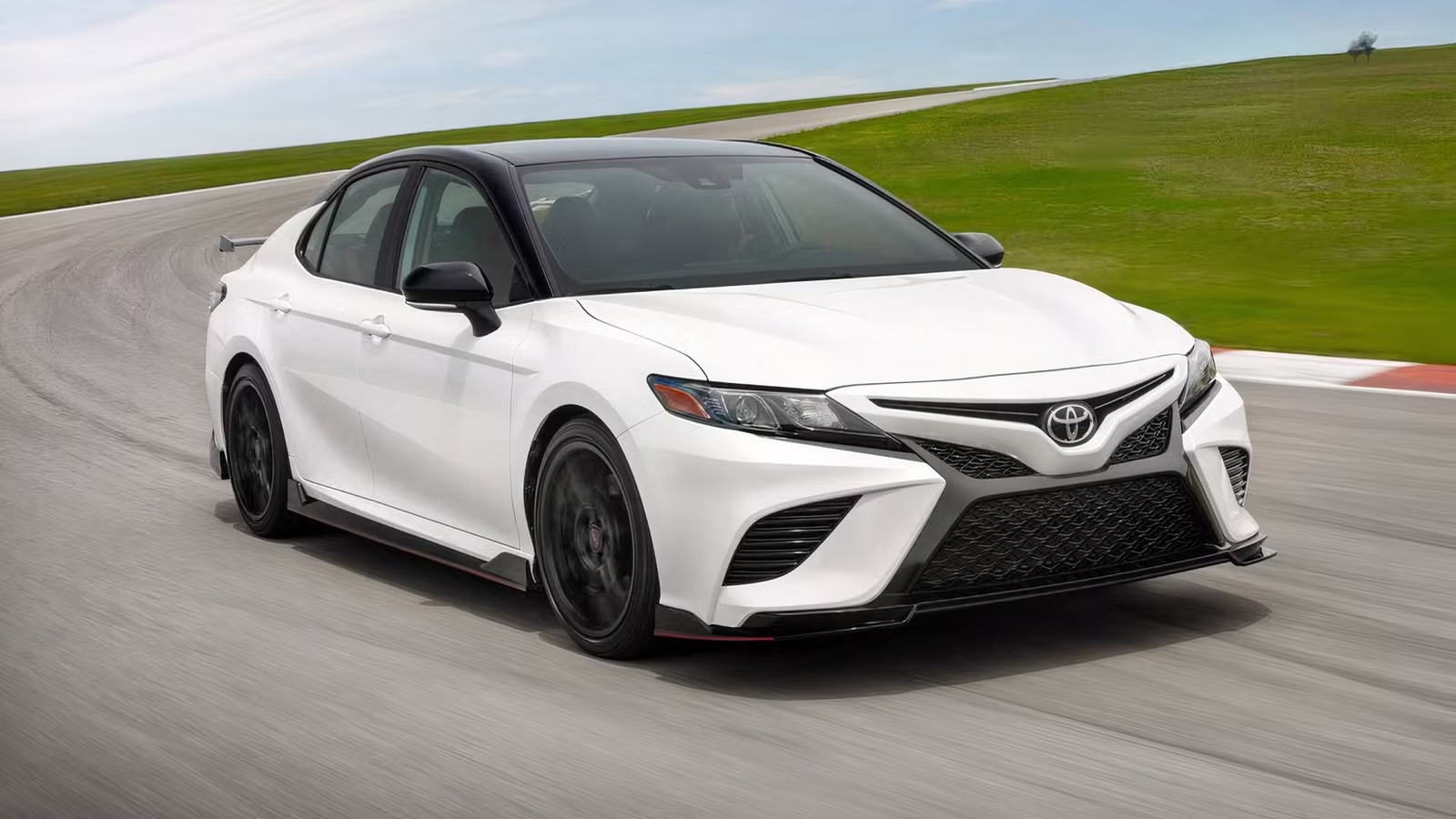
Toyota’s reputation for reliability isn’t accidental; it’s the product of deliberately conservative engineering, and nowhere is that philosophy clearer than in its V6 lineup. While turbocharged four-cylinders chase efficiency numbers and V8s chase horsepower headlines, one naturally aspirated V6 has spent two decades quietly outlasting everything around it. It shows up in family sedans, minivans, pickup trucks, and even Lexus luxury barges, racking up 300,000-mile service histories without drama. This is the story of that engine, its one real weakness, and where to buy it used today.
The V6 That Just Won’t Quit

Every automaker claims reliability. Few can back it up with two decades of consistent, cross-platform evidence the way Toyota can with its 3.5-liter V6. This isn’t a niche engine built for one halo model, it’s a workhorse that Toyota and Lexus dropped into everything from the Camry to the Avalon, and it kept running in nearly all of them.

The case for “most reliable Toyota V6 ever” rests on four pillars. Longevity, failure-point simplicity, low maintenance burden, and sheer breadth of deployment. On longevity, owner forums and RepairPal data consistently show these engines crossing 250,000 to 300,000 miles with nothing more than routine maintenance, including oil changes, spark plugs, and the occasional water pump. On failure points, there’s essentially one documented weakness, and it’s a design quirk rather than a structural flaw. On maintenance, the engine uses a timing chain rather than a rubber timing belt, eliminating one of the most common causes of catastrophic engine failure in aging cars. And on breadth, it appeared in over a dozen distinct Toyota and Lexus nameplates across nearly 20 years, giving it one of the largest sample sizes of any modern V6 on the road.
That combination — proven mileage, minimal maintenance, and mass deployment — is what separates a genuinely reliable engine from one that just has a good reputation. The engine in question is Toyota’s 2GR-FE.

Meet the 2GR-FE: Toyota’s 3.5-Liter Workhorse

The 2GR-FE debuted in 2003 in the Lexus RX 330 and quickly became Toyota’s default V6 for mid-size and full-size applications. Displacing 3.5 liters across a 60-degree bank angle, it produced anywhere from 268 to 296 horsepower and roughly 248 to 267 pound-feet of torque depending on the application and model year, with later revisions gaining slightly more output as Toyota refined the design.

What made the 2GR-FE stand out wasn’t outright performance; it was how conservatively it was engineered relative to its output. Toyota didn’t chase the last few horsepower with aggressive tuning or high compression ratios that stress internals. Instead, the engine was built with generous safety margins: an iron block for long-term structural rigidity, a relatively low-stress valvetrain, and port fuel injection (in most versions) rather than the more failure-prone direct injection systems that came to dominate the industry in the following decade. Toyota later introduced a direct-injected variant, the 2GR-FKS, but the original port-injected 2GR-FE is the version most associated with the engine’s bulletproof reputation, since it sidesteps the carbon buildup issues that plague direct-injection-only setups.
Over its production run, the 2GR-FE received modest updates — variable valve timing improvements, slight compression bumps, and small output gains — but Toyota resisted the urge to fundamentally redesign a formula that was already working. That restraint is a recurring theme in Toyota’s most reliable engines, and it’s central to why this one earned such a long production life.
The Water Pump Weak Spot (And Why It’s the Exception, Not the Rule)

No engine is flawless, and the 2GR-FE’s Achilles’ heel is well documented: an internal water pump. Unlike a traditional externally mounted pump that can be swapped out in under an hour, early 2GR-FE applications placed the water pump inside the engine, driven off the timing chain. When it fails — and it eventually does, usually somewhere between 90,000 and 150,000 miles — the timing cover has to come off to replace it, turning what should be a simple part swap into a labor-intensive repair.
This is the single most repeated complaint across owner forums, independent mechanics, and used-car inspection reports. It’s expensive relative to the part’s actual cost, and it catches unprepared owners off guard because there’s no external visual cue — no weeping seal you can spot during a routine inspection — until coolant starts showing up somewhere it shouldn’t.

But context matters here. The water pump issue is a design inconvenience, not a symptom of underlying weakness in the engine itself. It doesn’t indicate bearing wear, ring wear, or head gasket fragility the way many “known issues” on competing engines do. It’s a maintenance item with an awkward location, not a structural flaw. Once replaced — often alongside the timing chain as preventive maintenance — owners routinely report another 100,000-plus miles of trouble-free operation. Toyota also addressed this in later revisions and related engine families, moving toward external pump designs in some applications. For a used-car buyer, the takeaway is simple: budget for one internal water pump job over the life of ownership, and treat it as the cost of admission rather than a red flag.
Dual VVT-i and Iron-Block Simplicity
The Engineering Behind the Legend

The 2GR-FE’s durability traces directly back to a handful of deliberate engineering choices. First is the cast-iron cylinder block. While aluminum blocks are lighter and more common in modern V6s, iron holds dimensional stability better under repeated heat cycling over hundreds of thousands of miles, resisting the bore wear and warping that can plague lighter alloy blocks in high-mileage service. Toyota paired that iron block with aluminum cylinder heads, balancing weight savings where it mattered against long-term durability where it counted most.
Second is Dual VVT-i, variable valve timing on both the intake and exhaust camshafts. This system allows the engine to adjust valve timing continuously across the rev range, improving both low-end torque and high-rpm breathing without the mechanical complexity of forced induction or elaborate variable-lift systems. Because it’s a well-proven, incrementally developed technology rather than something Toyota rushed to market, the VVT-i actuators and oil control valves on the 2GR-FE have a strong track record, with far fewer reported failures than the timing chain tensioners and VVT solenoids that cause headaches on some rival engines.

Third, and arguably most important, is what Toyota left out. There’s no turbocharger spinning at extreme temperatures, no direct-injection-only fueling system prone to carbon buildup on the intake valves, and no complex cylinder deactivation system with its own failure modes. The 2GR-FE is naturally aspirated, port-injected in its most common form, and mechanically straightforward. Every one of those decisions trades a small amount of peak performance or efficiency for a large amount of long-term durability, precisely the trade-off that defines Toyota’s reliability-first design philosophy.
From Camry to Land Cruiser Prado
Everywhere Toyota Hid the 2GR-FE

Few engines in Toyota’s modern history have covered as much ground as the 2GR-FE. Its applications span sedans, minivans, SUVs, and even body-on-frame trucks, which is itself part of the reliability argument. An engine that performs well across wildly different vehicle weights, drivetrains, and duty cycles has been stress-tested by circumstance in a way a single-model engine never is.

On the Toyota side, the 2GR-FE appeared in the Camry (2007–2017), Avalon (2005–2018), Highlander (2008–2019), Sienna minivan (2011–2020), and even the RAV4 (2006–2018) in its V6 form. It also found its way into truck-adjacent applications, showing up in versions of the 4Runner-related lineup in some markets and in the Land Cruiser Prado internationally, where its low-stress, iron-block construction made it well suited to the demands of overlanding and heavy-duty use far from a dealership service bay.

On the Lexus side, the engine’s luxury-brand applications are arguably even more numerous: the RX 330/350, ES 350, GS 350, IS 350, and even sportier applications in the RC 350 all used variants of the 2GR-FE or its direct-injected 2GR-FKS sibling. That breadth means used-car shoppers have an unusually wide menu of body styles, price points, and feature sets to choose from while still getting the same fundamentally proven engine under the hood.
The Best Used Toyota or Lexus to Buy for This Engine Today

For buyers who want the 2GR-FE’s reliability without paying a premium for the Lexus badge, the sweet spot is a 2012–2017 Toyota Camry V6, specifically the XLE or SE trim. This generation combined the mature, later-revision 2GR-FE with Toyota’s typically strong resale-value floor, meaning even a well-optioned V6 Camry from this window can often be found in the $10,000–$15,000 range with 80,000–120,000 miles, often already past the point where a prior owner has dealt with the internal water pump.
For buyers who want more interior space and don’t mind a bit more vehicle to maintain, a 2011–2017 Toyota Highlander V6 offers the same engine in a three-row SUV package, which tends to hold its value even more aggressively than the Camry given ongoing demand for reliable family SUVs. Sienna V6 models from the same era are worth a look for buyers prioritizing interior room and all-wheel-drive availability over resale value, since minivans depreciate faster and can offer more engine-per-dollar.

For buyers willing to spend more for a nicer interior and quieter cabin around the same drivetrain, a 2013–2018 Lexus ES 350 is the connoisseur’s choice. It shares its platform and driveline heritage closely with the Camry but wraps it in noticeably more sound insulation, better materials, and Lexus’s typically excellent dealer service record, often for only a modest premium over a comparably equipped Camry XLE on the used market.

Whichever body style a buyer chooses, the pre-purchase inspection checklist stays the same: verify water pump replacement history or budget roughly $600–$1,000 for the job if it hasn’t been done, confirm regular oil-change intervals rather than gaps, and check for any transmission-related complaints specific to that model year rather than the engine itself. Get those boxes checked, and a 2GR-FE-powered Toyota or Lexus offers about as close to a sure thing as the used-car market has to offer — a naturally aspirated V6 built with enough margin to shrug off a decade of daily use, one water pump job included.
Sources: Toyota & Lexus U.S., RepairPal, iSeeCars & CarBuzz

Related posts


Latest Post


No Comments