
BMW Just Confirmed Its V8 Has A Long Future—And The 2027 X5 M Is The Proof
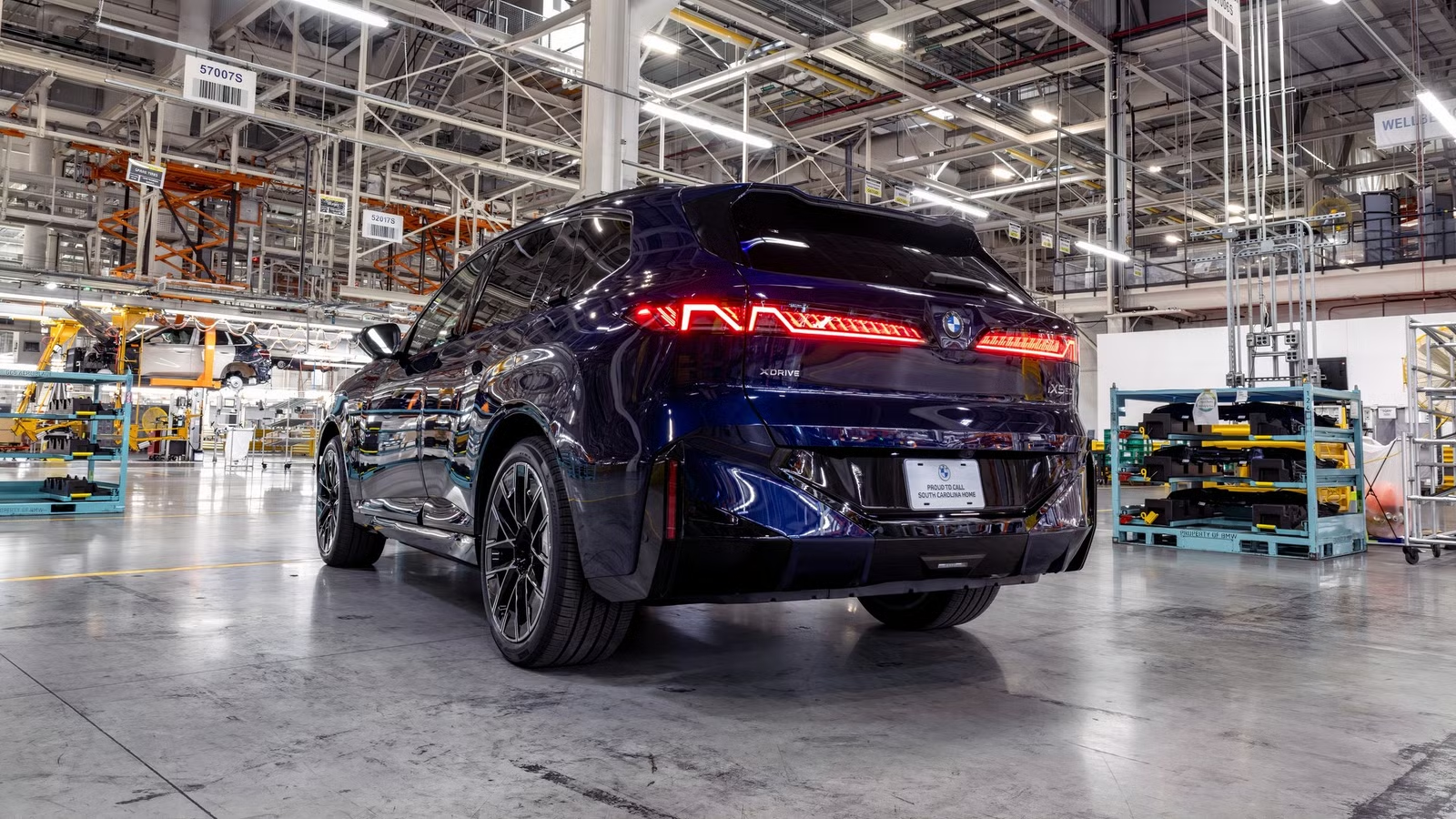
The industry has spent years quietly strangling its big engines—smaller displacements, more turbos, hybrid assist, and eventually full electrification. BMW just refused to follow that script. The brand has officially confirmed that its twin-turbo V8 will carry forward into the 2027 model year and beyond, with the 2027 X5 M serving as the clearest, most concrete proof of that commitment.

This is not a vague product roadmap promise or a carefully worded press statement leaving room for retreat. BMW’s confirmation lands as a genuine counter-move in an era when luxury performance brands are downsizing almost by default. For X5 M buyers and V8 loyalists who have been watching the segment shift, this is the news they’ve been waiting for.
The 2027 X5 M Keeps The Twin-Turbo V8 Alive
The 2027 X5 M is the anchor for BMW’s V8 commitment. Motor1 reported the confirmation on July 3, 2026, framing it simply: “Downsizing, be damned.” That phrase captures the broader significance here—BMW is not hedging, not offering the V8 as a premium-tier add-on while quietly shifting volume to a turbocharged six. The twin-turbo V8 remains the engine of record for the X5 M lineup going into 2027.

The S63 twin-turbo 4.4-liter V8 that powers the current X5 M Competition—rated at 617 horsepower in Competition trim—is the unit in question. BMW has built its M performance identity around this engine for well over a decade, and the 2027 confirmation signals that identity is not being traded in for electrification credits anytime soon. Both the standard X5 M and the X5 M Competition variants are expected to carry the engine forward, preserving the output hierarchy that enthusiasts in this segment have come to rely on.
Why This Matters When Most Rivals Are Moving On
Context makes this announcement land harder. The broader luxury performance segment has been in a slow retreat from large-displacement engines. Electrified powertrains—whether mild hybrid, plug-in hybrid, or fully electric—have become the default answer for meeting emissions targets without the political cost of outright cancellation. Some brands have kept their V8s on paper while quietly routing buyers toward six-cylinder alternatives through pricing and trim restructuring.
BMW’s move runs against that grain. Confirming the V8 explicitly, tied to a specific model year and a flagship performance nameplate, is a deliberate signal. The X5 M is not a niche halo product for a handful of buyers—it is one of the most visible performance SUVs in the segment, benchmarked against the Porsche Cayenne Turbo and the Mercedes-AMG GLE 63. Keeping the V8 there means keeping it where it gets noticed.
The timing also aligns with BMW’s recent work on engine longevity. The brand has been developing new ignition technology—pre-chamber combustion—aimed at improving fuel efficiency in M performance engines without sacrificing output. That kind of investment in internal combustion infrastructure is not the behavior of a company planning a quiet exit.
BMW Confirms The New M3 Gets No Plug-In Hybrid Compromise
The upcoming M3 will be a study in extremes, with BMW opting for a pure combustion engine and EV rather than a hybrid middle ground.
What This Signals For BMW’s Broader M Lineup

The X5 M confirmation is the clearest data point, but it points toward something larger about BMW M’s powertrain direction. The Vision BMW Alpina Concept, revealed in May 2026, also centered on a V8—a signal that the engine family has runway across multiple product lines, not just the X5 M.
For buyers cross-shopping the X5 M against electrified or downsized alternatives, the 2027 confirmation removes a significant source of uncertainty. Depreciation risk tied to powertrain obsolescence—a real concern when a manufacturer is known to be sunsetting an engine—is reduced when the brand publicly commits to continuation. That matters both at the point of purchase and at resale.
BMW has not announced specific changes to output figures or hardware for the 2027 X5 M beyond the engine’s continuation. What it has done is draw a clear line: the twin-turbo V8 has a future in the M lineup, and the 2027 X5 M is where that future starts.
In a segment where “the last V8” has become a recurring headline, BMW just made a point of not writing that story. The 2027 X5 M keeps the twin-turbo V8 where it belongs—under the hood of one of the benchmark performance SUVs on the market. That’s worth paying attention to.

Related posts


Latest Post


No Comments