
This Ultra-Rare Mercury Destroyed The 1964 GTO On Day One
The first-generation Pontiac GTO helped ignite the muscle-car era. Pontiac offered a 389-cubic-inch V8 with 325 horsepower, or 348 hp with Tri-Power, and sold 32,450 GTO packages in 1964. It was quick, usable, and available from a dealer.

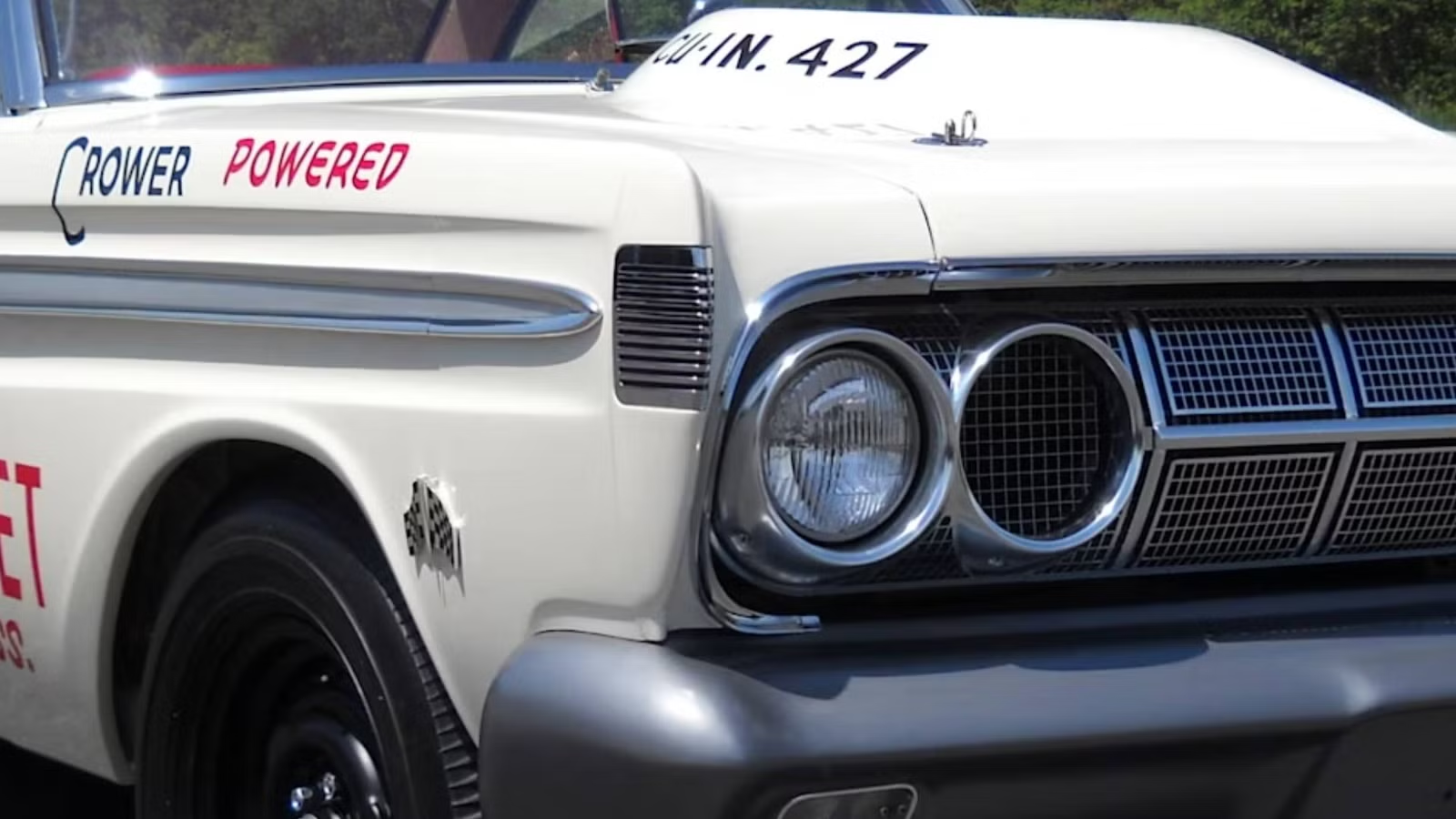
Mercury was doing something else entirely the very same year. It built a machine that packed a 425-hp 427 High-Riser, dumped almost everything that didn’t help at the drag strip, and ran 11.49 seconds. The model name can wait. The performance can’t.
Mercury’s 11.49-Second Mystery Car Left The GTO Behind
11.49 seconds. Ronnie Sox ran that elapsed time at the 1964 NHRA Winternationals, taking the Factory Stock Eliminator win in Mercury’s factory drag weapon. For some street-car perspective, a period test of the 348-hp Tri-Power GTO recorded 14.1 seconds at 104.2 mph. That’s a 2.61-second difference over 1,320 feet.

That isn’t somebody getting a better launch and winning by a fender. Even among the fastest ’60s muscle cars over the quarter mile, 2.61 seconds is enormous. Pontiac’s hottest 1964 GTO combination made 348 hp from its Tri-Power 389, while the mystery Mercury carried a 425-hp 427 High-Riser. The 77-hp difference matters, but it doesn’t explain everything. One car still had to work as transportation. The other needed to be very good at one thing for roughly 11 seconds.
There is no evidence Ronnie Sox lined up against that exact Road & Track GTO and sent it home looking for another carburetor. Pontiac sold its GTO to normal customers by the tens of thousands; Mercury’s car belonged to A/Factory Experimental, a class created specifically to let manufacturers mix engines and bodies in combinations that weren’t necessarily showroom-available. It isn’t an apples-to-apples comparison. That’s also why the gap is so entertaining.
And 11.49 wasn’t the end of it. Hot Rod records Dyno Don Nicholson running 10.75 at 127.65 mph at the 1964 Cars Magazine Super Stock Invitational, outrunning a 30-car FX field that included the new Race Hemi Mopars. An 11-second pass had already made a showroom GTO look ordinary. Now Mercury’s experiment was heading into the 10s.
How Mercury Built An 11-Second Factory Drag Weapon

Horsepower was the obvious part. The rest of the car shows just how seriously Mercury took the stopwatch. Mecum’s documentation for one surviving A/FX Lightweight lists a fiberglass front bumper, hood, fenders, and doors, lightweight glass, a Hurst-shifted four-speed, Ford 9-inch rear end with 4.56 gears, Dearborn Steel Tubing suspension work, lightweight bucket seats, and radio and heater deletion. The engine was Ford’s 425-hp 427 High-Riser. Mecum notes that lot information is consignor-supplied, so those details are safest when applied to that documented survivor.
The smaller Mercury body helped too. The 1964 car had a five-inch-shorter wheelbase and was 8.4 inches narrower than the larger 1963 FX cars using the same basic 427. The shorter wheelbase placed more mass over the slicks, while the narrower body pushed less air. The 1964 machines were running nearly a full second quicker than the previous year’s bigger FX cars.

None of the individual tricks sound especially exotic today, but stack them together and the intent is obvious. Fiberglass replaces steel. Lightweight glass removes more pounds. The 4.56 rear gears trade relaxed road speed for violent acceleration, while the radio, heater, and heavier seats get shown the door. Pontiac had already gone down a similarly ruthless path with its Swiss Cheese 1963 Pontiac Catalina Super Duty, where even the frame became fair game in the hunt for less weight. Mercury wasn’t building a nicer car. It was deleting everything the timing clocks didn’t care about.
That philosophy mattered as much as the engine. Factory drag racing had become a battle over power-to-weight ratio, traction, and how creatively Detroit could read a rulebook. Ford had already attacked Super Stock with its Thunderbolt program. Mercury went into A/FX instead, where the looser experimental rules gave it room to build something much further removed from a normal street car. The result looked familiar enough from the grandstands. Underneath, normal had left the building.
The 1964 Comet 427 A/FX Was The Ultimate Drag Weapon

The car was the 1964 Mercury Comet 427 A/FX Lightweight. That’s the cleanest umbrella name for Mercury’s factory drag weapon because adding Caliente or Cyclone to every example creates a historical argument that the surviving records don’t settle quite so neatly.
There is strong evidence for Caliente. Mercury had Dearborn Steel Tubing and Bill Stroppe Engineering build ten 427 High-Riser Comet Caliente coupes plus one Comet 202 wagon. Dyno Don Nicholson’s official history also says Dearborn Steel Tubing built eleven drag-race-only, 427 High-Riser-powered Comet Calientes, initially including a station wagon and hardtop prototype. That makes “Caliente” much more than a modern auction-house nickname.
The paperwork gives us something firmer for at least one surviving car. A Mecum-listed A/FX survivor carries VIN 4H23551848. Mercury’s 1964 warranty-plate documentation identifies series 23 as a two-door hardtop Caliente and series 27 as a two-door hardtop Cyclone. That supports the Caliente identity of that particular surviving car, but it doesn’t prove that every A/FX Comet built, modified, or raced during 1964 carried exactly the same trim identity.
The build count isn’t perfectly tidy either. Hot Rod’s history discusses an 11-car group, while Mecum’s listing calls its survivor one of 22 A/FX Lightweights. Those figures may reflect different batches or definitions of the program, which is why treating either as the undisputed total would be shaky. The safe name remains 1964 Mercury Comet 427 A/FX Lightweight. If you want to see how the body style continued terrorizing strips after 1964, HotCars has also featured a 1965 Mercury Comet Caliente running deep into the eights in modern nostalgia competition.
Beyond The GTO, Mercury Helped Create Funny Car Chaos

The A/FX Comet’s bigger legacy begins when factory drag racing stopped looking much like showroom racing. Mercury wasn’t alone in that arms race; Ford’s factory-lightweight Galaxies were another example of Detroit stripping weight and feeding race cars big-block power. But A/FX gave engineers even more freedom, and the results got weird quickly. NHRA’s history of the early Funny Car traces that path through Optional Super Stock and Factory Experimental before the cars began mutating into something new.
At the 1964 Nationals in Indianapolis, Jack Chrisman’s Sachs & Sons Comet took a much bigger step. The car used a supercharged, nitromethane-burning engine and recorded 10.25 seconds at 156.31 mph while running in B/Fuel Dragster. It didn’t yet have the flip-top body that would later define Funny Cars, and NHRA notes that supercharged Dodge Charger exhibition cars complicate any claim that Chrisman’s machine was unquestionably “the first.” Still, the blown, nitro-burning Mercury showed where factory-bodied drag cars were heading.

Then 1965 got properly strange. Altered-wheelbase Mopars shoved the rear axle forward by more than a foot and moved the front wheels roughly 10 inches forward, improving weight transfer while creating proportions that looked wrong next to conventional door cars. NHRA says those radical machines helped inspire the familiar “Funny Car” nickname because they simply looked unusual. Mercury answered in 1966 with tube-chassis, flip-top Comets campaigned by Nicholson, Chrisman, Eddie Schartman, and Kenz & Leslie. NHRA calls Nicholson’s Eliminator I the sport’s first flip-top Funny Car.
Then came the 1966 NHRA World Finals in Tulsa. Schartman beat Nicholson in an all-Mercury final, running 8.38 seconds at 174.08 mph to claim NHRA’s first official Funny Car win. That progression is striking: the mysterious 1964 Mercury in this story was an 11.49-second factory experiment, and two years later its flip-top relatives were deep into the eights. The GTO changed what enthusiasts could buy from Detroit. Mercury’s Comet helped change what a drag car could be.
Sources: Mercury, Pontiac, NHRA, Hot Rod

Related posts


Latest Post


No Comments