
The Forgotten Ford Sedan Hiding Mustang GT Hardware Underneath
The idea of a four-door Mustang has fascinated enthusiasts ever since the original launched the pony car craze in 1964. Ford has flirted with the concept over the past six decades but never committed to putting one into production. And before anyone says Mustang Mach-E, no, it doesn’t count.

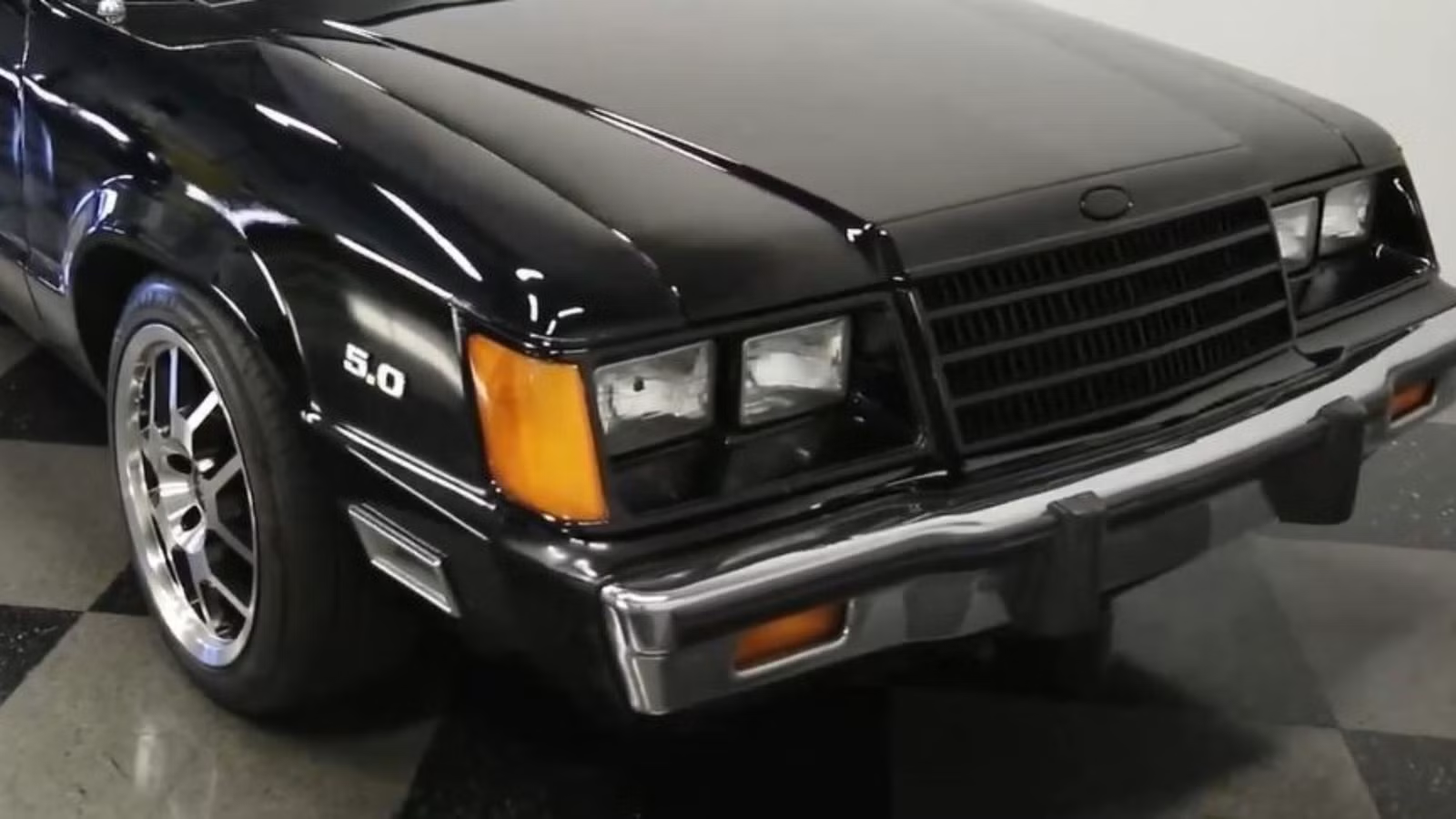
What many gearheads don’t realize is that Ford technically built one in the mid-1980s. Hidden behind the badge and conservative styling of a humble sedan was virtually everything that made the era’s hottest Mustang special, even if almost nobody recognized it at the time.
A Racing Legend Accidentally Created The Perfect Sleeper
Few names in American motorsports carry the same weight as Bob Bondurant. The American race car driver is famous for victories with Shelby American, success at Le Mans, Formula 1 starts, and a World Manufacturers’ Championship title before a devastating crash forced him into retirement in 1967. Refusing to leave the sport behind, he launched the Bob Bondurant School of High Performance Driving, which quickly became the destination for racers, law enforcement, actors, and enthusiasts looking to sharpen their skills behind the wheel.

As the school grew, Bondurant ran into an unexpected problem. Two-seat sports cars couldn’t accommodate an instructor and three students, while the era’s four-door sedans were too soft and unstable for track use. His solution was to create the car Ford never had. Bondurant started with Ford’s all-new 1983 LTD sedan, not because it looked sporty, but because it shared the same rear-wheel-drive Fox platform as the Mustang GT.

Sharing the chassis meant many of the Mustang GT’s mechanical components were effectively bolt-on upgrades, allowing Bondurant’s team to build a capable four-door without reinventing the wheel. They swapped in the Mustang GT’s 5.0-liter V8, heavy-duty suspension, sway bars, and brakes, creating a sedan that behaved nothing like the family car it appeared to be. It could hustle around a road course with remarkable composure while accommodating four occupants, making it the ideal training tool for his expanding high-performance driving school.
Ford Decided This Sleeper Deserved A Showroom

Bondurant’s timing couldn’t have been better. Donald Petersen, then Ford’s president, was sending executives through the racing school to get a feel for the company’s cars. Because the school relied exclusively on Ford vehicles, Petersen eventually sampled Bondurant’s specially prepared four-door sedan himself.
Legend has it that Petersen was greatly impressed by Bondurant’s LTD, stunned by how flat it cornered and how eagerly it accelerated. He immediately recognized its potential as an American answer to European sport sedans. Petersen instructed Ford’s Special Vehicle Operations (SVO) and engineering teams to turn Bondurant’s one-off concept into a production reality. The result was the closest thing to a four-door Mustang that’s ever come out of Dearborn.
Meet The 1984-1985 Ford LTD LX: The Four-Door Mustang Ford Never Bragged About

The mystery car was the 1984–1985 Ford LTD LX, a short-lived sports sedan Ford quietly introduced in mid-1984 to take on European benchmarks like the BMW 5 Series and Mercedes-Benz W123. It was based on the fourth and final generation of the LTD, which had been completely reworked for 1983. Compared with its predecessor, the new car was smaller, lighter, more aerodynamic, and, most importantly, built on Ford’s rear-wheel-drive Fox platform instead of the old Panther chassis. That shared architecture made it the perfect foundation for Bondurant’s prototype and allowed Ford to bring his formula to the showroom with minimal reinvention. Beneath the conservative styling, the LTD LX was essentially a Mustang in a business suit.
It Borrowed Far More Than Just The Mustang’s V8

The LTD LX may have looked like every other commuter in the office parking lot, but underneath its conservative sheet metal was a parts-bin masterpiece. Its centerpiece was Ford’s 5.0-liter High Output V8, the same engine that powered the Mustang GT. It was officially rated at 165 horsepower and 245 lb-ft of torque (some sources claim 1985 output rose to 175 hp), with every example paired with a mandatory four-speed AOD automatic.
The engine was just one piece of the LTD LX’s performance puzzle. The sedan also inherited the Mustang GT’s performance-focused chassis, including a 3.27:1 Traction-Lok limited-slip rear axle, larger front and rear anti-roll bars, gas-charged shocks and struts, firmer springs, upgraded front disc brakes, and a heavy-duty brake master cylinder. Together, those components transformed what appeared to be a mild-mannered sedan into a surprisingly capable back-road machine with handling that felt distinctly European. It missed out on the more powerful carbureted V8 and five-speed stick reserved for manual Mustang GTs, but no other Ford sedan came closer to capturing the pony car’s character.
Fun Fact: Many people mistake the LTD LX for Ford’s LTD Police Package model, but they were quite different. The LX traded the LTD Police Package’s column shifter for a center console and floor shifter, added a factory tachometer, and used a shorter 3.27:1 Traction-Lok rear axle.
The Interior Gave Away Its Sporting Intent

While the LTD LX’s exterior looked like a boring family sedan, stepping inside instantly shattered that illusion. Gone were the ordinary sedan seats, replaced by six-way adjustable low-back sport buckets trimmed in deep charcoal gray cloth. Their pronounced side bolsters held the driver and front passenger firmly in place during aggressive cornering, making full use of the car’s upgraded suspension. Even more unusual was the inflatable lumbar support, which was adjusted by squeezing a small rubber bulb connected to the seat. This was a feature more commonly associated with European sport sedans, not a midsize Ford.
Ford also ditched the column-mounted shifter in favor of a full-length center console and a floor-mounted T-handle shifter for the four-speed AOD automatic, giving the cockpit a distinctly sporty feel. Ahead of the driver sat another exclusive feature: the only factory tachometer ever fitted to a Fox-body LTD.
Its Performance Numbers Don’t Tell The Whole Story
On paper, the LTD LX wasn’t especially quick. A run to 60 mph took about nine seconds, which won’t impress anyone today. Even in 1984, some enthusiasts wished Ford had paired it with the Mustang GT’s hotter four-barrel V8 and five-speed manual transmission instead of the mandatory automatic. Still, those numbers need context. By 1984, the muscle car era had been blunted by the oil crises and strict emissions regulations.
More importantly, the LTD LX impressed where spec sheets couldn’t. MotorWeek clocked 0 to 60 mph in 8.7 seconds, but came away more impressed by its balanced handling, broad torque curve, crisp passing power, and steering that “made a good run at rivaling Germany’s best in response and feel.” It wasn’t the fastest sports sedan, but it felt far quicker than its numbers suggested. Looking back, it’s easy to see the LTD LX as one of the earliest ancestors of the modern sleeper sedan.
Why Ford Pulled The Plug So Quickly

The LTD LX had all the ingredients of a winner, but it ended up having too little time in the spotlight. Production lasted just 18 months, ending after the 1985 model year. One key reason was that buyers weren’t exactly lining up for a performance-oriented family sedan in the mid-1980s. Most enthusiast sources put total production at around 3,260 examples, although some later records suggest as many as 5,287 were built. Either way, demand never reached the level Ford had hoped for.
The bigger issue was the market itself. The rear-wheel-drive midsize sedan was rapidly falling out of favor as buyers gravitated toward smaller, more fuel-efficient front-wheel-drive cars. Ford’s answer arrived in 1986 with the revolutionary Taurus, whose aerodynamic styling and front-wheel-drive layout made the Fox-body LTD and its sleeper LX variant an idea whose time had already passed.
Fun Fact: Mercury developed a sister model called the Marquis LTS, but it never made it to U.S. showrooms. Instead, it was sold exclusively in Canada for the 1985 model year. With just 134 examples reportedly built, it’s even rarer than the LTD LX itself.
The LTD LX Is Still One Of Ford’s Best-Kept Secrets

The LTD LX checks plenty of collector-car boxes. It borrowed Mustang GT hardware, was built in limited numbers, and is widely regarded as one of America’s earliest modern sleeper sedans. Yet it has never earned the recognition those credentials suggest. Many enthusiasts still don’t know it exists, and surviving examples rarely come up for sale. When they do, they remain surprisingly affordable.
One pristine LTD LX brought only $7,975 at an RM Sotheby’s auction in 2020, while several others have been advertised for less than $10,000. The highest asking price we found was a $12,995 example listed on Hemmings in 2024. In contrast, the average price for a Fox Body Mustang GT on Classic.com is $21,081.
Perhaps that’s fitting. The LTD LX was designed to fly under the radar from day one, and four decades later, it still does.
Sources: LTDLX.org, Hemmings, RM Sotheby’s, Classic.com, Ford

Related posts





Latest Post


No Comments