
The 175-HP American Cruiser That Just Outgunned Harley’s Entire Milwaukee-Eight Lineup
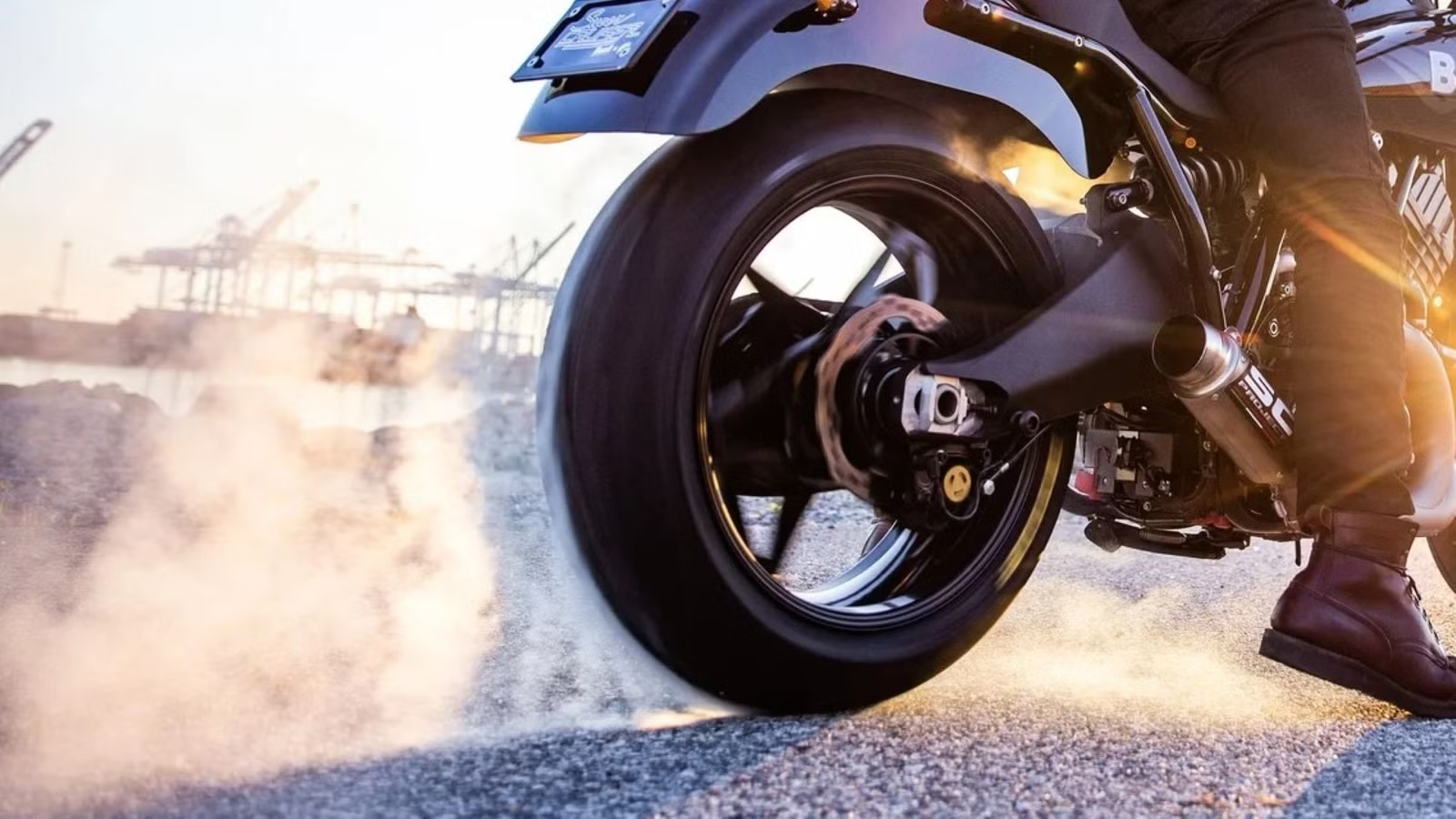
In American culture, bigger is almost always better, and we have spent decades building large-displacement engines and big, beefy, homegrown American bikes. Harley-Davidson got its bigger-is-better formula down to a science, while Indian developed its own interpretation of the big American V-twin. Both companies have offered motorcycles with plenty of low-end torque, but the traditional cruiser has generally emphasized engine character, comfort, and styling more than outright performance.

That has left a fairly clear distinction between American cruisers and the sportier motorcycles coming from Europe and Japan. A big V-twin could produce impressive acceleration from a stop, but high-speed cornering, braking performance, and outright horsepower were usually areas where the imported machinery held the advantage.
Harley-Davidson Set The Ceiling For Modern American Muscle
Harley-Davidson largely defined the upper end of American cruiser performance over the last few decades. Its most powerful street models typically combine large-displacement engines with stripped-down styling, low seats, and legs in recliner position. The company’s hot-rod cruisers developed a following among riders who wanted strong acceleration without giving up the character of a traditional Harley-Davidson.

The arrival of the liquid-cooled Revolution Max engine is a huge departure from that approach. The Sportster S uses a 1,252cc V-twin producing 121 horsepower, with a running-order weight of 502 pounds. While its engine architecture, higher-revving character, and modern chassis distinguish it from the air-cooled pushrod engines that have long defined the company’s traditional lineup, the Sportster S remains a cruiser rather than a full-scale performance motorcycle.
Big-Inch Pushrods Defined The Modern Power-Cruiser Era

The Milwaukee-Eight 117 illustrates the approach Harley-Davidson has taken with its larger and more powerful cruisers. Used in models such as the Low Rider S, the 1,923cc pushrod V-twin produces a claimed 114 horsepower and 125 lb-ft of torque. Its strongest characteristic is the amount of torque available at relatively low engine speeds.
However, this setup is predominantly to give the Low Rider S an amazing everyday riding experience. The power delivery suits a motorcycle that spends much of its time on the street, but the chassis presents a different set of compromises. At approximately 679 pounds in running order, the Low Rider S carries considerably more mass than a modern middleweight sport bike. Its suspension and ground clearance also limit how aggressively it can be ridden through corners.
The 2026 Buell Super Cruiser Shatters The Domestic Status Quo

The 2026 Buell Super Cruiser takes a different approach to the American performance cruiser. Developed by Buell in collaboration with custom motorcycle builder Roland Sands, it combines a cruiser-style riding position with a high-output liquid-cooled V-twin and a chassis designed for more aggressive road riding. The styling retains some familiar custom cruiser features, including a compact front fairing, wide handlebars, and a relatively low seat. Beneath that bodywork sits a 1,190cc, 72-degree V-twin engine and a lightweight chassis, with a starting price of $25,900.
The engine is the major departure from the conventional American cruiser formula. Buell claims 175 horsepower at 7,750 rpm and 94 lb-ft of torque at 8,500 rpm, putting the Super Cruiser well above the Harley-Davidson Sportster S and Milwaukee-Eight 117 in peak horsepower. The difference is not just a matter of the numbers on the specification sheet. The Buell’s engine is designed to produce its strongest performance at higher engine speeds, while Harley-Davidson’s larger pushrod engines emphasize low-rpm torque, giving the Super Cruiser a different character when the road opens up and the engine is allowed to rev.
485 Pounds Changes The Performance Equation

The Super Cruiser’s claimed weight is one of its most important specifications. Buell lists the motorcycle at 485 pounds wet without fuel, putting it well below the curb weight of most large American cruisers. That difference affects acceleration, braking, and how much effort the rider needs to put into changing direction. It also gives the 175-horsepower engine less mass to move, which helps explain the bike’s performance figures.
The Super Cruiser’s compact dimensions and relatively narrow profile should also make it easier to manage than a typical heavyweight cruiser. Its low mass and sport-oriented chassis give the rider more freedom to move around the motorcycle when cornering, while the lighter overall package reduces the effort required to transition from one turn to the next. The power-to-weight ratio is a major part of the bike’s appeal, although it does not automatically make it faster than every competing motorcycle.
Chassis Hardware Borrowed Straight From The Racetrack

The Super Cruiser’s engine wouldn’t mean much without a chassis capable of managing its output. Buell built the motorcycle around a lightweight tubular steel frame, with the engine and other major components arranged to keep the center of mass relatively low. The compact wheelbase and sport-oriented geometry are intended to make the motorcycle responsive without giving up the basic riding position associated with a cruiser.
The mid-mounted foot controls give the rider more support when braking and cornering, while the handlebars provide leverage over the front end. That allows the rider to use body position and pressure on the foot pegs to influence the motorcycle through a turn. The handlebar position alone gives a very cruiser appearance, yet riders report that it still feels like a sportbike first and foremost.
Fox Suspension And Brembo Calipers Deliver 50 Degrees Of Lean

The suspension consists of fully adjustable Fox inverted forks at the front and a piggyback Fox monoshock at the rear. The adjustability allows the rider to alter the suspension’s response to braking, acceleration, and road conditions. That is particularly useful on a motorcycle with this level of engine output, where suspension settings influence how the chassis responds under braking and how consistently the tires maintain contact with the road.
The Super Cruiser also uses 17-inch sport wheels and Dunlop Sportmax Q5A high-performance tires. Buell lists a maximum lean angle of 50 degrees, although the actual usable cornering clearance will depend on tire choice, road conditions, suspension settings, and, of course, the rider. Radial-mount four-piston Brembo calipers provide the front braking hardware, giving the motorcycle the kind of brake setup commonly found on performance-oriented machines.
High-Rpm Power Gives The Buell A Different Character

The Super Cruiser’s engine output becomes most useful when the motorcycle is already moving. Buell claims a 40-to-80 mph roll-on time of 2.48 seconds in documented performance testing. That is a strong figure for a motorcycle in this category, although testing conditions, gearing, rider technique, and measurement methods can affect the result. The engine’s high-rpm power also gives it a dery distinct sound from pushrod V-twins.
Rather than relying primarily on low-speed torque, the 1,190cc engine continues producing power as the revs rise. That makes the Super Cruiser well suited to high-speed passing and acceleration out of faster corners. Its claimed output also puts it in the same general performance conversation as more powerful European performance cruisers, including the Triumph Rocket 3 and Ducati XDiavel V4, although engine output alone does not determine which motorcycle will be faster.
Raw Analog Speed Demands Serious Sacrifices

The Super Cruiser’s performance comes with a significant limitation: it does not include ABS or electronic wheelie control. It does, however, feature 20 levels of traction control, giving the rider a range of settings for managing rear-wheel slip under acceleration. That makes the Buell different from a completely analog motorcycle, although braking and front-wheel lift remain the rider’s responsibility. With a claimed 175 horsepower, the distinction matters.
The lack of ABS makes tire condition, road surface, and braking technique particularly important. Wet pavement, painted road markings, loose gravel, and cold tires can all reduce available grip, while the traction control system provides assistance when the rear tire begins to lose traction under power. The Buell’s electronics package is therefore less comprehensive than that of many modern performance motorcycles, but it is not absent. The rider still has to manage the motorcycle’s braking and acceleration carefully, even with traction control available.
The Final Verdict On America’s Newest Horsepower War

The 2026 Buell Super Cruiser represents a different direction for the American performance cruiser. Its combination of a claimed 175-horsepower V-twin, a lightweight chassis, and sport-oriented suspension gives it a performance focus that is unusual in the traditional American cruiser market. The important distinction is not simply that the Buell produces more horsepower than a Harley-Davidson Milwaukee-Eight 117, but that the entire motorcycle has been designed around a different balance of weight, engine speed, chassis response, and riding position.
That approach challenges the idea that an American cruiser must be heavy and low-revving to retain its identity. The Super Cruiser shows that a motorcycle can retain the basic visual language of a custom-built American street bike while using a much more performance-oriented mechanical package. It gives buyers another option in a category traditionally dominated by large-displacement, heavyweight cruisers, and demonstrates that there is room for a more aggressive approach to the American performance cruiser.
Source: Buell Motorcycle, Harley-Davidson, Indian Motorcycle, Brembo, Fox Factory, J.D. Power Motorcycles, Roland Sands Design, Powersports Business

Related posts


Latest Post


No Comments