
The Plastic-Doored 4×4 That Beat Jeep At Baja By Two Hours In 1977
Twenty-one production-based 4x4s started their class at the 1977 Baja 1000. Just nine finished. And when the dust finally settled, the winning truck had put nearly two hours between itself and the next-place Jeep CJ-7. Not bad for a 4×4 with plastic door inserts, from an automaker that had just started building SUVs. Today, automakers sell Baja-inspired trucks and SUVs with long-travel suspension, oversized tires, and factory racing programs to prove the hardware. Ford turned that formula into a Raptor empire. But somebody else wrote the playbook decades earlier.
You Can Buy Your Choice Of Baja Racers Right Off The Showroom Floor

Ford Motor Company rolled up to the 2008 Baja 1000 in a completely unexpected prototype: the first F-150 SVT Raptor. Nearly two decades on, Detroit has treated buyers to a full ensemble of factory-built desert-racing-inspired 4x4s. The 2010-2014 F-150 Raptor set the bar high with long-travel FOX suspension, wide-track off-road tires, skid plates, and an available 6.2-liter V8 that made 411 horsepower and 434 lb-ft. The truck returned for a second generation (2017-2020) with a turbocharged “EcoBoost” V6 that upped the output to 450 hp and 510 lb-ft.
Buyers in other countries got a Ranger Raptor as early as 2018, but it didn’t hit U.S. shores until the 2024 model year. Jeep joined the U.S. factory desert-racer party with the 2020-present Gladiator Mojave. Unlike the brand’s Rubicon rock-crawling package, the Mojave’s suspension and chassis are tuned for high-speed desert running. It features 2.5-inch FOX shocks, hydraulic bumper stops, and reinforced frame/suspension hardware.

The next year, Ram dropped the Hellcat’s 700+ horsepower supercharged V8 into a 1500 with long-travel desert-runner suspension to create the 2021 TRX. With 35-inch off-road tires and 14 inches of rear suspension travel, it was a major F-150 Raptor competitor. Ford answered by reworking the GT500’s supercharged V8 for its third-gen F-150 Raptor R and offering 37-inch tires. Ford also introduced the Bronco Raptor for 2022, with its own 37-inch tires and 3.0-liter EcoBoost V6.

Ford’s first F-150 Raptor prototype took third in its Baja 1000 class. Since then, the automaker has entered multiple Raptor prototypes and near-production vehicles in the grueling race. For 2010, it debuted its first EcoBoost F-150 at Baja. In 2016, the second-gen F-150 Raptor also finished third in the stock class. In 2019, it showed up with the Bronco R race prototype but didn’t finish. The improved prototype returned in 2020 and finished the race. In 2022, a next-generation Ranger Raptor won its stock class. FoMoCo took its factory racing program to the next level during the 2023, 2024, and 2025 Baja 1000s, each of which showcased multiple vehicles from its Raptor family or off-road concepts.

It might seem like Ford invented the Baja-ready factory racer playbook. But the truth is that another major American automaker pioneered the Baja-1000-to-showroom pipeline earlier. To be exact, 31 years earlier.
Your Favorite Farmer’s Favorite 4×4

International Harvester is an agricultural-equipment giant formed when several companies, including McCormick and Deering, merged in 1902. From the jump, it didn’t limit itself to tractors and harvesters. In 1907, the company announced its first motor vehicle, the “Auto-Buggy.”
By 1915, IH had expanded to a commercial-grade Model F truck with a 2,000-pound payload. The company debuted a conventional half-ton pickup with its 1937 D-Line D-2. It debuted a metal-bodied station wagon on a truck frame in 1953. In 1956, International Harvester offered 4WD configurations of both its light trucks and its station-wagon lineup, paving the way for an all-new vehicle.

In 1958, the automaker began designing a small 4WD vehicle to challenge the Willys Civilian Jeep (CJ) line. The designers even considered a plastic body to save weight, but settled on traditional steel. The first Scout 80 rolled off International Harvester’s Fort Wayne assembly line in December 1960 for the 1961 model year. The Scout used a 100-inch wheelbase, and International quickly expanded its body configurations and amenities. It was so successful that IH released the second generation, the Scout II, in 1971.
The Scout II soon expanded to a 118-inch wheelbase option. By 1976, the Terra and Traveler trims boasted more luxurious amenities. But the market was demanding the opposite. Powerful, lightweight off-roaders were all the rage: Ford’s Bronco, General Motors’ Blazer/Jimmy, and Mopar’s Dodge Ramcharger/Plymouth Trail Duster were all essentially nimble 4WD muscle cars. International Harvester began rethinking the Scout lineup.
The IH Scout SSII Was Stripped Down To Humiliate Jeep

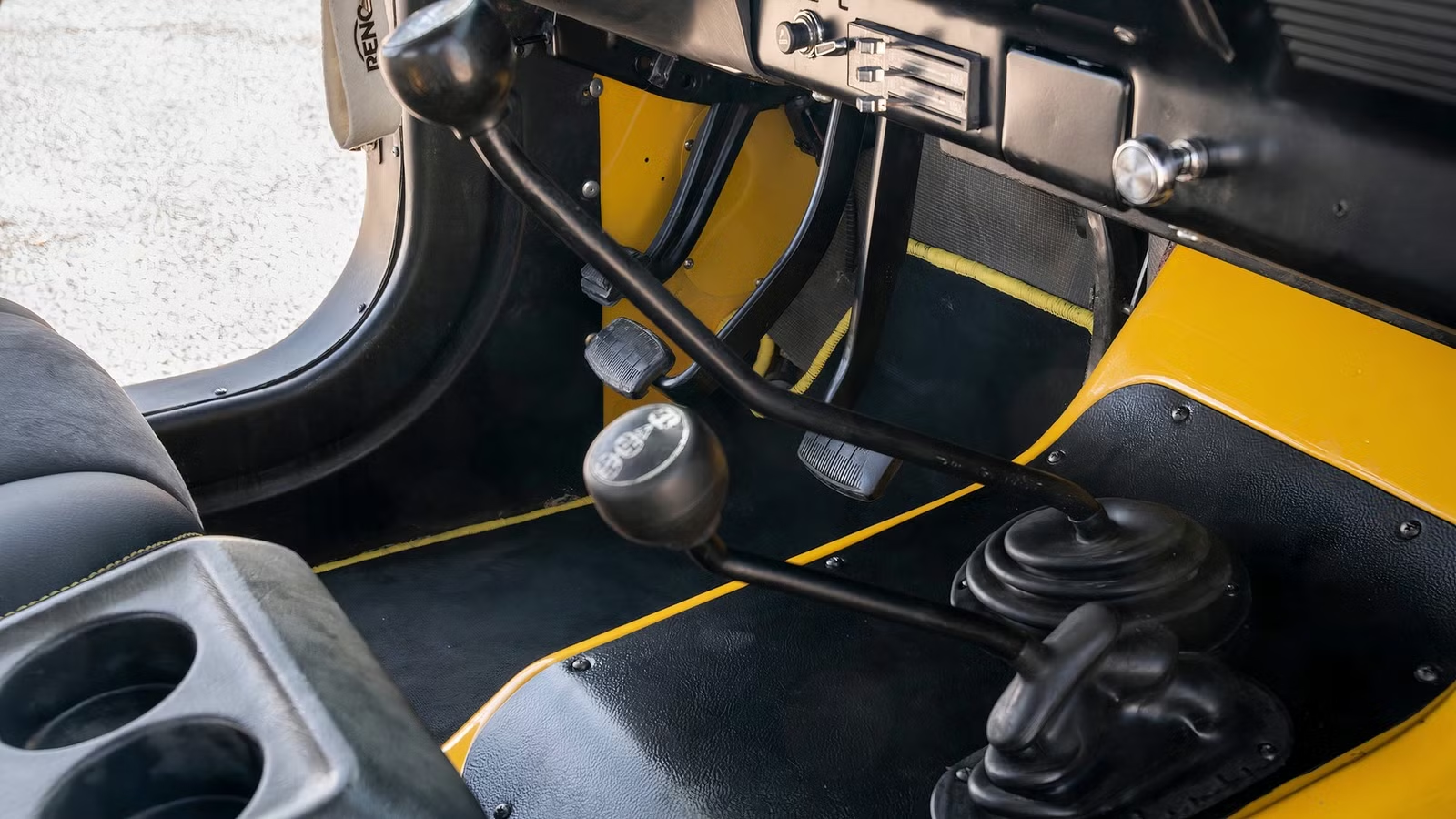
The 1977 Super Scout II didn’t add bodywork or another luxury package. Instead, the new model turned the Scout II back into an intentionally primitive open 4×4. Instead of metal doors, it had ABS plastic inserts filling the lower part of its door openings and soft, roll-down doors along with a soft roof. It saved even more weight with its plastic grille. The Rancher Special even shipped without a passenger seat, though it was an available extra. The roll bar, however, came on all Scout SSIIs.
The Super Scout II (or SSII, as it was originally badged) was available with a budget-friendly 196-cubic-inch I4. Its largest available engine was a 345-cubic-inch V8, giving it an intimidating power-to-weight ratio. Curb weight varied significantly with trim. Some models came in above 4,000 pounds, while a bare-bones Rancher Special reportedly came in much lower.

The SSII had a two-speed transfer case behind either a manual or automatic transmission. It also featured Dana 44 axles at both ends of its 100-inch wheelbase. Like all Scout IIs, it featured front disc brakes. Packages such as the Baja Cruiser came with heavy-duty springs and shocks, off-road tires, and skid plates. Other packages included the Sport and Brush Buster.
The 1977 Scout II SSII started at $5,168. The CJ-7 was still advertising an MSRP around $4,500. With its higher MSRP, IH was extra motivated to prove it could out-Jeep the Jeep. So it challenged the CJ to a race.
The Super Scout II Wasn’t Just Dressed As A Desert Racer

International decided to show what the SSII could do with factory-backed racing teams. Jimmy Ray Jones was the first official driver, and his SSII got 35-inch Desert Dog tires, increased suspension travel, chassis/axle reinforcement, and even a reversed front-shackle setup for higher-speed desert running.
Off-road racing rookie Jerry Boone bought an SSII himself and prepared it for the race at his family’s dealership. His SSII had a stock 345-cubic-inch V8. Instead of raw power, he’d focused his energy on reinforced front hubs and custom thin leaf-spring packs. IH reports that he impressed the automaker so much in early races that it brought him onto the factory team. The company later helped him with front-shackle reversal and additional engine work.

In total, 21 vehicles entered the 1977 Baja 1000’s production-based Class III. Just nine finished. Boone handily won the class. His nearest competitor was a poor Jeep CJ-7 that lagged nearly two hours behind. Another factory-supported racer, Sherman Balch, won the 1977 Southern California Off-Road Enthusiasts (SCORE) Riverside Championship. The automaker estimates that its $150,000 in factory-racing spending earned it $2.5-$3.5 million worth of Scout II publicity.
How The World Forgot About The OG Factory Baja Racer

Even the SSII couldn’t save International Harvester’s light-vehicle division. In 1980, IH announced plans to divest its Scout business to prop up the rest of the company. The sale never happened, and Scout production ended that October. All in all, International had built approximately 4,000 SSIIs.
Much of the SUV segment has spent decades trying to catch Jeep’s relentless sales. In the late 1970s, the Scout II SSII made Jeep feel vulnerable, both in racing and in the fight for enthusiast attention. It’s no surprise that when Ford took another swing at off-road supremacy in the 21st century, it landed on the Scout’s old playbook: conquer Baja before trying to conquer showrooms. Today the Bronco Raptor continues to take the fight directly to the Wrangler. But the Scout SSII dominated Baja first.
Sources: Ford Motor Company, Scout Motors

Related posts
Latest Post


No Comments