
10 Honda Bikes Riders Keep Longer Than Expected
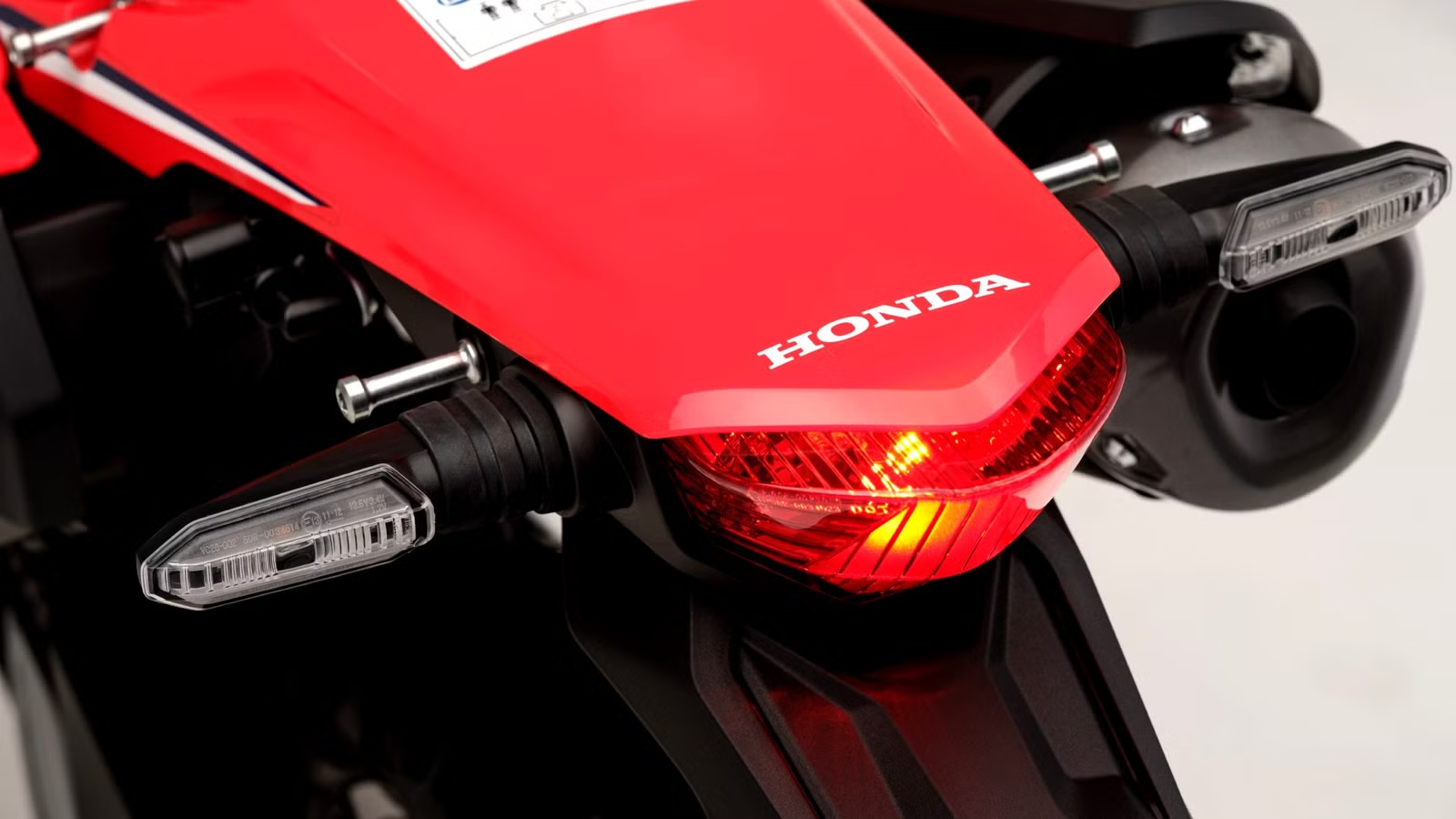
Normally, you buy a motorcycle to keep for a few years, then trade up when something more advanced comes along. But there are some that tend to become permanent fixtures in the garage. Honda has built plenty of the latter, and through the decades, their bikes have earned reputations for all the right things. Examples include mechanical durability, approachable performance, and the kind of everyday usability that owners tend to question the need to sell. We’re talking about 10 such examples in the current lineup, ranging from simple dual-sports to sophisticated ADVs and entertaining sport bikes.
Honda CRF300L
Price: $5,749

If you take a look at the CRF300L, you realize that some of the most long-term bikes are the small-capacity ones. Honda developed the CRF300L as a street-legal dual-sport with enough off-road ability to make trails exhilarating without making the pavement miserable. The 286cc liquid-cooled single is compact and uncomplicated, and the chassis is built around the familiar dual-sport formula with long-travel suspension and a 21-inch front wheel and 18-inch rear.

The CRF300L already has Honda’s bulletproof reputation, but it is so light and inexpensive to maintain that it invites experimentation. Owners with a little bit of mechanical knowledge can routinely service the bike in their backyards. Larger jobs warrant a trip to the service center, but it takes away a lot of expenses.
Honda Rebel 500
Price: $6,799


The Rebel 500 has a rather interesting place in Honda’s history because it carries a name that dates back to the mid-1980s. The original Rebel was created as an approachable cruiser at a time when large motorcycles were intimidating for newer riders. The modern Rebel keeps that accessible philosophy but replaces the old-school formula with a more sophisticated 471cc liquid-cooled parallel-twin engine.

That accessibility is essentially why some owners prefer to keep the Rebel 500 in their garage for long periods of time. Even if they decide to upgrade motorcycles, the Rebel is such an easy bike to swing your leg over and ride away that owners may end up using it for their everyday commute. It handles city streets like a champ, and highway rides aren’t slow either. It can do this while keeping you relatively comfortable for the entire journey.
Honda NX500
Price: $6,899

The NX500 is easy to put onto this list because it occupies one of Honda’s more sensible launches. It doesn’t try to dominate anything but just casually proves to you why it’s such a reliable motorcycle. The NX500’s origin traces back to the CB500X: a motorcycle that already has a reputation for being an affordable and approachable ADV. The NX is built on that same principle, and its 471cc parallel-twin is shared with a number of other bikes.

What makes the NX500 particularly easy to keep is its balance. It has long-travel suspension, ADV-tourer wheel sizes, and a 32-8-inch seat height, making it far easier to live with than many full-size adventure bikes. It is large enough for long highway trips and has suspension long enough for gravel and rough roads. But it’s not so large that an everyday commute becomes hectic. In fact, like the Rebel 500, a lot of people tend to use this as their daily driver, making it fairly unnecessary to replace.
Honda XR650L
Price: $6,999

The Honda XR650L is one of those motorcycles that seems to have ignored the calendar. Introduced for the 1993 model year, the bike has remained remarkably consistent for more than three decades. The current model uses a tried-and-tested formula. A big 644 cc air-cooled single-cylinder engine that produces approximately 43 horsepower and 38.2 pound-feet of torque. It has long-travel suspension, a 21-/18-inch wheel combo, and a seat height of 37 inches.

What makes the XR650L so hard to part with is the absolute simplicity of it. It’s not a luxurious adventure bike, a highway missile, or a tech exhibit. Its simple mechanicals are easy to understand and maintain, allowing even backyard mechanics to keep the bike in tune without too many expenses. But its highlight has to be its usability. It is fiercely capable of taking anything you throw at it. Take it on a back road sprint, a highway cruise, or strap on some luggage and take a multi-day tour, and it will follow you without complaint or restraint.
Honda Shadow Phantom
Price: $8,699

The Shadow Phantom represents another side of Honda’s long-term ownership story. It has been part of Honda’s American motorcycle lineup for decades, and the Phantom developed its own identity through its stripped-down appearance, blacked-out finishes, low seat, and relaxed riding positions. The V-Twin configuration also gives it the kind of character that clearly distinguishes it from Honda parallel-twin Rebels.

The Shadow Phantom is important because it sort of became associated with a particular period of someone’s life. The relaxed ergonomics encourage leisurely rides, and the 745cc V-twin’s delivery suits backroads and casual highway cruising. It is approachable enough to use regularly, too, while weekend trips are all about calm, collected cruising. You may discover that the Shadow is not the fastest or the most sophisticated motorcycle, but its reputation as a solidly built Honda gives owners the freedom to simply leave it in the garage without thinking about ever reselling.
Honda Rebel 1100
Price: $9,699

The Rebel 1100 is a much newer motorcycle than several others on this list, but has already developed the ingredients that encourage long-term ownership. Introduced in 2021, Honda expanded the Rebel nameplate from approachable small and middleweight cruisers into real powerful sport cruiser territory. This isn’t a conventional cruiser, however, and uses the 1,084cc parallel-twin from the Africa Twin. It’s tuned for strong, usable road performance rather than off-road grunt. And you get a DCT variant, too.

The Rebel 1100’s trick is that its 27.9-inch seat and relaxed ergonomics make it suitable for both urban riding and longer trips. So a trip to the coffee shop with your friends is just as easy as the fast-paced cruise down the coastline. Don’t forget the list of electronics it comes with, making it a genuinely easy motorcycle to hang onto. A little more money can get you its bagger version, too!
Honda Transalp
Price: $10,199

The Transalp name has a history that shoots back to the 1980s. This middleweight ADV was designed to cover both paved and unpaved roads, and the original became respected for its versatility. When Honda brought back the name, it gave the new Transalp a 755cc liquid-cooled parallel-twin, 21-inch front and 18-inch rear tire, and long-travel suspension.

The modern Transalp gets its sentimental value from riders familiar with the original machine. They appreciate the name returning, but with modern engineering and a very adaptable nature. Once you ride something like this, switching to a specialized machine seems like giving up something rather than moving forward. This is the sweet spot between small adventure bikes and heavyweight machines.
Honda Fury
Price: $11,499

Introduced for the 2010 model year, the head-turning Fury was Honda’s boldest attempt at building a factory custom cruiser. And the fact that this dramatically styled machine has remained in Honda’s stable is evidence of its popularity. It’s not a conventional cruiser with custom parts strapped on, but built from the ground up, making it look like it rolled out of a custom garage rather than from a big motorcycle manufacturer.

And underneath that dramatic styling is a fairly conventional Honda foundation with a 1,312cc liquid-cooled V-twin that produces 57 horsepower and 79 pound-feet of torque. Now, it looks like something that should require constant tinkering, but it comes from a manufacturer that is famous for its durable bikes. Owners may buy this bike because of the way it looks, the way it sits on the road, or the number of heads it turns. But selling something as unique as this is more than a matter of finding another cruiser.
Honda CBR600RR
Price: $11,499

The CBR600RR is an interesting motorcycle because sport bikes are usually treated as stepping stones. You buy one, learn its abilities and boost your confidence, and you move on. But somehow, this sport machine has demonstrated that owners decide there is no reason to graduate from it. The 599cc inline-four engine is the centerpiece of this bike, delivering the high-revving character that made middleweight sport bikes so beloved.

What this bike does so differently is that, as modern bikes have become larger and more powerful, the CBR600RR gives you a more mechanical feel. You have to work for the performance in a way that modern electronics tend to make easy. For owners who grew up in the golden age of middleweight sport biking, the CBR can carry considerable sentimental weight.
Honda Africa Twin
Price: $15,199

The Africa Twin carries a lot of history in its name. The original became famous through Honda’s Paris-Dakar racing efforts and eventually developed a cult following as a large adventure motorcycle capable of traveling way off the beaten path. But when Honda revived the name for the modern era, the company created a machine that could handle the dirt while still being capable of covering huge distances on pavement.

Its 1,084cc liquid-cooled parallel-twin engine comes paired with either a 6-speed manual transmission or a DCT setup. The bike runs on long-travel Showa suspension, with a 21-/18-inch tire combo and a curb weight of 510 pounds. You can also get the Adventure Sports variant for even more pizazz and versatility, thanks to its electronic suspension and 19-inch front wheel.
Source: Honda Powersports

Related posts


Latest Post


No Comments