
The Suzuki Katana Traditional Riders Rioted Against At Cologne
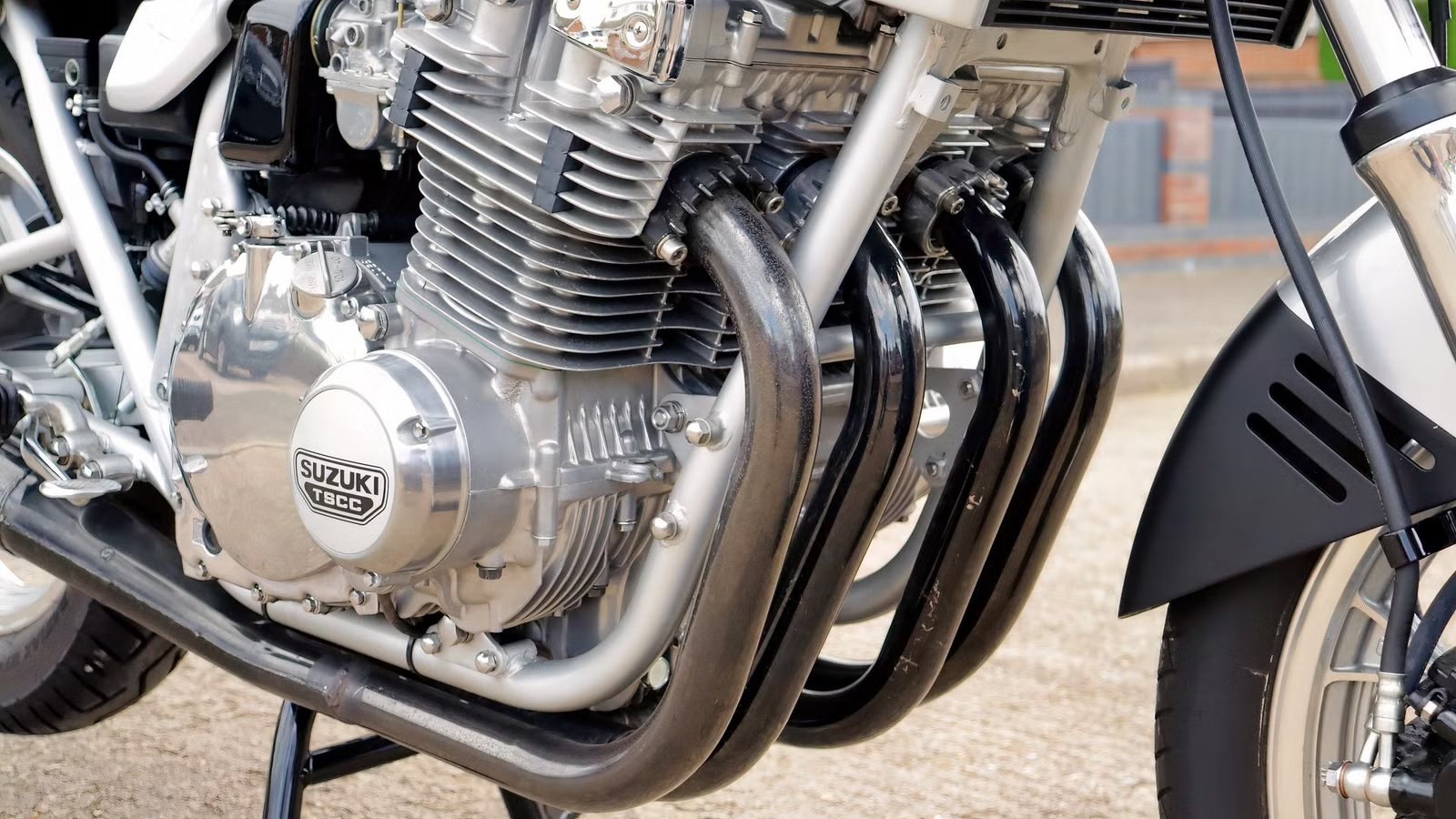
Suzuki walked into the 1980 IFMA show in Cologne with something nobody in the industry had asked for. The established players had spent the decade one-upping each other on cylinder counts and top speeds, all wrapped in roughly the same silhouette. What showed up on Suzuki’s stand looked like it had wandered in from a different decade entirely, and the reaction from the people whose job it was to sell motorcycles was not what anyone in Hamamatsu expected.
The Wedge That Changed Everything

By 1980, the superbike class had settled into a familiar rhythm. Four-cylinder engines kept growing, fairings stayed minimal or absent, and styling briefs mostly asked designers to make the tank a bit longer and the paint a bit louder. Honda, Kawasaki, and Yamaha were locked into an arms race measured in displacement and top-end horsepower, and the bikes that resulted from it looked more or less interchangeable to anyone outside the enthusiast press.
That sameness had a name. Industry writers had already started calling these machines the Universal Japanese Motorcycle, a label that stuck because it was accurate. Round headlight, twin shocks, air-cooled inline-four sitting upright in a steel cradle frame. It worked, and buyers kept buying, but nobody was pretending the visual side of the business was getting much attention from the people who built the engines.
Suzuki had its own version of the problem, and a fairly stubborn one at that. Its existing 1100cc flagship was mechanically excellent and visually forgettable, the kind of bike a rider bought for the spec sheet rather than the way it looked parked outside a cafe. Fixing that meant admitting the in-house styling department had hit a wall, which was not a small thing for a company as historically conservative as Suzuki.

A Design Brief Built to Break the Mould

Suzuki’s own marketing manager in Germany put the problem to Japanese management in blunt terms, arguing that the company had some of the most technically capable bikes on the market wrapped in styling nobody found interesting. The response was to look outside Japan entirely for the fix.
Suzuki brought in a newly formed German outfit led by a designer who had previously run styling at one of Europe’s most respected motorcycle makers, alongside two colleagues with backgrounds spanning sports car and touring bike design. None of them had a finished production motorcycle to their name yet. What they delivered, after a winter spent refining a clay mockup into a running prototype, was unlike anything a Japanese manufacturer had put its name to before. The brief had called for something distinctive. Nobody at Suzuki seemed fully prepared for how far that team would run with it.
The Suzuki Katana Nobody Wanted to Sell

The bike behind that mockup was the GSX1100S Katana, and its opening prose has to start with why it backed up the shock value. Under that angular bodywork sat a 1,074cc air-cooled inline-four making 111 hp at 9,500 rpm, with 72 lb-ft of torque arriving at 6,500 rpm. Suzuki quoted a dry weight of just 510lbs, light enough that period road tests recorded a genuine 140 mph out of the fairing-equipped 1000cc variant tested in period, numbers that made contemporary rivals look soft by comparison. The Honda CB900F of the same era, widely respected in its own right, made do with 95 hp, 57 lb-ft of torque, and a heavier 514-pound dry weight, and most testers pegged its top speed closer to 120 mph in early trim.
Why Distributors Balked First

Suzuki’s own American arm looked at the 1100cc Katana and passed. The U.S. distributor was unsettled enough by the radical style that the bike simply never got imported in its original form. It took a smaller-displacement variant built to homologate for production racing before American Suzuki agreed to bring a Katana stateside at all, arriving a full model year after Europeans could already buy one.
That hesitation was not limited to one office. Trade press across Europe treated the Cologne unveiling as an interesting experiment rather than a serious production plan, and the general assumption in the room was that something this far outside convention would never survive contact with a factory production line.
The Hidden Champion

The trade rejection turned out to be badly wrong about demand. Riders who actually threw a leg over the Katana found an aggressive riding position, genuine top-end speed, and a look that made every UJM parked next to it seem instantly dated. Word spread through the same enthusiast circles the trade press had assumed would reject the bike outright, and dealers who had hedged their initial orders found themselves scrambling for more stock once it became clear the styling was not scaring buyers away at all.
Sales in Europe held up well enough that Suzuki kept expanding the family rather than quietly discontinuing it, adding smaller-displacement Katanas across several capacities through the decade. A bike the dealers doubted became one that riders actively sought out, and that gap between institutional skepticism and rider enthusiasm is the part of the story that gets lost when people only remember the awkward debut.
A Following the Dealers Never Saw Coming

Owners clubs and enthusiast circles built around the Katana’s distinct silhouette well before the collector market took any notice, trading tuning tips and showing bikes off at gatherings the original distributors never bothered attending. That grassroots credibility mattered more later than anyone selling the bike in 1981 could have guessed.
It also meant clean, unmolested examples survived in enthusiast hands rather than getting parted out or neglected, which matters enormously to anyone shopping the collector market for one today. A bike that spent its life being genuinely ridden and cared for by people who chose it on purpose tends to age very differently from one that sold on price alone and then got abandoned in a shed the moment a newer model arrived.
The Collector’s Reckoning

Present-day demand backs up the reversal. A clean, mechanically sorted 1985 GSX1100S Katana recently sold at auction for $4,280, a figure that tracks well above what a comparably conditioned, mechanically unremarkable UJM from the same era typically fetches. For context, the Honda CB900F, a genuinely respected performance bike in its own moment, shows an average sale price of $4,759 across recorded market transactions, with a standout 1982 example reaching $11,000 at a 2024 auction sale in Las Vegas. The Katana sits comfortably in that same conversation despite never having outright performance superiority to lean on against its stronger rivals.
What buyers are paying for now is exactly what dealers rejected in 1980. A shape that refused to look like anything else on the floor, penned by a design house nobody in Japan had heard of, on a bike the importers themselves doubted enough to leave sitting in Europe for a year. That kind of design courage rarely gets rewarded on the spot. It usually takes a couple of decades and a fresh set of eyes that never had to defend the thing to a skeptical dealer network in the first place, and the Katana is as clean a case of that delayed vindication as 1980s Japanese motorcycling has to offer.
Sources: Mecum, Iconic Motorbike Auctons, Classic.com.

Related posts


Latest Post


No Comments