
The World’s Fastest Accelerating Car You’ve Never Heard Of
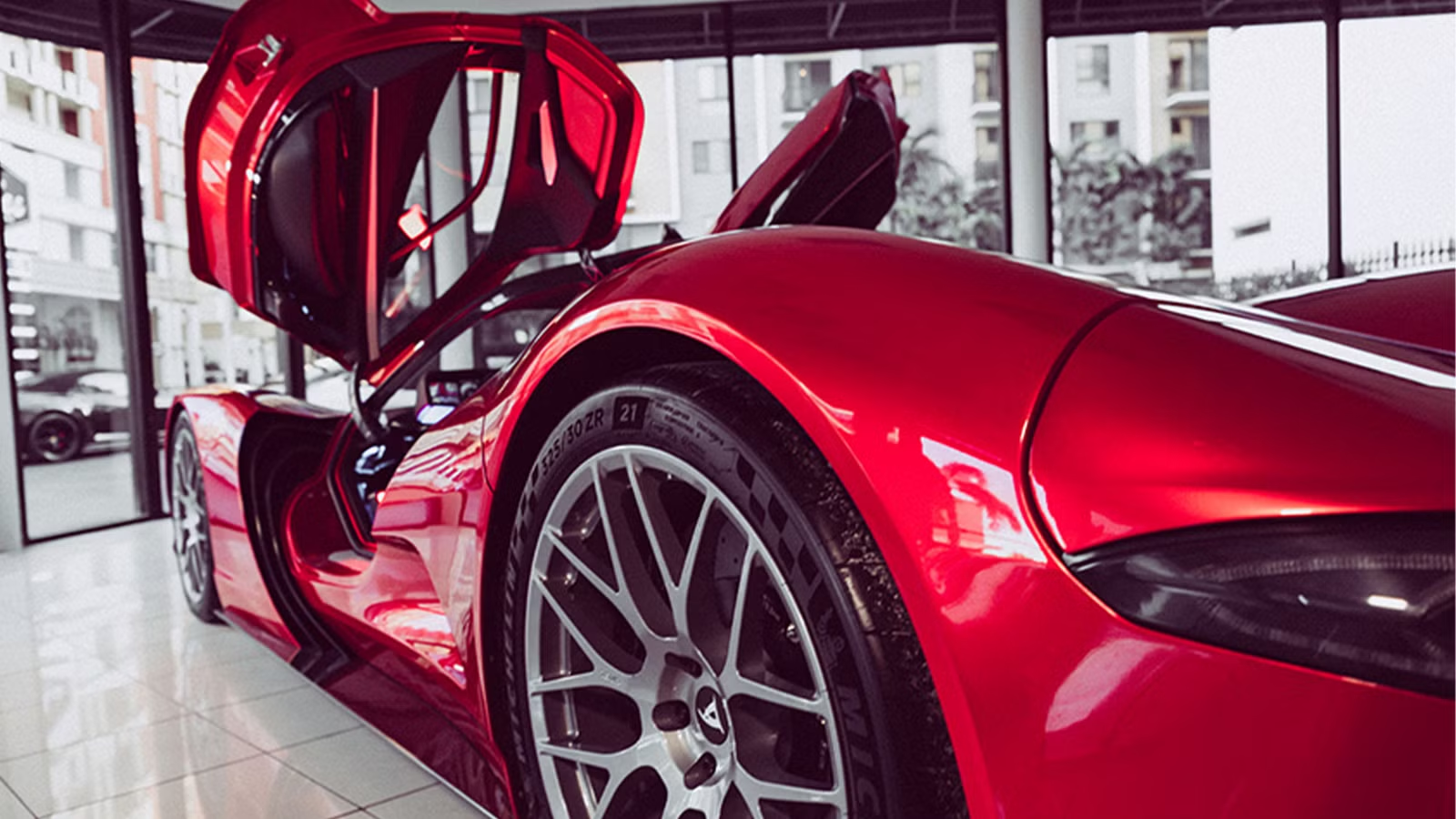
Every few years, something emerges from an unexpected corner of the automotive world and quietly rewrites the performance rulebook. Right now, that something is Japanese, fully electric, and capable of launching to 60 mph faster than almost any machine ever built — and there’s a good chance you’ve never heard of it.

It doesn’t announce its arrival with a thunderous exhaust note. It simply materializes, splits the air with surgical precision, and disappears into the distance before your brain has finished registering what just happened. This isn’t a product of the usual European hypercar establishment — no Italian dynasty, no Swedish speed obsessive. This is something altogether different, and altogether unexpected.
Japanese Engineering Takes On The World’s Fastest
As rare as a daytime owl sighting, the Aspark Owl SP600 is a hypercar so fast, so futuristic, and so exclusive that it almost feels like a concept brought to life. But make no mistake — the Aspark Owl is no concept. This electric beast from Japan is the real deal, and it’s rewriting the rulebook on what performance looks like in the EV era. Built by Aspark, a company previously known for engineering services rather than high-speed dreams, the Owl SP600 is Japan’s answer to the Bugatti Chiron, Rimac Nevera, and Lotus Evija. What makes it so remarkable is that it doesn’t merely compete in the hypercar segment — it dominates it.

The Owl’s claimed 0–60 mph sprint of just 1.72 seconds places it among the quickest cars ever made — and arguably makes it the fastest-accelerating production car in history. The Aspark Owl has also set a record as the world’s fastest battery-powered electric prototype hypercar, clocking 272.6 mph during a high-speed run. This car doesn’t simply accelerate; it effectively teleports itself to another point in space.
Aspark Owl Specs
|
Powertrain |
Quad Electric Motors |
|
Horsepower |
1,984 hp |
|
Torque |
1,475 lb-ft |
|
0–60 mph |
1.72 seconds |
|
Top Speed |
249 mph |
|
Battery |
64 kWh Lithium-ion |
|
Range |
~280 miles (WLTP) |
|
Weight |
4,188 lbs (1,900 kg) |
|
Chassis |
Full Carbon Fiber Monocoque |
|
Price |
$3.5 million |
|
Production |
Limited to 50 units |
The History Of The Aspark Owl
The story of Aspark is one of ambition and pure engineering grit. Founded in 2005 in Osaka, the company built its reputation providing technical and design services to automotive clients. Then, at the 2017 Frankfurt Motor Show, Aspark unveiled something that genuinely shook the industry — a prototype of an all-electric hypercar that could allegedly sprint from 0 to 60 mph in under two seconds. Plenty of enthusiasts and journalists were skeptical, but the Japanese firm was dead serious.
Development of the Owl stretched over several years. The early prototype was more proof-of-concept than production-ready machine, but Aspark remained relentless in its pursuit. A partnership with Manifattura Automobili Torino (MAT) in Italy ultimately brought the vision to life, and the Owl was ready for customers by 2020. It may well be Japan’s first true hypercar, and it serves as a clear shot across the bow of every performance automaker on the planet. Aspark now stands as a symbol of what’s possible when bold vision meets exceptional engineering.
Design Of The Owl: The Last Airbender

One look at the Aspark Owl tells you everything about its intent. The ultra-low stance — just 39 inches tall — sculpted bodywork, and dramatic curves make it look as though it was shaped by the wind itself. The body is constructed entirely from carbon fiber to minimize weight while maximizing stiffness and rigidity. An active rear wing deploys at speed to generate downforce, then tucks away cleanly when not needed. Butterfly doors hinge upward like a mechanical bird of prey, living up to the car’s name.
Inside, the cabin blends ultra-luxury with advanced technology. Fine leather, carbon fiber, and brushed aluminum wrap the interior, while digital displays dominate the dashboard. Driver and passenger are cocooned in motorsport-grade seats without sacrificing comfort, according to Aspark.
Only 50 units of this masterpiece will be built. Each car is fully customizable to the buyer’s specification, meaning no two Owls will ever be identical — exclusivity is guaranteed by design.
Pros
- Incredible acceleration (0–60 mph in 1.72 seconds)
- Fully electric with 1,984 hp and instant torque
- Extremely rare – only 50 cars made
- Futuristic design with carbon fiber body and butterfly doors
- Lightweight and high-performance engineering
- Street-legal and track-ready
Cons
- Very expensive ($3.5 million price tag)
- Limited driving range (~280 miles)
- Unknown long-term support from a new carmaker
- Not practical for daily driving (very low and exotic)
- Lower top speed than some rivals (249 mph max)
- Unproven reliability in real-world use
How The Aspark Owl Compares To Other Hypercars
The hypercar world is stacked with heavyweights, many of them recognizable even outside hardcore enthusiast circles. We’ll leave the Tesla Model S Plaid out of this conversation — impressive acceleration aside, it doesn’t belong in the hypercar class when it comes to overall driving dynamics. The Bugatti Chiron Super Sport 300+, Rimac Nevera, Lotus Evija, and Koenigsegg Jesko Absolut are all genuine monsters of performance. So how does the Aspark Owl measure up?
Bugatti Chiron Super Sport 300+
- Top Speed: 304 mph (unofficial)
- 0–60 mph: 2.4 seconds
- Power: 1,578 hp (W16 quad-turbo)
The Bugatti is faster at the top end, but the Owl destroys it off the line.
Rimac Nevera
- Top Speed: 258 mph
- 0–60 mph: 1.85 seconds
- Power: 1,914 hp (quad electric motors)
The closest real-world rival to the Owl. Similar technology, a slightly higher top speed, but the Owl still edges it in 0–60 times.
Lotus Evija
- Top Speed: 217 mph
- 0–60 mph: Just under 3 seconds
- Power: 2,000 hp (electric)
The Evija wins on peak power output, but can’t match the Owl’s acceleration or top speed.
Koenigsegg Jesko Absolut
- Top Speed: Estimated 330+ mph
- 0–60 mph: 2.5 seconds
- Power: 1,600 hp (twin-turbo V8)
The Jesko is engineered for outright speed records, but it runs on gasoline and has yet to complete official top-speed runs.
A Phantom In The Hypercar World

The Aspark Owl reigns as the king of acceleration and one of the fastest electric cars on the planet. While rivals may boast higher top speeds, none can match the Owl off the line. It isn’t trying to win the longest race — it’s built to dominate the launch like nothing else on earth. The Aspark Owl is one of the greatest automotive surprises of the 21st century: born from a company no one saw coming, it’s a masterpiece of Japanese engineering cloaked in Italian craftsmanship and driven by electric fury. It doesn’t command the same headlines as its European rivals, but perhaps that’s the point. It’s not here to be famous. It’s here to be the fastest — and if you blink, you’ll miss it.

Related posts



Latest Post


No Comments