
The Pontiac Dealer-Sold Ferrari Lookalike Maranello’s Lawyers Killed In 1988
During the 1980s, Ferrari replicas were everywhere. Most began life as unfinished fiberglass kits stacked in crates, waiting for enthusiasts to source a donor car, spend countless weekends fitting body panels and hoping the finished product resembled the Italian supercar pictured in the brochure. Some looked convincing from a distance. Many didn’t.

One American company took a completely different approach. Instead of selling enthusiasts a project, it sold them a finished car through a franchised dealership with financing, paperwork and a manufacturer’s warranty. It blurred the line between coach building and factory production so convincingly that it eventually attracted attention from Maranello—not because of how it drove, but because of how it looked.
Most Ferrari Lookalikes Started In A Garage: This One Started At A Dealership
Replica cars weren’t unusual during the 1980s. Ferrari-inspired bodies appeared on everything from Volkswagen Beetles to Pontiac Fieros, fueled by an aftermarket industry eager to offer supercar looks without six-figure running costs. Most were home-built projects or low-volume specialist conversions, and buyers generally accepted inconsistent build quality as part of the experience.

The dealership model changed that equation. Instead of asking customers to become builders, one American coach builder convinced Pontiac dealers to sell its conversion as a brand-new vehicle. Buyers could arrange financing, sign the paperwork, collect the keys and drive away the same day, much like purchasing any other new car in the showroom.
That distinction mattered. The conversion wasn’t being marketed as a homemade kit or a used sports car wearing new body panels. It occupied an unusual middle ground between a factory production car and a specialist coach-built model, lending it a level of legitimacy that almost no replica manufacturer had managed before.
It also created a contradiction that seems almost impossible today. One of America’s largest dealer networks was quietly selling a car that looked remarkably similar to one of Italy’s best-known sports cars, complete with warranty support and factory paperwork.
The Oldsmobile Muscle Car Smart Collectors Snap Up Quietly
Pounce on this rare Oldsmobile muscle car before word gets out and its value finally explodes.
It Was A Coach-Built Exotic Wearing A GM Warranty

The company behind the project wasn’t General Motors but Corporate Concepts Limited (CCL), a Michigan-based coach builder with experience developing specialty vehicles for major manufacturers. Rather than building cars from scratch, CCL purchased brand-new donor vehicles, removed their original exterior panels and replaced them with its own fiberglass bodywork before the finished cars were delivered through participating Pontiac dealerships.
Because the underlying donor remained a brand-new General Motors product, customers retained factory warranty coverage on the mechanical components. That single detail separated the program from almost every other Ferrari-inspired conversion on the market. Owners weren’t buying a partially assembled replica from a niche workshop; they were buying what appeared to be a professionally finished specialty car through an authorized retail channel.
The arrangement also explains why the project attracted so much attention. Coach builders had been rebodying production cars for decades, but few had managed to integrate their products so seamlessly into an established dealership network. For a brief moment, it looked as though American ingenuity had found a legal way to put Italian theater into mainstream showrooms.
It also raised an obvious question. If customers could buy something that looked remarkably close to a Ferrari without ever visiting a Ferrari dealer, how long would Maranello tolerate the arrangement?
Meet The Pontiac Mera

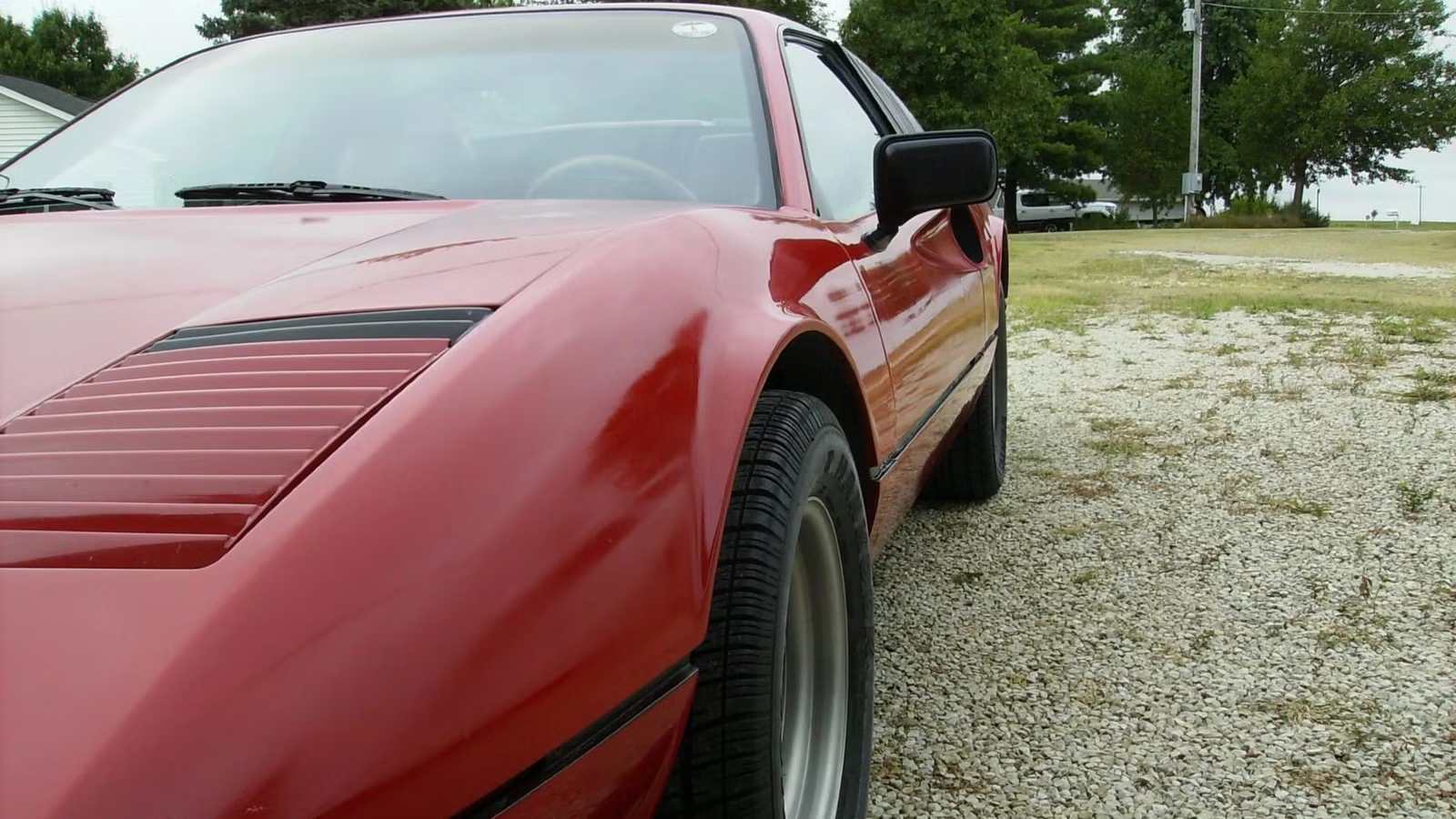
The answer arrived in 1987 as the Pontiac Mera, a coachbuilt sports car created by Corporate Concepts Limited using brand-new Pontiac Fiero donor cars. Rather than modifying used examples, CCL converted new cars supplied through Pontiac dealerships, replacing the original composite body panels with a fiberglass body that borrowed heavily from the proportions of Ferrari’s 308 GTS and later incorporated styling cues associated with the 328.
Production lasted just two model years. Corporate Concepts built 88 Meras on a 1987 Pontiac Fiero GT chassis before switching to the 1988 Pontiac Fiero Formula, producing another 159 examples. That brought total production to 247 units, making the Mera one of the rarest dealer-sold Pontiac derivatives ever offered.
The visual transformation was dramatic, but underneath, the Mera remained mechanically faithful to its donor car. That wasn’t necessarily a drawback. By 1987, the Fiero’s reputation had improved considerably thanks to suspension revisions and ongoing engineering updates that addressed many of the criticisms leveled at earlier models.
Pontiac Mera Key Specifications
|
Engine |
Power |
Torque |
Transmission |
Drivetrain |
|
2.8-liter naturally aspirated V6 |
140 hp |
170 lb-ft |
5-speed manual or 3-speed automatic |
Rear-wheel drive |
Price also played a significant role in the Mera’s appeal. Depending on specification, buyers typically paid between $24,000 and $28,000, placing it well above the price of a standard Fiero but still at roughly half the cost of a contemporary Ferrari 308. It wasn’t inexpensive by Pontiac standards, but it offered visual drama that very few cars in its price bracket could match.
Beneath The Bodywork, It Was Still Pure Pontiac

The Mera’s greatest strength wasn’t that it fooled Ferrari owners. It was that it avoided many of the compromises associated with replica cars. Because the donor retained Pontiac’s mid-engine layout, the proportions looked convincing without the stretched noses and awkward wheel placement that plagued many front-engine Ferrari replicas. The Fiero’s removable composite body panels also simplified the conversion process, allowing Corporate Concepts to install its own fiberglass bodywork without redesigning the underlying structure.
Performance, however, remained unmistakably Pontiac. The 2.8-liter V6 delivered respectable rather than breathtaking acceleration, reaching 60 mph in roughly eight seconds depending on transmission choice. Anyone expecting Ferrari performance would have been disappointed, but that was never really the point. The Mera sold theatre, not lap times.
That decision made ownership considerably easier than maintaining an Italian exotic. Routine servicing could be carried out through Pontiac dealerships using widely available GM mechanical parts, and consumables cost a fraction of what Ferrari owners faced. A clutch replacement, for example, involved familiar General Motors components rather than specialist Italian hardware, making long-term running costs significantly more approachable than those of a genuine 308.
Even today, that practicality remains part of the Mera’s appeal. It delivers the proportions, seating position and mid-engine layout that enthusiasts associate with exotic cars while relying on a drivetrain that most American technicians could understand without specialist training.
Ferrari Didn’t Beat It In Court—But The Settlement Ended The Experiment

The Mera’s greatest strength also became its biggest problem. It looked convincing enough to attract Ferrari’s attention. Rather than targeting General Motors or Pontiac, Ferrari filed a trademark infringement action against Corporate Concepts Limited, arguing that the Mera’s appearance too closely resembled its own road cars. The dispute never reached a courtroom verdict. Instead, both parties reached an out-of-court settlement in 1988, after which Corporate Concepts voluntarily ended Mera production.
That distinction matters because the story is often oversimplified. Ferrari didn’t force General Motors to stop building a rival sports car; GM had never built one. The legal dispute centered on an independent coach builder that had successfully integrated its conversion into Pontiac’s dealer network. Once that relationship ended, one of the most unusual dealership experiments of the 1980s disappeared almost as quickly as it had appeared.

The Mera also became one of the most visible casualties of a period when Italian manufacturers increasingly defended their designs against increasingly convincing replicas. Plenty of Ferrari-inspired kit cars continued to exist, but few enjoyed the credibility—or visibility—of being sold through an established franchised dealer network with a factory warranty attached.
Surviving Meras have gradually found their audience. Collectors aren’t chasing them because they’re the fastest Fieros ever built or because they outperform the Ferraris that inspired them. They’re interested because no other American manufacturer came this close to offering an exotic-looking coach-built car through mainstream dealerships while retaining the convenience of factory-backed ownership.
That’s what makes the Mera such an unusual chapter in Pontiac history. It wasn’t simply another Ferrari replica. It was a professionally engineered, dealer-sold coach-built conversion that blurred the boundary between factory production and aftermarket imagination. For two brief years, an American buyer could sign a Pontiac purchase agreement, receive a GM warranty and drive home in something that looked far more Italian than anyone in Maranello was comfortable with. That combination has never really been repeated, which explains why the Mera continues to occupy such an unusual corner of automotive history.
Source: GM Heritage Center

Related posts




Latest Post


No Comments