
The 1977 French Wagon That Predicted The Crossover Boom By 20 Years
Most modern crossovers follow a very simple recipe – car-like mechanicals, a roomy body, extra ride height, and just enough SUV attitude to make the school run look like an expedition. That formula became mainstream in the 1990s, but a small French company had already worked it out in 1977. Its strange creation looked ready for the wilderness while sending power only to its front wheels. The idea drew plenty of skepticism, but buyers proved that capability was only part of the appeal.
The 1970s SUV World Was Very Different

During the 1970s, a vehicle that looked ready for the wilderness generally had the hardware to back it up. Land Rovers, Jeeps, and similar machines came from a world of farms, armies, mud, and rough tracks. The Range Rover changed the mood after its 1970 launch by mixing that toughness with far more comfort and style. Even so, underneath the nicer cabin sat serious equipment. The original Range Rover used a V8, permanent four-wheel drive, long-travel suspension, and disc brakes at all four corners. Range Rovers crossed the Darién Gap and the Sahara during headline-making expeditions in the 1970s. It became the benchmark for an off-roader that owners could use every day without feeling as if they had borrowed equipment from a construction site.
That ability came at a price. Four-wheel-drive hardware added shafts, differentials, weight, mechanical losses, and more parts that had to be paid for and maintained. Large engines also had large appetites, an awkward trait after the 1973 oil crisis made fuel use impossible to ignore. The Range Rover sat at the expensive end of the market as well – contemporary British pricing put one at roughly £8,500 to almost £10,000 depending on the date and source. An ordinary family wagon cost far less, and buyers who genuinely needed to drag trailers through fields could justify the difference.
That gap created an opportunity hiding in plain sight. Plenty of drivers liked what an off-roader said about them even if their biggest obstacle was a muddy parking lot beside a hiking trail. They wanted cargo space for hobbies, a cabin that felt less ordinary than a sedan, and styling that suggested a life more exciting than Tuesday traffic. They did not necessarily need low-range gearing and four driven wheels every morning.

Some Buyers Wanted The Adventure More Than The Drivetrain

The answer began with a deeply unglamorous foundation: a front-wheel-drive commercial vehicle. Instead of engineering a new four-wheel-drive chassis, the designers could start with an existing small van and pickup platform, reinforce and stretch what they already had, then spend their limited money where customers could actually see and use it. A modest four-cylinder engine would keep the package affordable, while a much taller rear body could add passenger and cargo room. Bigger tires, more ground clearance, and rugged exterior pieces could supply the visual drama.
The specification sheet made the contradiction even more obvious. Power went only to the front wheels, and production models never offered four-wheel drive. A 1.4-liter four-cylinder produced roughly 80 hp through a four-speed manual transmission. Sources vary on the exact ground-clearance measurement, with period-style figures ranging from about six inches at the low points to a little over eight inches depending on where it was measured. In practical terms, it had around seven inches where it mattered most: useful for rutted lanes and rough fields, but nowhere near enough to turn the vehicle into a mountain goat. The drivetrain was ordinary on purpose.
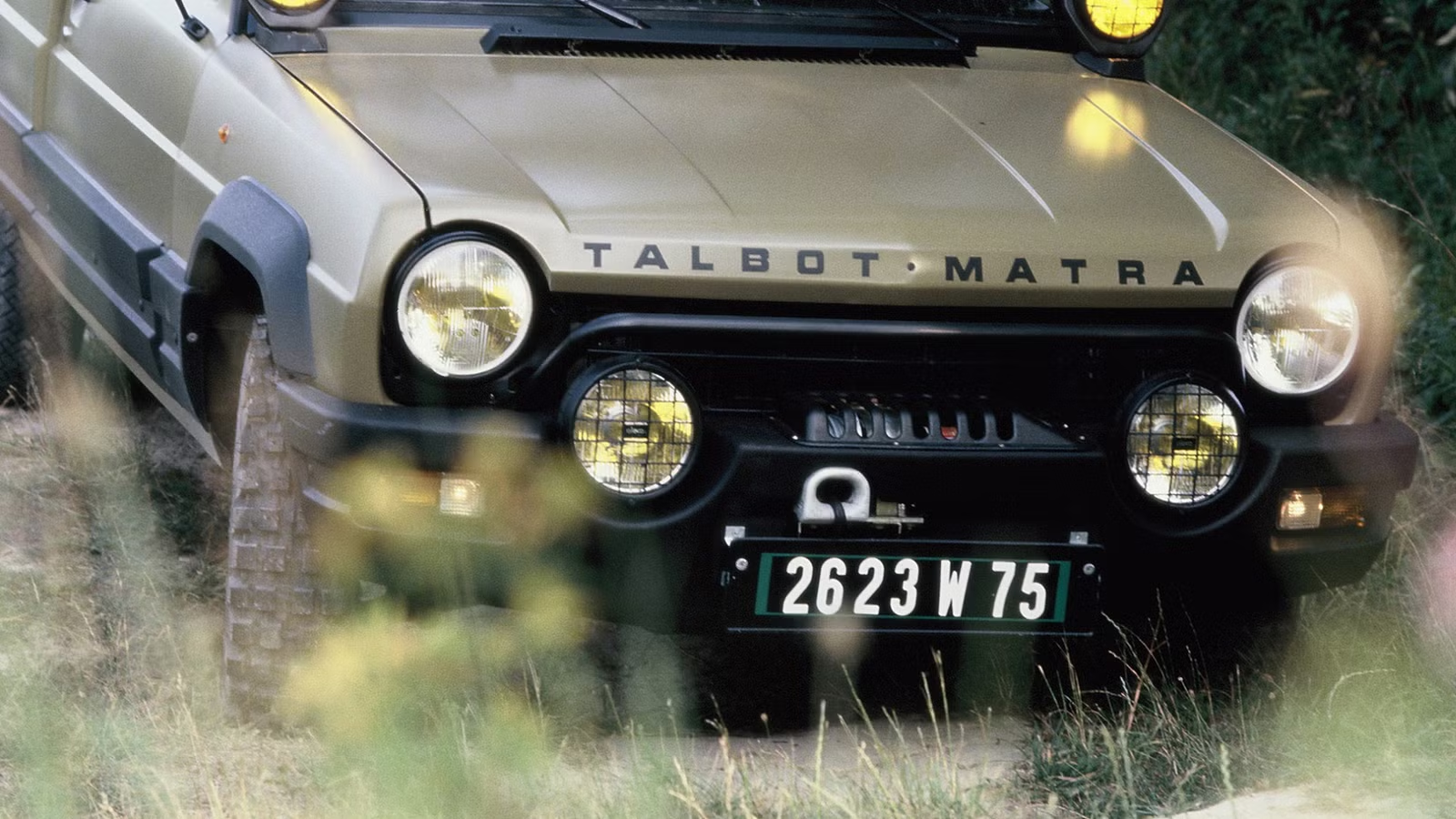
The body, meanwhile, acted as if nobody had told it about those limitations. Thick black plastic wrapped around the wheel arches and lower body. A roof rack sat above the cab. The rear roof stepped upward to create more interior height. Auxiliary lamps crowded the nose and scuttle, while a nudge bar added another dose of bush-country theater. Brilliant.
The Matra-Simca Rancho Was A Crossover Before The Term Even Existed

That machine was the Matra-Simca Rancho, introduced in 1977. French specialist Matra developed it under the project name P12 with mechanical help from Simca, then part of Chrysler Europe. Its roots lay in the Simca 1100 commercial family, commonly described through the VF2/VF3 pickup and van derivatives. Matra kept much of the front structure, doors, windshield, suspension layout, and front-wheel-drive architecture. It fitted the 1,442cc four-cylinder used in larger Simca and Chrysler models, good for about 80 hp, then built a longer and stronger rear structure. A steel frame supported large fiberglass and polyester body panels. The result looked almost unrelated to the humble work vehicle underneath, which was exactly the point.

Matra put most of its creativity behind the front seats. The tall rear body created a huge, glassy cabin, and the rear bench sat about four inches, or 10 centimeters, higher than the front seats. Rear passengers therefore gained a theater-style view of the road decades before stepped seating became common in SUVs and MPVs. Huge side windows made the cabin feel even larger, and a split tailgate echoed the Range Rover, while the roof rack helped disguise the abrupt jump in roof height. Buyers could even add a rear-facing third row, turning the Rancho into a seven-seater.
Calling the Rancho the undisputed first crossover creates more arguments than it settles. Earlier vehicles had already mixed passenger-car components with utility bodies, and crossover definitions become messy very quickly once historians start digging. The Rancho matters because it anticipated the later formula with unusual precision – it had car-derived, front-wheel-drive mechanicals, used SUV styling without matching SUV hardware, and offered more space and a higher seating environment than a normal family car. In addition, it cost far less than a premium four-wheel drive, and, most importantly, Matra sold it around leisure, image, and lifestyle rather than around towing a field gun through knee-deep mud.

The money explained why customers existed. When the Rancho reached Britain in 1978, period sources place its price at about £5,650 to £5,670. That was not bargain-basement money; a Volvo 245 DL wagon listed at around £5,357. Yet the Rancho still sat thousands of pounds below a Range Rover. Matra therefore gave buyers much of the visual impact and everyday utility for a far smaller bill. Performance remained modest, with roughly 80 hp moving around 2,500 pounds of French fiberglass, steel, glass, and optimism. But outright speed hardly mattered.
Nearly 58,000 Buyers Proved The Fake-Off-Roader Idea Wasn’t Fake At All

Matra openly admitted it did not expect the experiment to become a giant hit. Sources differ slightly on the original forecast, usually putting it around 20,000 to 25,000 vehicles. Production ultimately reached somewhere between about 56,000 and 58,000 Ranchos before the model disappeared in 1984. Customers effectively voted for the soft-roader concept with their wallets.
Whether a Rancho could follow a Range Rover through deep mud therefore misses the more interesting point. Most modern crossover owners also spend far more time on pavement than on axle-deep trails. They value easy entry, a commanding view, flexible cargo room, family-friendly packaging, comfort, and styling that feels more adventurous than a traditional hatchback or wagon. Four-wheel drive can help in poor weather, but many crossovers have long offered front-wheel-drive versions because a large part of the market does not need anything more. The Rancho exposed that split unusually early, and while critics saw a fake 4×4, buyers saw a useful vehicle that carried bikes, luggage, children, camping gear, or whatever else happened to be ruining the upholstery that weekend. Its so-called weakness was actually the business plan.

Almost two decades later, major Japanese manufacturers turned a similar set of priorities into a global segment. Toyota launched the first RAV4 in 1994 and openly describes it as a compact SUV built around a passenger-car approach. Honda followed with the CR-V in Japan in 1995, combining passenger-car-like road manners with a roomy cabin and marketing built around an active lifestyle. Those vehicles were more advanced, better engineered, and available with real four-wheel-drive systems, so the Rancho was no direct mechanical blueprint. The family resemblance lies in the product logic, where car-like behavior came first and SUV image and useful packaging came with it.
The Rancho’s Real Legacy Ended Up Reshaping Two Vehicle Segments

As Matra looked for a successor, president Philippe Guédon pushed toward an even more passenger-focused idea built around space, flexibility, and family use. Early projects used hardware connected to the Chrysler-Talbot world and explored a one-box, van-like shape with a roomy cabin. Peugeot had taken control of Chrysler’s troubled European operations in 1978, however, and the new owner faced limited money and plenty of problems of its own. Matra’s proposals failed to win approval at PSA, and the rejection forced the small company to look elsewhere for a partner. In hindsight, Peugeot passed on one of those ideas that became much more obvious after somebody else made it work.
Matra took the concept to Renault. Renault accepted it, development moved onto Renault hardware, and the project evolved into the Renault Espace, which reached the market in 1984. The finished Espace used a galvanized steel structure with composite exterior panels, extending Matra’s experience with unconventional construction. Early sales looked frighteningly weak, but the Espace eventually became a defining European MPV and helped establish the idea of the purpose-built family people carrier. The Rancho had led Matra toward another category that traditional automakers had not yet fully understood.

That makes the Rancho more important than its fake-off-roader jokes suggest. Its first lesson was that SUV image could sell without SUV mechanical complexity. Its second was that buyers would reward clever packaging when it made everyday life easier. One path points toward the crossover boom led by vehicles such as the RAV4 and CR-V. The other points toward the Espace and the European MPV.
Today’s crossovers are faster, safer, quieter, cleaner, and packed with technology that a 1977 Matra engineer would have treated as witchcraft. Many offer sophisticated all-wheel drive, too. Yet the sales pitch remains familiar – give a normal car more space, more stance, more attitude, and a little taste of adventure. Matra worked that out when disco was still new. The rest of the industry simply took a couple of decades to catch up.
Source: Matra, Simca, Renault, Chrysler

Related posts





Latest Post


No Comments