
BMW M2 Manual Take Rate: 50% of US Buyers Choose the Stick
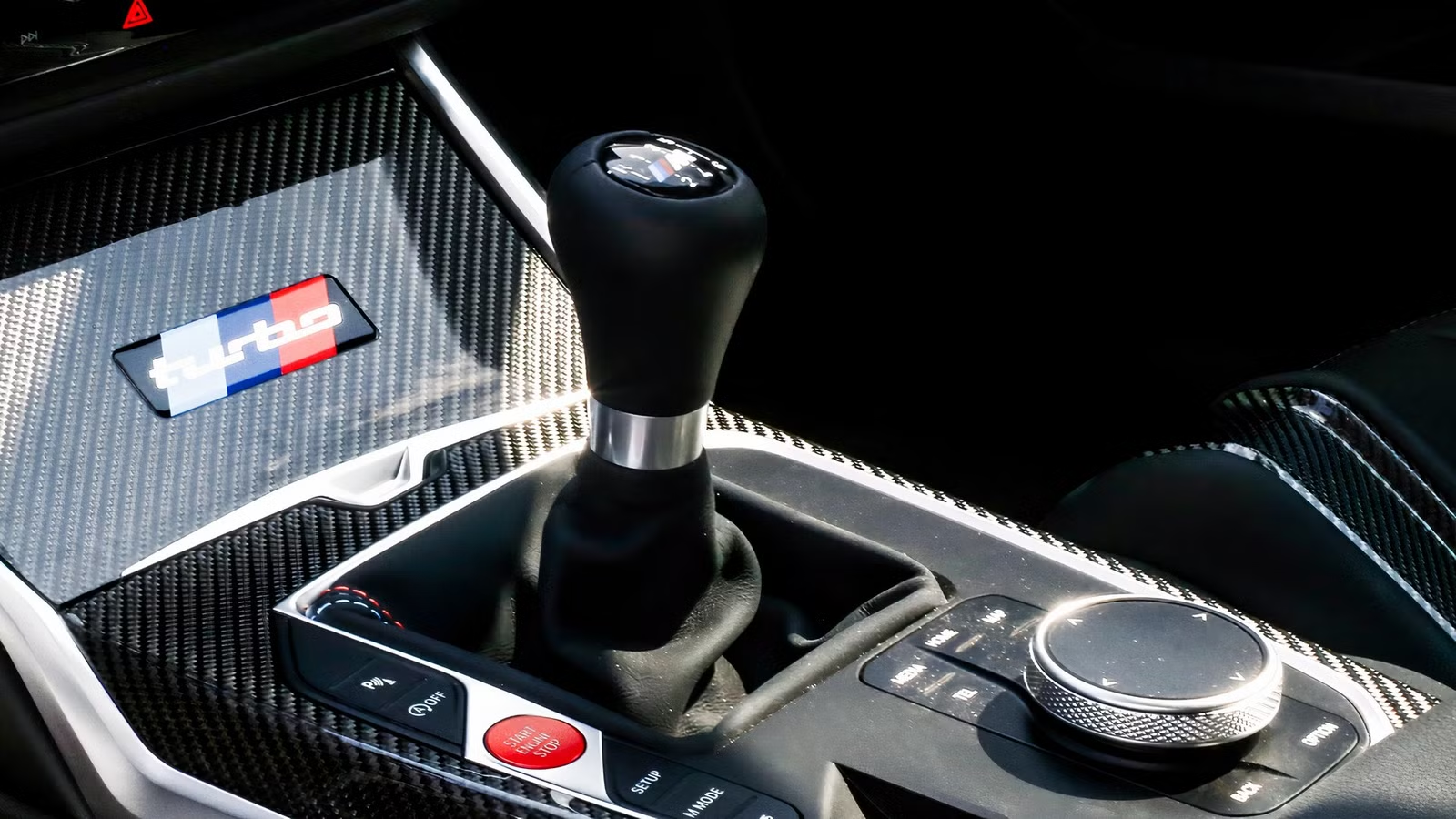
BMW M CEO Frank van Meel dropped a number this week that the manual transmission’s defenders have been waiting for years to cite: exactly half of all M2s sold in the United States are ordered with a six-speed manual gearbox. Not a niche sliver, not a regional curiosity — a dead-even 50/50 split on a $60,000-plus performance coupe. The kicker is that the eight-speed M Sport Steptronic automatic costs nothing extra and is objectively quicker off the line.

That data point matters well beyond BMW’s order sheets. At a moment when McLaren is reviving the manual for the MCL 6GT concept, Porsche is extending clutch-pedal availability deeper into the 911 lineup, and a wave of automakers have signaled manual commitments stretching into 2027 and beyond, van Meel’s figure gives the whole movement a hard business case to stand on. When half of wealthy, performance-focused buyers voluntarily choose the slower option at zero cost penalty, the bean-counters have a very difficult argument to make.
Van Meel’s Quote and What It Signals for the M Division
Speaking to Motor1, van Meel put it plainly: “especially in the U.S. the love for the manual transmission is enormous.” That’s not marketing copy — it’s a CEO explaining a production decision after the fact. The M2’s manual take rate was the direct justification BMW cited for building the M3 CS Handschalter, a limited-edition, six-speed-only M3 produced in “very limited numbers” exclusively for the U.S. and Canada. Van Meel noted that demand was “enormous” and the car was “practically sold out immediately.”

For context, most automakers consider a 10 percent manual take rate a success worth celebrating. A 50 percent split on a car where the automatic is free and faster isn’t just impressive — it’s the kind of data that rewrites internal conversations about product planning. BMW didn’t have to guess whether U.S. enthusiasts wanted a manual M3 CS. The M2’s order books told them.
The Handchalter Strategy and BMW’s Broader Manual Playbook

The M3 CS Handchalter isn’t an isolated experiment. BMW has been running a calculated playbook around limited-run manual models aimed squarely at the U.S. market. The M2 Turbo Design Edition was another manual-only limited-edition M-car built for American buyers. Before that, toward the end of the Z4’s production run, BMW launched the Z4 M40i Handchalter — a six-speed drop-top roadster that gave U.S. buyers one last chance at a manual Bimmer sports car with a fabric roof.
The pattern is deliberate. Rather than making the manual a costly add-on, BMW set the six-speed as the M2’s standard configuration and offered the automatic at no charge. That structure inverts the usual incentive, and the 50 percent take rate suggests it’s working exactly as intended — revealing genuine preference rather than price-driven compromise. The Handchalter badge, which translates roughly to “hand-shifter,” has become BMW M’s shorthand for a specific kind of driver.
Where BMW Manuals Actually Live in the Lineup

The enthusiasm is real, but the availability is narrow. Right now, the M2, M3 , and M4 are the only BMW models sold with a clutch pedal — and only in rear-wheel-drive configuration. Any buyer who wants xDrive all-wheel drive on an M3 or M4 must take the eight-speed automatic. The manual is strictly a rear-drive privilege.
That boundary is unlikely to expand into the broader BMW lineup anytime soon. Non-M 3 Series and 4 Series models haven’t offered a manual in years, and the M5‘s move to a plug-in hybrid powertrain effectively closed that door for good. The physics of integrating a conventional clutch with a hybrid drivetrain — particularly one where the electric motor lives inside the transmission, as on the 911 GTS T-Hybrid — present real engineering hurdles that even willing manufacturers are struggling to clear. For now, the M2 remains the most accessible entry point into a BMW with three pedals.
The Bigger Picture: Manual Momentum Heading Into 2027

BMW’s data lands in the middle of a broader industry moment. At Monterey Car Week just weeks ago, manual transmissions were the dominant conversation thread among supercar executives. Porsche announced it would bring the clutch pedal back to the 911 Carrera S in North America, with CEO Timo Reisch saying the company will “try to offer manual transmissions as long as we are legally allowed to, and as long as there’s customer demand” — and that demand is expected to last “well into the next decade.” McLaren unveiled the MCL 6GT concept with a conventional manual as its headline feature. Even Bugatti CEO Mate Rimac said he was “definitely” interested in a manual model, offering the tantalizing tease: “Imagine a V-16 with a manual.”
Not every brand is on board — Lamborghini and Czinger have both indicated manuals don’t fit their hybrid-heavy architectures — but the direction of travel among rear-drive, naturally aspirated or turbocharged performance cars is unmistakably toward more clutch pedals, not fewer. Van Meel’s 50 percent figure is the clearest market validation that movement has produced. Gearheads have been saying for years that they’d buy a manual if given the chance. The M2’s order books prove it.
The M3 CS Handchalter is already gone. But the M2 is still here, still available with a six-speed, and apparently selling that configuration at a rate that should keep BMW’s manual program funded for the foreseeable future. If you’ve been waiting for the industry to take the three-pedal crowd seriously, this is the data point worth bookmarking.

Related posts


Latest Post


No Comments