
The Forgotten Motorcycle With A Corvette Engine Under The Tank
Few engineering philosophies have shaped the automotive world quite like the relentless pursuit of excess. More displacement, more power, more torque, more speed — gearheads have always pushed toward the extreme, and there has never been a shortage of builders willing to meet them there. In the car world, that hunger is fed by performance sub-brands like AMG and dedicated tuning houses like Hennessey, Brabus, and Shelby, who take existing platforms and strip away the constraints that corporate ownership imposes. The results are machines that feel genuinely unhinged — and that’s exactly the point.

In the motorcycle world, extra-performance versions are usually provided by the brands themselves under the guise of homologation specials. However, there’s one brand that blurs the lines between cars and bikes, creating a bike around a V8 sports car engine, and making something devastatingly powerful in the process — truly honoring that “more” automotive mantra.
Motorcycles With Car Engines Aren’t A New Phenomenon
Van Veen OCR 1000
While rare, replacing a motorcycle engine with a car engine isn’t exactly unheard of. All the way back in the 1970s, Dutch company Van Veen had the idea of fitting a rotary engine into a motorcycle. The engine — a 1000cc twin-rotor Wankel unit — was originally developed by Comotor, a joint venture between NSU and Citroën, and was reportedly good for 100 hp.

The bike was produced in a very limited run of just 38 examples and cost $15,000 new in 1978. Between the exceedingly high price, poor press reviews, and the reliability issues inherent to rotary engines, it didn’t exactly fly out of showrooms, and it faded into near-total anonymity.
Millyard Viper V10

British engineer Allen Millyard has made some extraordinary bikes in his time. From the Tinker Toy — a 4.2-liter, 48-cylinder Kawasaki — to the Flying Millyard, which uses an aviation engine, he’s responsible for machines that arguably shouldn’t exist. The most relevant here is his Millyard Viper V10 — a hand-built, street-legal motorcycle powered by a 500-bhp, 8-liter Dodge Viper V10 engine, capable of exceeding 200 mph.
Millyard used the bike to set the fastest tandem motorcycle world speed record in 2023. With TV presenter Henry Cole on the back, the pair reached 183.5 mph.
Münch Mammut 2000

One of the stranger-looking bikes with a car engine, the German-engineered Münch Mammut 2000 housed a two-liter Opel EcoTech engine producing 260 hp, with an electronically limited top speed of 156 mph. Only 15 of the planned 250 bikes were officially built before Münch realized that production costs exceeded the retail price — cementing it as one of the most expensive and rare car-engined motorcycles ever made.
While many brands have tried and failed, there’s one company that made it their mission to take Corvette engines and mount them in motorcycles — and they’ve made a success of it for over 25 years.
Meet The Boss Hoss: A Corvette-Powered Chopper

The Boss Hoss was started by Monte Warne in 1990 with the goal of creating a bike with three to four times more horsepower than any other bike available.
He built that first bike for himself using a Chevy V8 engine pulled from a stock car and, after a successful showing at Daytona Bike Week, turned the project into a business.
The first bikes were somewhat primitive and crude, but they hinted at what was possible. A 1992 model — one of the first couple dozen to roll out of the factory — had a gas tank fabricated from two wide-body tanks split and welded together, creating a massive 8-gallon tank at a time when 5 gallons was considered large.

It was needed, though, as the V8 Chevy 350 crate motor the bike used wasn’t going to be easy on fuel. For comparison, cars fitted with the same engine at the time — like the Silverado — had 25-gallon tanks. Sure, there’s more weight in a truck, but these bikes are no lightweights either — you’re easily looking at over 1,000 lbs.
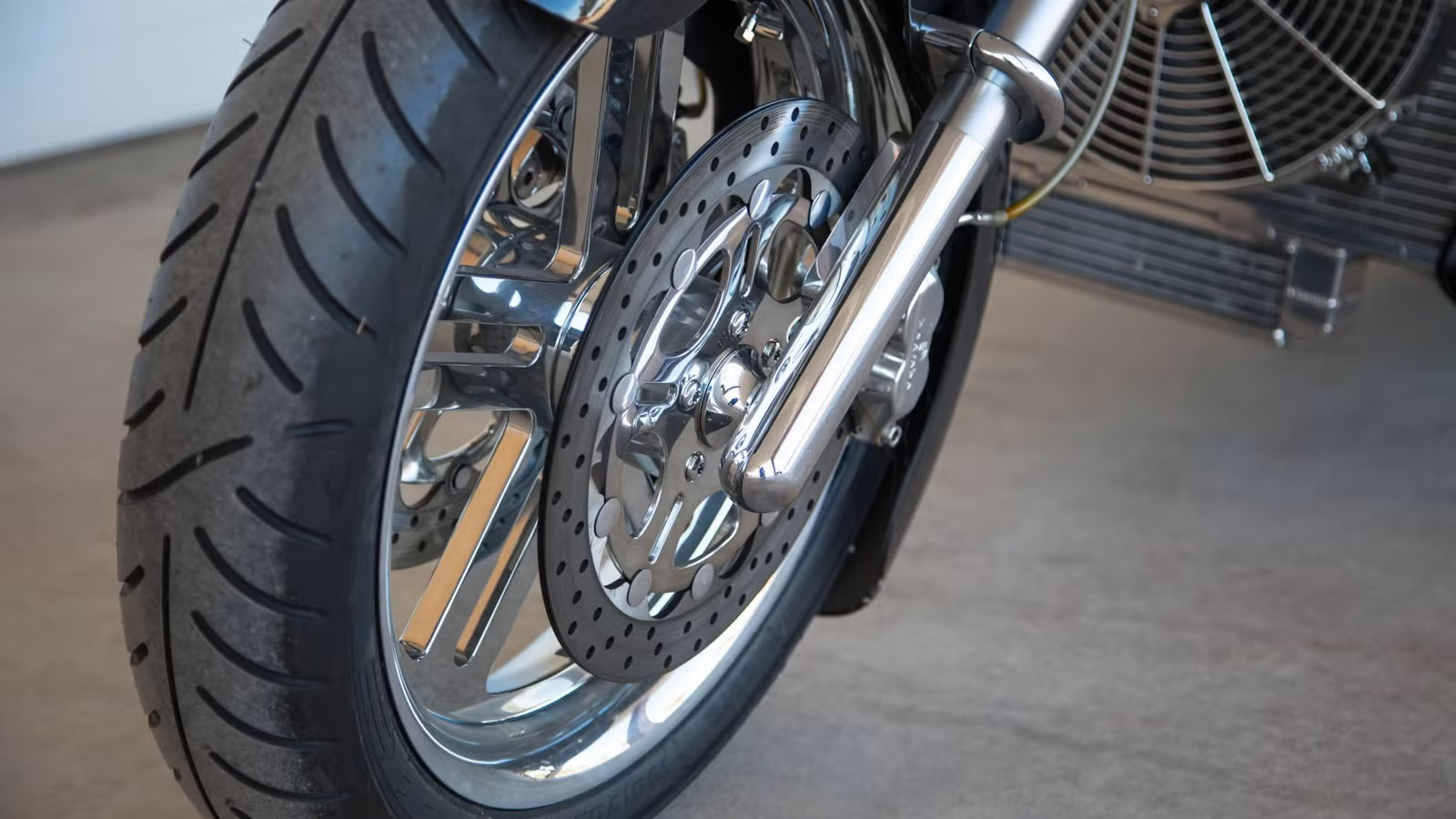
As you can imagine for a bike with such massive weight and power, finding motorcycle tires that could cope with all that heft was impossible. So they didn’t — they used a car tire on the rear instead.

Harley-Davidson parts were also repurposed, with the bike emulating the prototypical cruiser design. Far from being limited-run machines, there was instantly a market for the bikes — the company was selling 300 units per year by the mid-1990s.
From there, they iterated, adapted, and evolved from a radical engineering experiment into a genuine production company, manufacturing bikes for people who want the biggest machine on the block.
Boss Hoss BHC-3 ZZ4 SS

|
Price |
Power |
Torque |
Years |
|
$36,000 |
355 hp |
405 lb-ft |
1998–2002 |
By the late 1990s, Boss Hoss had evolved well beyond the original designs, making meaningful changes such as swapping the one-speed bikes for a two-speed automatic transmission, improving build quality, inverting the suspension to sharpen handling, and refining the overall package.
By 1998, the lineup had crystallized around the Boss Hoss BHC-3 ZZ4 SS — a 5.7-liter V8 producing 355 hp and 405 lb-ft of torque.
Boss Hoss Cruiser Bike

|
Starting Price |
Maximum Horsepower |
Maximum Torque |
Weight |
|
$70,995 |
600 hp |
568 lb-ft |
1,226 lbs wet |
One of the two main styles that Boss Hoss offers (alongside a range of trikes), the Cruiser comes with several engine options, including a 376 cubic inch GM LS3 — the same unit found in the Corvette — while the top-spec option is a 496 cubic inch Big Block engine pushing 600 hp.
With a dry weight of 1,100 lbs, a wet weight of 1,226 lbs, and an 80-inch wheelbase, it’s not the most maneuverable machine on the road, so the bike includes a reverse gear to help riders manage tight spots.
Boss Hoss Touring Bagger Bike

|
Starting Price |
Maximum Horsepower |
Maximum Torque |
|
$69,995 |
563 hp |
545 lb-ft |
If Harley-Davidsons are the King of the Baggers, this must be the Emperor. Like the Cruiser, it comes with multiple engine options, topping out just below the 496 ci Big Block at a 454 cubic inch Small Block. The Bagger also features a reverse gear — welcome given its even-larger 84-inch wheelbase — while the 43.5-inch width (courtesy of the rear panniers) means that even a Small Block engine doesn’t look out of place inside this behemoth.
Boss Hoss Continues The Search For “More”

The quest for “more” is one that can never truly be completed — it can only be temporarily satisfied. It has led to some of the greatest machines on the planet and keeps enthusiasts guessing about what the next iteration might bring.
At least, that would be the case for most situations. Sure, engines can get bigger, top speeds can climb higher, and power figures can keep rising — but to what end?
Boss Hoss was born from that pursuit of “more” and has chased it ever since — to the point of producing motorcycles with more power than a Porsche GT3 RS. What the future holds for the brand and its bikes remains to be seen, but it’s clear they’re far from alone in wanting to find out what the next iteration of “more” looks like.
Sources: Srkcycles, Yesterdays.nl, Boss Hoss Cycles Germany, Motorcycle Cruiser, Auto Evolution

Related posts

Latest Post


No Comments