
This 300-HP Lexus Sleeper Matched BMW Muscle Without The German Repair Bills
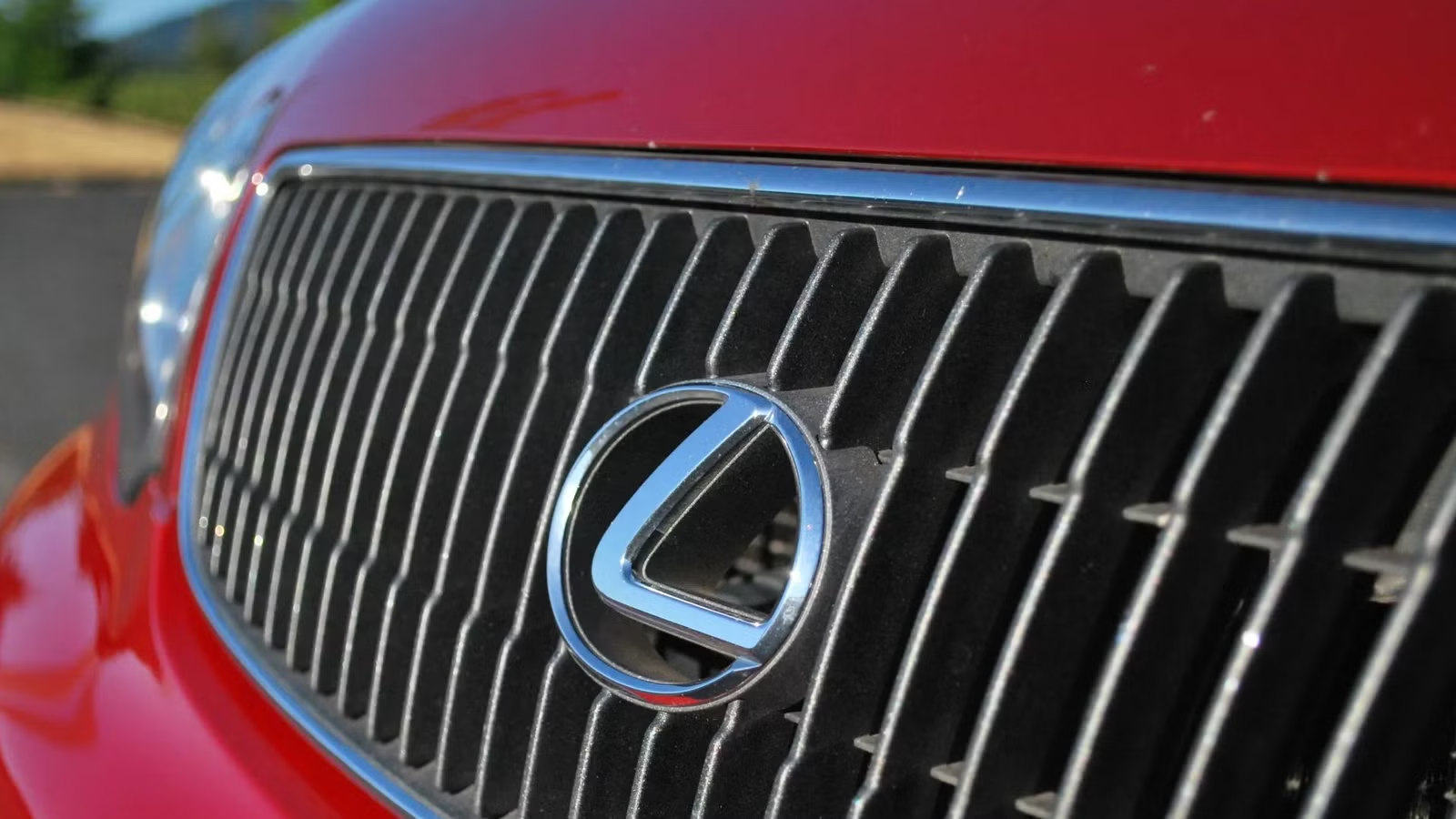
By the late 1990s, the luxury sports sedan had evolved into one of the automotive industry’s fiercest battlegrounds. Premium automakers were no longer competing solely on refinement, prestige, or comfort—straight-line performance had become just as important. Yet impressive acceleration figures alone weren’t enough to win enthusiast approval. Reputation increasingly depended on something less tangible: how a car made its driver feel. Amid that landscape, one Japanese luxury sedan quietly produced performance numbers comparable to the benchmark BMW 540i, yet never earned the same reputation. Its greatest disadvantage wasn’t found beneath the hood or within its chassis, but somewhere far less mechanical.
The BMW 540i Became The Benchmark For Every V8 Sport Sedan

By the time the E39-generation BMW 540i arrived, BMW had already established itself as the benchmark for building sports sedans that balanced luxury with genuine driver involvement. The 540i refined that formula further by combining a smooth, naturally aspirated V8 with a chassis that felt equally comfortable on a winding back road and a long-distance highway journey. It wasn’t the fastest executive sedan of its era, nor the most powerful, but it delivered an experience that felt complete in a way few rivals managed.
Much of that reputation stemmed from BMW’s decision to offer the 540i with a six-speed manual transmission. At a time when luxury manufacturers were increasingly steering buyers toward sophisticated automatic gearboxes, BMW continued to cater to enthusiasts who valued direct mechanical engagement above outright convenience. The manual-equipped 540i became more than just another drivetrain option—it became central to the car’s identity and helped cement its status as the driver’s choice within the segment.

That timing proved significant because enthusiast culture increasingly equated three pedals with authenticity. Automotive publications praised manual transmissions for the greater sense of involvement they provided, while buyers often viewed them as proof that a manufacturer genuinely prioritized the driving experience. Automatic transmissions had become smoother, more intelligent, and, in many situations, equally capable, but public perception hadn’t evolved at the same pace.

As a result, any rival hoping to challenge the BMW faced an obstacle extending well beyond measurable performance. Matching its acceleration or handling would not automatically earn the same respect if enthusiasts believed the driving experience itself was compromised. It was against this backdrop that another luxury manufacturer quietly pursued a fundamentally different vision for the modern performance sedan.
One Luxury Automaker Refused To Copy BMW’s Formula

While much of the segment increasingly embraced the formula that had made German performance sedans so desirable, one manufacturer chose not to chase driver involvement in exactly the same way. Instead of building a car that demanded constant interaction, its engineers focused on delivering effortless performance, exceptional refinement, and the kind of long-term durability that had already become a defining strength of the brand. The objective wasn’t to imitate the benchmark—it was to prove there was another path to building a genuinely capable luxury performance sedan.
That philosophy shaped the development of a new rear-wheel-drive executive sedan that represented a significant departure from its predecessor. Engineers strengthened the chassis, refined the suspension, sharpened steering response, and improved overall body control, but resisted sacrificing ride quality simply to create a harsher, more aggressive character. The goal remained balance rather than extremity, ensuring the car retained the comfort expected of a premium luxury sedan while becoming noticeably more rewarding to drive.

The same thinking extended beneath the hood. Rather than chasing peak horsepower figures alone, engineers concentrated on creating a V8 that delivered broad, effortless torque, exceptional smoothness, and dependable performance over hundreds of thousands of miles. Variable Valve Timing with intelligence (VVT-i) broadened the engine’s operating range, while careful calibration prioritized immediate real-world response instead of requiring constant high-rev driving to access meaningful performance. The result reflected an engineering philosophy that valued usable speed over dramatic theater.
That approach ultimately produced a luxury sedan capable of matching the segment’s established benchmark where objective performance was concerned—even if it arrived there through an entirely different philosophy.
The Lexus GS 400 Quietly Produced BMW 540i Numbers

That sedan was the Lexus GS 400, introduced as the flagship performance model of the second-generation GS lineup. Rather than attempting to replicate BMW’s character, Lexus developed the GS 400 to demonstrate that effortless refinement and genuine performance could coexist without compromise. It wasn’t designed to become a track-focused sports sedan or a luxury car with a larger engine. Instead, it embodied Lexus’s belief that engineering sophistication could deliver competitive performance while remaining unmistakably Lexus.
Power came from a revised 4.0-liter 1UZ-FE V8 equipped with VVT-i, producing 300 horsepower and 310 lb-ft of torque. Paired exclusively with a five-speed electronically controlled automatic transmission driving the rear wheels, the GS 400 recorded 0–60 mph times ranging from approximately 5.7 to 6.0 seconds in contemporary road tests, depending on the publication. Those figures placed it directly alongside the BMW 540i and Mercedes-Benz E420/E430, proving that Lexus had achieved genuine parity where straight-line performance was concerned.

The engine’s character mattered just as much as its headline figures. With roughly 80 percent of its peak torque available from just 1,800 rpm, the revised 1UZ-FE delivered immediate, seamless acceleration across almost the entire rev range. Rather than encouraging drivers to chase redlines, it produced effortless thrust whether pulling away from traffic lights, merging onto a highway, or overtaking slower vehicles. That broad torque delivery perfectly reflected Lexus’ grand touring philosophy, making the GS 400 feel consistently responsive without demanding constant driver effort.
The industry’s recognition of the 1UZ-FE reinforced that engineering achievement. The V8 earned repeated praise for combining refinement, performance, and durability, including recognition through Ward’s 10 Best Engines program during the GS 400’s production period. It demonstrated that Lexus hadn’t simply built a reliable luxury engine—it had created one of the most sophisticated V8 powerplants of its era. On paper and on the road, the GS 400 had achieved exactly what it set out to do: produce performance capable of running with the BMW 540i through engineering rather than imitation.
One Missing Pedal Changed The Way Enthusiasts Remembered It

Despite matching the BMW 540i in outright performance, the GS 400 never achieved the same standing among driving enthusiasts. The reason had little to do with horsepower, acceleration, or chassis capability. Instead, it came down to a single product decision that shaped public perception from the moment the car arrived in showrooms.
Unlike the BMW 540i, which offered buyers the option of a six-speed manual transmission, the GS 400 was available exclusively with a five-speed electronically controlled automatic. Lexus engineered the transmission to prioritize smoothness and refinement, while its E-Shift manual mode allowed drivers to select gears sequentially. For everyday driving, it was quick, unobtrusive, and well matched to the V8’s broad torque curve. But to enthusiasts accustomed to equating manual gearboxes with driver involvement, it wasn’t enough.

Period road tests reflected that contrast. Reviewers consistently praised the GS 400’s composure, effortless power delivery, and remarkable refinement, often acknowledging that it could match or closely trail the BMW in objective performance testing. Yet when discussions turned to driver engagement, the conversation almost inevitably returned to the BMW’s manual transmission. The ability to choose gears manually with a clutch pedal created a stronger emotional connection, even if it offered little measurable advantage in day-to-day performance.
That distinction ultimately shaped how both cars were remembered. The BMW became the enthusiast’s benchmark because it delivered not only speed, but also a level of interaction that buyers associated with a true driver’s car. The Lexus, meanwhile, was viewed as the more mature and refined alternative—a car that achieved similar results through engineering sophistication rather than mechanical theater. In hindsight, its reputation was influenced less by what it could do than by what it chose not to offer.
The GS 400 Makes More Sense Today Than It Did In 1998

Viewed through a modern lens, the GS 400’s philosophy appears surprisingly forward-thinking. Today’s high-performance luxury sedans are almost exclusively equipped with sophisticated automatic transmissions, while smooth, effortless torque delivery has become a defining characteristic of the segment. The qualities that once led some enthusiasts to dismiss the Lexus have since become accepted as the industry standard.
Its naturally aspirated 1UZ-FE V8 has also earned a reputation for exceptional durability, with numerous examples covering high mileage while retaining the refinement that made the engine so impressive when new. Combined with conservative styling, solid build quality, and a well-balanced rear-wheel-drive platform, the GS 400 has become increasingly appreciated by enthusiasts seeking an understated performance sedan that can still be driven and enjoyed without constant mechanical attention.

Perhaps more importantly, time has shifted the conversation away from what the GS 400 lacked and toward what it accomplished. Rather than attempting to imitate BMW’s formula, Lexus proved there was another way to build a compelling performance sedan—one that prioritized seamless power delivery, engineering refinement, and everyday usability without sacrificing genuine pace. That philosophy may not have generated the same enthusiast mythology as the manual-equipped 540i, but it produced a car that has aged with remarkable dignity.
The GS 400 was never remembered as loudly as its German rival, yet history suggests it deserved greater recognition. It demonstrated that matching the benchmark didn’t require copying it, and that intelligent engineering could be just as effective as chasing the traditional enthusiast playbook. Its legacy is therefore defined not by the transmission it never offered, but by how convincingly it proved there was more than one route to building a great V8 sport sedan. Currently, examples trade in the range of $7,000 to $11,500 on the used market.
Sources: Lexus Pressroom and Heritage, Toyota Global

Related posts





Latest Post


No Comments