
The British Motorcycle Maker That Owned 1 In 4 Bikes Sold Worldwide
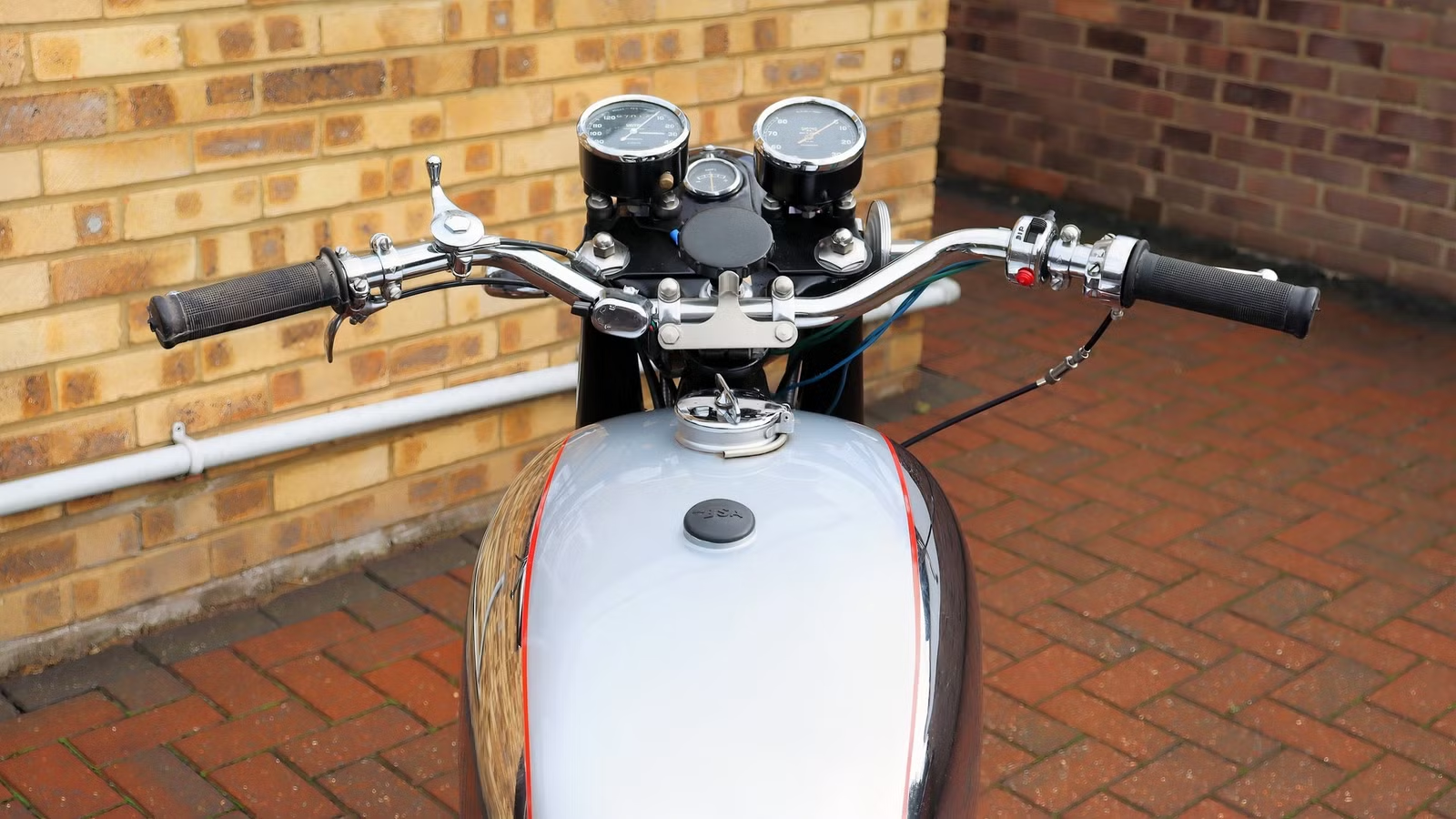
Before its downfall in the seventies, the British motorcycling industry delivered some of the best performance-focused bikes you could get your hands on. Models like the Triumph Bonneville and Norton Commando were all the rage during the sixties, while the more exclusive, highly coveted Vincent Black Shadow had been pushing the performance envelope as far back as 1948. Then there were those legendary Norton Manx race bikes, the later triple-cylinder BSA Rocket 3 and its rebadged Triumph Trident sibling, just to name a few. So, if you wanted to go fast on two wheels before Japan’s big fours rolled around, you would have most likely ridden something from Britain.
A Closer Look At BSA

BSA’s story is particularly interesting, because the company had once been an outright industry leader going from strength to strength. It actually started out as a small arms manufacturer all the way back in 1861, though, hence the acronym which stands for Birmingham Small Arms. And it wasn’t until 1903 that BSA established a motorcycle division, whose very first model debuted in 1910 right as the parent firm went on to acquire the Daimler Motor Company (not to be confused with the German automaker). Then came the First World War and BSA’s priorities shifted toward supporting the British Army, but its expansion resumed once the conflict ended.
Notably, BSA bought the Lanchester Motor Company in 1931 to bolster its presence on the automotive segment, while also ramping up its motorcycle production with models like the Blue Star and Empire Star. The Gold Star — nowadays remembered as the manufacturer’s most famous bike — made its debut in 1938, but production was halted the following year as the continent descended into chaos yet again. During WWII, BSA supported Britain’s war effort with munitions, Browning machine guns for Spitfire fighter planes and more than 125,000 service motorcycles. The post-war years saw the company rising to its absolute peak, and the legendary Gold Star nameplate returned fully updated in 1949.

The Honda Cruiser That Made Harley-Davidson Sweat In The 1980s
Harley-Davidson may rule the cruiser segment, but its not uncontested. In the ’80s, Honda made the giant bleed.
The 1950s Were BSA’s Golden Years

Come 1951, it was Triumph’s turn to be brought under BSA’s growing umbrella, and times were good for both the Birmingham manufacturer and the British motorcycle industry as a whole. The company was in a perfect position to take advantage of the post-WWII boom, when people’s need for cheap transportation skyrocketed and machines such as the A7, A10 or Bantam were right there to give them what they wanted. BSA ultimately became the world’s biggest motorcycle manufacturer during the fifties, with its badge worn by one in four bikes sold globally at the time. That kind of market share is virtually unfathomable today, so it’s difficult to comprehend how it all came crashing down just two decades later. Let’s focus on the good times for now, though.
The Fabled Gold Star Led The Charge

BSA’s flagship earned its name from racing, with Wal Handley clocking an average speed of 107.57 mph during one lap at the Brooklands circuit in 1937 and 102.27 mph over the entire race. He finished in first place with a modded Empire Star and was subsequently awarded the gold star pin, which went to participants averaging over 100 mph. The following year, BSA commemorated the occasion with what would become its best-known model, and the Gold Star nameplate was officially born. In its pre-war iteration (codenamed M24), the bike was powered by a 496cc single and produced in extremely limited quantities, with just 564 units said to have been built before the start of the Second World War.
Then, upon its return in 1949, the Gold Star could be had with your choice of a 350cc or 500cc single-cylinder engine. These thumpers were hand-built to each customer’s specification with a wide array of options as far as engine internals were concerned, so one Goldie (as the model was affectionately nicknamed) could potentially be very different from the next. Either way, the absolute pinnacle of the Gold Star lineup was the DBD34 Clubman, which came out in 1956 kitted with a 499cc OHV single. The motor had a little over 40 horsepower on tap, and buyers often had it paired with an RRT2 close-ratio gearbox. Top speed was rated at around 110 mph, making the DBD34 one of the fastest production singles in existence at the time.
BSA Gold Star DBD34 Specifications
|
Engine |
Air-Cooled OHV Single-Cylinder |
|
Displacement |
499cc |
|
Transmission |
4-Speed Close-Ratio |
|
Horsepower |
~40–42 HP |
|
Top Speed |
110 MPH |
The fabled Gold Star stayed in production until 1963, by then representing the ultimate expression of the British single. Even before the DBD34, Goldies were absolutely killing it on the racetrack to the point where an entire racing class was rendered uncompetitive. We’re talking about the Junior and Senior Clubman’s TT at Isle of Man, where the Gold Star’s dominance effectively made the whole thing pointless by 1955. The divisions were scrapped thereafter, and the final 350cc Junior event saw as many as 33 out of 37 riders on BSA Gold Stars. But, believe it or not, the model’s success was something of a double-edged sword, because it made the company pretty much blind to the storm clouds gathering on the horizon.
The First Superbike To Break 150 Horsepower
In 1998, Yamaha built a motorcycle that rewrote every assumption about what a production superbike could do. The industry spent years catching up.
An Autopsy Of BSA’s Downfall

The swift decline of Britain’s motorcycle industry is often attributed to the technologically superior machines from Japan flooding Western markets, with Honda’s revolutionary CB750 in the lead. Yet the truth is a bit more nuanced, as the Japanese takeover of the seventies was more like the final nail in the coffin rather than being solely responsible for the collapse. British manufacturers had many issues hiding under the surface, and they weren’t exactly quick to streamline manufacturing or adopt new technologies. Designs were outdated and management was complacent, leaving brands like BSA fully exposed to the onslaught initiated by the CB750 in 1969 and dialed up by later models such as the Kawasaki Z1.
Even direct government intervention and the Norton Villiers Triumph (NVT) merger of 1973 couldn’t save them, especially after BSA’s massive £3 million trading loss two years earlier. The Birmingham firm ceased production in the summer of ‘73, and NVT ultimately failed to protect its constituents from bankruptcy. With that came the end of British dominance over the performance motorcycle segment, making room for Japan’s Big Four to bring it into a new era. The whole series of events stands as a cautionary tale of what can happen when companies fail to innovate and evolve over time, even if it seems like the good times will never end. But BSA isn’t altogether dead nowadays.
Legacy And Revival

Much like Royal Enfield, the brand was resurrected as a subsidiary of an Indian firm named the Mahindra Group, and a modern version of the beloved Gold Star was launched in 2021. It seems perfectly positioned to ride the wave of the current modern classic trend, so the public’s response has been rather positive so far. Pricing for the model-year 2026 starts at just $7,695 in the States, making the new Goldie a solid retro pick that won’t drain your bank account. On the other hand, a DBD34 in good shape could fetch well over $20,000 at auction, while the highest recent sale of a pre-war M24 variant commanded a whopping $37,305 according to Hagerty. Clearly, such a precious piece of British motorcycling history doesn’t come cheap; not when it came to represent vintage single-cylinder tech at its peak!
Sources: BSA, Hagerty, Bring a Trailer, H&H Classics, Mecum

Related posts
Latest Post


No Comments