The Forgotten Sports Car That Deserves A Second Look
9 minutes reading
Monday, 7 Sep 2026 00:15 0 34 autotech
Some sports cars deserve to be forgotten. Either they are unreliable, didn’t quite deliver the performance they promised, or just look like they should never have made it off the design sheets. Then there are the sports cars that don’t deserve to be hidden away because of a lack of nostalgia surrounding them or because something a little more powerful turned up. This turbocharged 2000s American sports car made by Pontiac is one that shouldn’t be forgotten any longer.
Not every good sports car gets the attention it deserves. Some arrive when we are looking elsewhere, while others come from brands that don’t have the pull of Porsche, Ferrari, or Chevy. Think of the original Alpine A110: it is small and light, and was built with an engine that ranges up to 1.8 liters and kicks out 185 horsepower. It was never hugely powerful, but it made the most of its light weight and tuned handling. In the ’70s, it did exceptionally well in the WRC, but it did not sell in huge numbers.
Only roughly 8,100 units were ever sold. Alpine was a small brand and the A110 was never going to have the reach of a Porsche 911 or a Corvette. However, its combination of low weight, rear-engine traction, and sharp handling make it a proper driver’s car. Not all the best sports cars need to have huge horsepower or a well-known badge on the front to be good.
Low Production Numbers Can Make Great Cars Easy To Forget
Front 3/4 shot of 1992 Venturi 400 Trophy parkedBring A Trailer
The Fiat Coupe is a good example of a sports car that had plenty going for it but never became a major name. Co-designed with Pininfarina, it looked unlike most other European sports cars of the time. Later models of the 20V Turbo have a 2.0-liter five-cylinder with 220 horsepower under the hood, and it could hit 60 mph in around 6.5 seconds. It was quick for its class, distinctive, and relatively affordable, but the lack of badge appeal got the better of its legacy.
The same goes for the ’92 Venturi 400 Trophy. Built for Venturi’s one-make racing series, it has a bi-turbo V6 that shifts out around 400 horsepower and was built in collector-grade numbers. It was a heck of a sports car, but the memory of it has, for the most part, faded. Obviously, this is due to not many people getting to experience driving one when it was made, but then again, not many people have driven a Ferrari 250 GTO.
The Pontiac Solstice GXP Has The Hardware To Be Taken Seriously
Front 3/4 shot of 2007 Pontiac Solstice GXP parkedBring A Trailer
A combination of low production numbers and lack of recognition in the face of the likes of Porsche and Chevrolet has resulted in the same fate for the Pontiac Solstice GXP (and its sibling, the Saturn Sky Red Line). The Solstice only saw production between 2006 and 2010, but the Solstice GXP only saw production between 2007 and 2009.
The standard Pontiac Solstice saw roughly 52,200 units made, which includes a small run of 485 coupes. The GXP only saw 12,219 GXP Roadsters and 781 GXP Coupes made. We can see why they have been forgotten, especially when you consider that the MX-5 has seen over 450,000 units made for the U.S. market alone.
A Turbocharged Four-Cylinder Good For 260 Horsepower
Shot of 2007 Pontiac Solstice GXP engine bayBring A Trailer
The thing is, the GXP shouldn’t be forgotten, chiefly, because it gets a 2.0-liter LNF Ecotec inline-four mated to either a five-speed manual or five-speed automatic transmission, with noise exiting through dual-exhaust outlets. Horsepower is stout at 260 at 5,300 rpm, while torque is just where you want it, at 260 pound-foot at 2,500 rpm.Originally, GM also offered upgrades that resulted in 290 horsepower and 350 pound-feet of torque.
The standard Solstice gets a naturally aspirated inline-four, but is rated far lower at 177 horsepower at 6,600 rpm and 166 pound-foot at 4,800 rpm. So, the limited-run GXP is far more convincing as a quick sports car.
Rear-Wheel Drive And A Lightweight Body Made It A Proper Driver’s Car
Profile shot of 2009 Pontiac Solstice GXP parkedBring A Trailer
The turbocharged Solstice tips the scales at around 2,950 pounds, so just lighter than a 2009 Audi TT, and around the same weight as the 2009 Cayman S. Its light weight and non-upgraded turbo-four translate to impressive 0–60 mph times of 5.2 seconds in the coupe, and 5.6 seconds in the roadster. The standard Solstice takes 7.2 seconds to get to speed, while something like the base-trim FWD 2009 TT needs 6.4 seconds to get to 60 mph, and even the Quattro, V6-equipped 2009 TT needs 5.7 seconds.
While a lot of sports cars are now AWD, the Solstice GXP’s rear-wheel drive setup also suits those of us who like driving-driving. It was designed so you could feel the rear tires pushing the car out of a corner rather than the front end doing all the work. Add in a low ground clearance of 4.3 to five inches and a light body, and there is simply less car to slow down, turn, and change direction. The specs make a compelling case on paper — but specs alone don’t make a driver’s car. What owners actually say about living with and driving the GXP is what separates it from being a forgotten footnote.
What Owners Who’ve Actually Driven One Say About The GXP
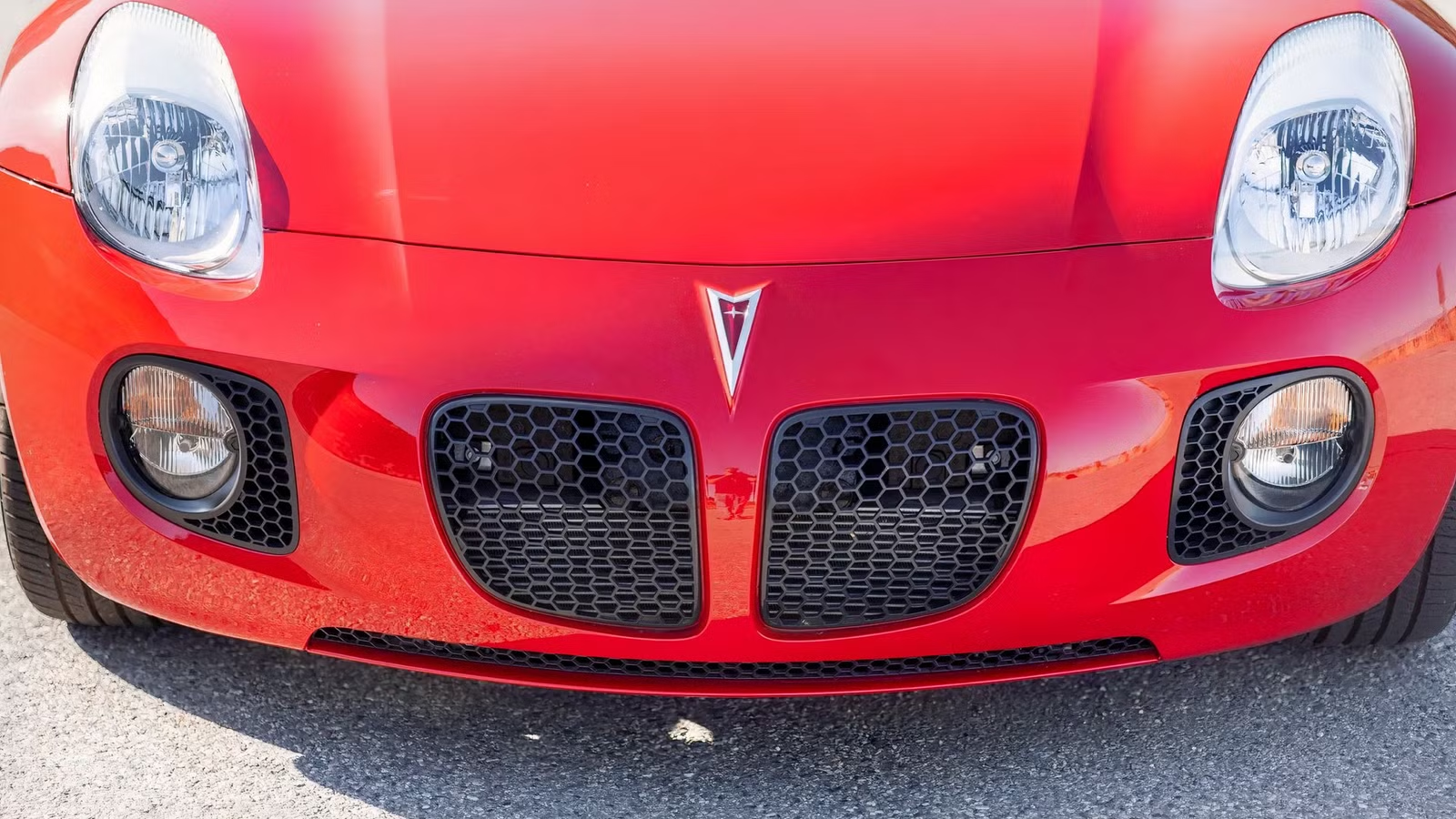
Close-up front 3/4 shot of 2009 Pontiac Solstice GXP parkedBring A Trailer
If you are a fan of American sports cars with a long hood, short deck, molded front ends, sloping roof on the coupe, and nicely muscular wheel arches, something like the Solstice GXP should get your attention.
It almost has a Japanese sports car look about it compared to other American models of the era (think the Viper SRT10 and Corvette), with short overhangs and small proportions, and today, there is little on the road that looks quite like it. That’s not where it ends, though; people who have owned one not only love the look of them, but also love driving them.
Sharp Handling Gives It The Credibility To Match Its Styling
Rear 3/4 shot of 2007 Pontiac Solstice GXP parkedBring A Trailer
Owners who have left a review on Kelley Blue Book rate the 2007–2009 Solstice (which includes the GXP) 4.6 out of 5 overall, with ratings of 4.7 out of 5 for performance and 4.8 out of 5 for styling. There are currently (September 2026) 298 owner reviews, and 98 percent of them say they’d recommend one.
Alongside the turbo-four and RWD rig, the GXP’s chassis got a good amount of road-fun attention as well. Pontiac fitted Bilstein monotube dampers, 20 percent firmer springs, larger anti-roll bars, and stiffer bushings than the regular Solstice models. It also gets 18-inch Eagle F1 tires (originally) for plenty of grip, hydraulic power steering, and an independent suspension setup to keep it settled but engaged on winding roads, which is exactly the kind of driving this two-seater is made for. One owner who left a review of a 2009 model on Kelley Blue Book puts it nicely.
It handles better than any car I’ve driven, even a BMW. The ride isn’t really smooth but it corners on these mountain roads like no other.
Why The GXP’s Small Footprint And Manual Gearbox Make It Feel Like A Modern Driver’s Car
Shot of 2009 Pontiac Solstice GXP cabinBring A Trailer
The Solstice GXP only measures in at 157.2 inches in length by 71.3 inches in width, and rides on a 95.1-inch wheelbase. It also has a 60.7-inch front track and 61.4-inch rear track. So, it is a pretty small car by modern standards, and you can feel that from behind the wheel. The short body and wide stance are designed to make it feel easy to place on the road, while having the wheels pushed out toward the corners gives you a better sense of where it starts and ends. It is, really, what you want from an engaging sports car from the 2000s.
Then there is the manual transmission option, something that is generally lacking in modern offerings. The GXP comes equipped with an Aisin five-speed manual, which Pontiac originally described as having short throws. It would be a lie to call it the slickest manual gearbox ever made, but the ratios work well with the turbo-four, including a 3.75:1 first gear and 3.73:1 final drive. You have to work the gears yourself, and for anyone who misses that kind of engagement, the GXP is built for it.
At $16,500 Average Auction Price, The GXP’s Flaws Are Easy To Forgive
Front 3/4 shot of 2007 Pontiac Solstice GXP parkedBring A Trailer
2009 Pontiac Solstice GXP, engineBring A Trailer
There are some very good reasons why the Solstice GXP has been forgotten: Pontiac disappeared almost immediately after the final units were rolled out, models like the MX-5 were continuing their dominance in the well-priced two-seater market, the GXP never had any real time to establish itself, and it did have some foibles. These foibles include poor driver visibility (thanks to thick rear pillars and bulky rear haunches), some reported drivetrain racket, and a general lack of refinement. However, for a seldom-seen and still head-turning American sports car, it deserves another look.
Today, Classic.com says the average auction price of a Solstice GXP is just $16,561, with the highest price fetched at auction being $33,300. The good news for used sports car buyers is that the Classic.com Benchmark price is, at time of writing, down to $18,208 and dropping. At current prices, the Solstice GXP’s combination of performance, old-school build, rarity, and character makes it difficult to dismiss, even with its downsides and despite being largely forgotten.
Base Trim Engine
2.4L 4 Cylinder Gas
Base Trim Transmission
5-Speed Manual
Base Trim Drivetrain
Rear-Wheel Drive
Base Trim Horsepower
173 hp
Base Trim Torque
167 lb-ft @ 4500 rpm
Fuel Economy
19/25 MPG
Make
Pontiac
Model
Solstice Coupe
Segment
Sports Car
Sources: Bring A Trailer, Classic.com, and Kelley Blue Book.










No Comments