
Ford Built a Mid-Engine Corvette Killer in 1962 Then Buried It
On October 7, 1962, the United States Grand Prix brought Formula 1’s world championship to Watkins Glen, New York, and thousands of race fans filled the grandstands. Between the weekend’s sessions, a Ford transport trailer rolled into the paddock carrying something Detroit had never shown in public.

A tiny aluminum roadster came down the ramp, and Formula 1 driver Dan Gurney climbed aboard to run demonstration laps at over 100 mph. The car worked, the crowd cheered, and Ford shelved it anyway, leaving a question America wouldn’t answer for another 58 years.
Dan Gurney Showed An F1 Crowd Detroit’s Future At Watkins Glen
Ford had partnered with the managers of Watkins Glen since the track’s first Formula 1 race in 1961, and the company treated the Grand Prix weekend as a publicity stage. The 1962 event offered something no auto show could match: a real road course, a crowd of committed racing fans, and one of the world’s best drivers ready to put on a show.

Gurney ran the little roadster through non-competitive demonstration laps at over 100 mph, and some accounts put his speed closer to 120 mph. That was quick enough to make the point in front of people who watched Grand Prix machinery for a living.

The prototype also led the Drivers’ Parade of Honor, rolling ahead of a procession of Ford Galaxies carrying Formula 1 drivers from around the world. Sir Stirling Moss served as the race’s honorary starter that weekend, which meant Formula 1 royalty surrounded a Dearborn experiment, and the experiment held its own.
Reporters left convinced that Ford was preparing a rival for the Chevrolet Corvette. What they had seen was not a styling model on a turntable but a running car with genuine pace, driven hard in public by a Grand Prix winner.
A non-functional Chevrolet styling exercise sat ignored at the same event while Ford’s prototype circulated the track. One company had brought a sculpture, and the other had brought a sports car.
The Original Mustang Was A Mid-Engine Featherweight Sports Car

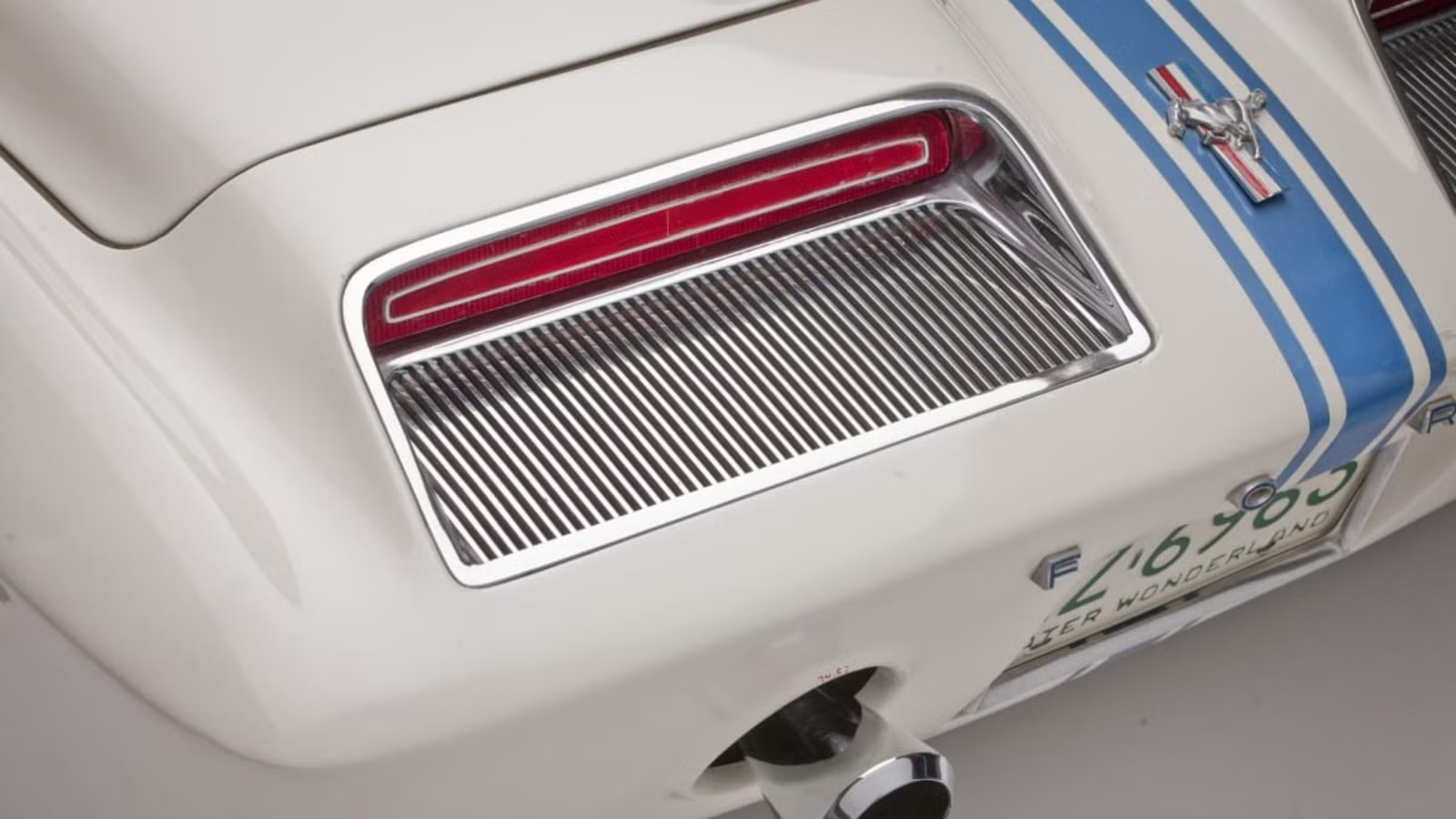
The car was the Ford Mustang I, a mid-engine two-seat roadster and the first vehicle ever to wear the Mustang name. Its galloping-horse emblem, created by designer Phil Clark, would carry over to the pony car that made the badge famous, but almost nothing else on the car did.
Behind the cockpit sat a 1.5-liter 60-degree V4 (half a V8) driving the rear wheels through a four-speed transaxle. The engine produced 89 hp in street tune and up to 109 hp in race specification.

A welded tube space frame carried a hand-formed aluminum body that stretched just 154 inches on a 90-inch wheelbase, with the roll bar standing roughly 40 inches off the ground. The proportions belonged to a European sports racer, not anything wearing a blue oval in 1962.
Four-wheel independent suspension, rack-and-pinion steering, and front disc brakes completed the hardware. This was serious chassis engineering from a company whose bread and butter was the humble Falcon.

The cockpit followed the same racing philosophy, pairing a low racing-style windscreen with an integral roll bar behind the two seats. A full set of instruments faced the driver, including a tachometer, oil pressure gauge, ammeter, and water temperature indicator, in an era when many American cars made do with warning lights.
Every published account puts the Mustang I under 1,500 lbs, and the most commonly cited figure is around 1,200 lbs. At that weight, even 109 hp delivered real pace, which is how Dan Gurney carried the little roadster past 100 mph at Watkins Glen.
Ford’s Skunkworks Built A Real Sports Car In 100 Days

A small task group inside Ford created the Mustang I, with engineer Roy Lunn leading development alongside designers John Najjar and Phil Clark. Eugene Bordinat’s styling studio shaped the body, while engineer Herb Misch handled the chassis work.
The program carried the internal code name Allegro, and its schedule bordered on absurd. Ford handed construction to Troutman and Barnes, a race car shop in Culver City, California, which took the styling team’s clay model and fiberglass molds and delivered a complete running prototype with a hand-fabricated aluminum body in roughly 100 days.

The powertrain came from Ford’s stillborn Cardinal program, a compact front-wheel-drive economy car developed for America and then canceled for the U.S. market. The design crossed the Atlantic instead and entered production in Germany as the Ford Taunus.
Lunn’s team took the Cardinal’s complete front-drive unit, with its engine, gearbox, and axle packaged together, and mounted it behind the seats. An economy car’s hardware became a mid-engine sports car’s heart at almost no cost.

The mission targeted the affordable sports car market that Detroit had ceded to Europe. Ford wanted a lightweight two-seater that could fight MG and Triumph on price while chasing the Corvette on image.

The Shelby Cobra had become a public sensation only months earlier, which made the timing look deliberate. Ford’s own press materials even framed the roadster as a high-performance machine suited to a mass sports car market, so when a real mid-engine prototype hit a Grand Prix circuit, the press had every reason to believe a production two-seater was next.
The Four-Seater That Killed It Was Approved Before The Debut

The decision that doomed the Mustang I had already been made before Gurney turned a wheel. According to Hagerty, Henry Ford II greenlit a sportier Falcon-based four-seater, the project Lee Iacocca had championed, a full month before the Watkins Glen debut.
The Mustang I served as a publicity stunt for Ford’s “Total Performance” racing program, built to generate excitement for performance models the company actually intended to sell. The mid-engine roadster was lapping a circuit it had already lost.

The favorable public reaction did leave one lasting mark, because the well-received concept handed Ford leadership an easy answer to an unresolved question. The four-seater’s design had been locked down that summer, but the car still lacked a name, and the crowd response at Watkins Glen settled the matter.
Ford leadership chose mass-market economics over engineering ambition, and the math was hard to argue with. Four seats, Falcon underpinnings, and a showroom-friendly price produced the 1964 production Mustang, which sold in numbers no two-seater could ever have touched.

The prototype handed its successor three things: the name, Phil Clark’s emblem, and the side-scoop styling cue that survived as a decorative vent. Nothing mechanical made the trip.
Shelving the Mustang I also ended Detroit’s most public attempt at a mid-engine sports car, and no American automaker carried the layout forward into volume production. The idea Gurney demonstrated at Watkins Glen simply went dormant, waiting for someone to pick it back up.
America Waited 58 Years To Pick Up Where Gurney Left Off

Sympathetic designers and engineers reportedly hid the prototype for years to keep it away from the crusher, shuffling it out of sight whenever scrapping loomed. The story remains lore rather than documented fact, but the car’s survival is not in question.
Ford eventually restored the roadster and donated it to the Henry Ford Museum in Dearborn, Michigan, where the sole running Mustang I remains on display today. The first car to wear the most famous name in American performance sits just miles from the studios where it was sketched.

The mid-engine layout never disappeared from America, but it lived only at the market’s edges. Roy Lunn moved straight onto the racing program that produced the Le Mans-winning Ford GT40, while later machines like the Saleen S7, the Mosler MT900, and Ford’s own GT supercar were hand-built exotics with six-figure prices and tiny production runs.
Pontiac’s Fiero came closest to the Mustang I’s formula in the 1980s, pairing a mid-mounted engine with genuine affordability and real sales volume. GM sold it as an economy commuter on borrowed underpinnings, then canceled it in 1988 just as the chassis matured into something properly sporting.

That left the promise of Watkins Glen unfulfilled until the 2020 Corvette C8, the first attainable mid-engine sports car a mainstream American automaker ever fully committed to. It arrived 58 years after Gurney’s demonstration laps, wearing the badge of the very car the Mustang I was built to beat.
A featherweight aluminum roadster proved the concept in public, gave America’s favorite pony car its name, and then watched the industry circle the idea for six decades. Chevrolet finished a thought that Ford started and abandoned.
Sources: Ford, Henry Ford Museum, Hagerty, Racing Archives

Related posts




Latest Post


No Comments