
First Ride-By-Wire Production Motorcycle: 2006 Yamaha YZF-R6
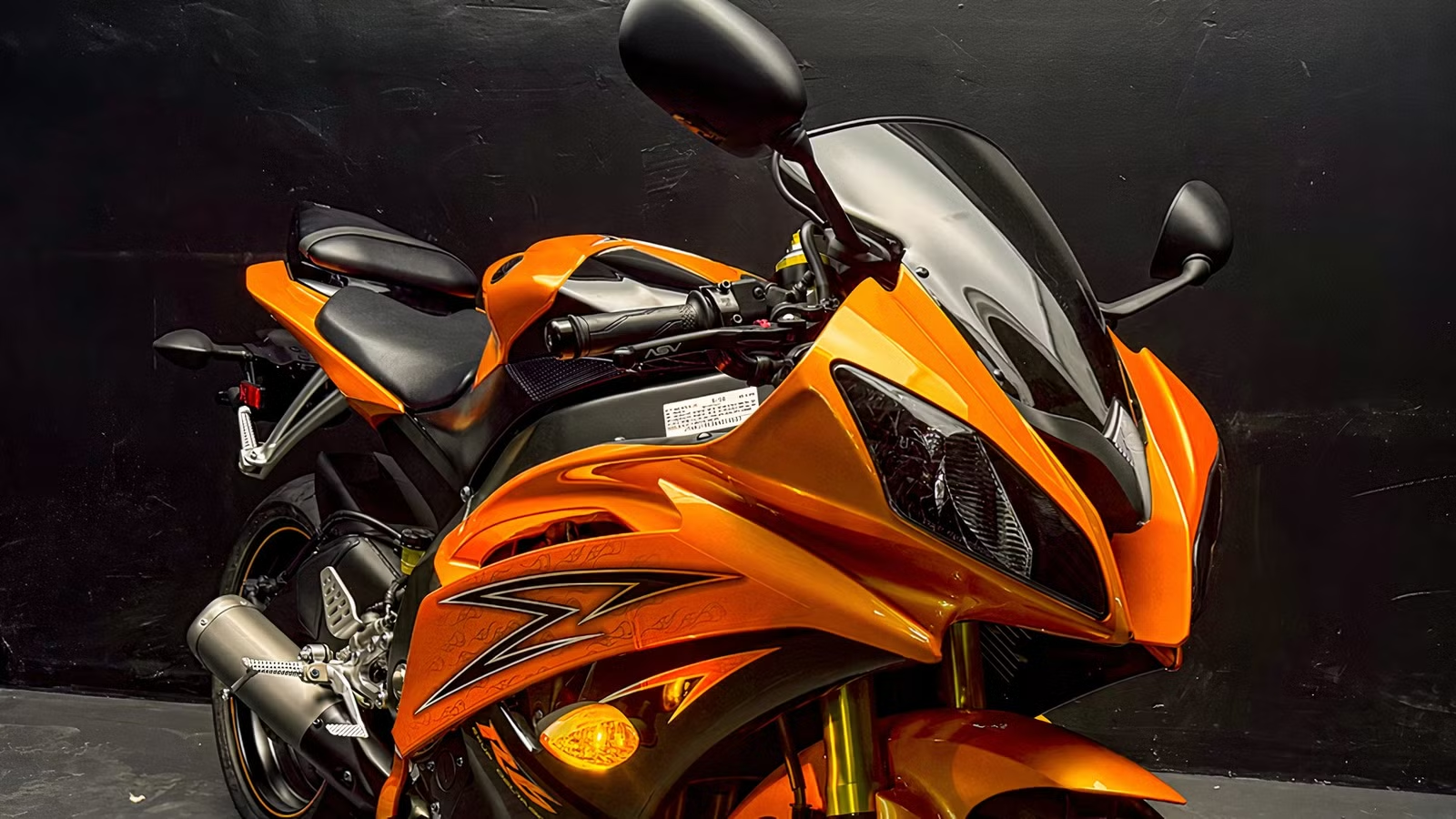
Today, many motorcycles are packed full of electronic wizardry for improved safety and convenience. Things like ABS, ride modes, and traction control have become increasingly common as the years went by, albeit much later than similar systems in cars. But there was a time when everything was up to riders and their skill set, with no electronic safety net to save them if they messed up. Of course, many of us are actually quite fond of that analog riding experience, yet there’s no denying that rider aids made the joys of motorcycling far more accessible and less intimidating to the broader public. That being said, let’s focus more specifically on ride-by-wire technology for the purpose of today’s article.
What’s The Deal With Ride-By-Wire Throttles?

Before ride-by-wire (or RBW) became a thing, a bike’s throttle was controlled mechanically via cable as opposed to the ECU. This worked just fine, but making that connection electrical through the engine’s control unit brought about a few major benefits which shouldn’t be taken for granted. Not only does it allow for the easier and more effective integration of, say, traction control, but technologies such as bidirectional quickshifters or cruise control wouldn’t be possible at all without it. Other benefits include smoother acceleration and improved fuel efficiency, though some riders still prefer cable-operated throttles for their analog feedback, linear predictability and complete lack of digital latency. Nonetheless, the upsides seem to outweigh the drawbacks, but which motorcycle was the first to adopt ride-by-wire?
An Important Caveat We Need To Clarify

Some people might point to the Aprilia Shiver 750 from 2007 as the world’s first ride-by-wire bike, yet that’s not entirely correct. The Shiver was, indeed, the first to really explore the vast array of possibilities afforded by this tech, implementing an advanced system similar to the ones we have today. Despite that, Aprilia wasn’t the one to use ride-by-wire before everyone else, as that honor belongs to an entirely different machine from Japan. It beat Aprilia by a year as far as the implementation of electronically-controlled throttles was concerned, even if it didn’t exploit it to the same extent as the Shiver. And the company credited with this development is none other than Yamaha, debuting its first ride-by-wire system on one of its popular sport bikes for the model-year 2006.

Ride-By-Wire First Arrived On The 2006 Yamaha YZF-R6

The Japanese marque’s earliest version of RBW was called YCC-T, which stands for Yamaha Chip Controlled Throttle. It took approximately seven years to develop before finally appearing on the 2006-model R6 sport bike, albeit without any ride modes or other electronic assists. This is because Yamaha’s goal was improved performance, not making the R6 easier or more convenient to ride. The setup comprised cables running from the handlebar to throttle position sensors, while the ECU would measure several variables in milliseconds before prompting a servo motor to open or close the throttle butterflies. Airflow could thus be optimized electronically at high revs, and the technology was first used in racing before trickling down to Yamaha’s YZF-R6 production bike. Ride-by-wire wasn’t the only notable thing added to the model in 2006, though.

In fact, the R6 was treated to a comprehensive redesign that year, becoming far more radical in just about every way. At its core sat a high-revving, liquid-cooled 599cc inline-four boasting twin fuel injectors for each cylinder, a 17,500-rpm redline and 16 titanium valves operated by dual overhead cams. The engine’s compression ratio was rated at 12.8:1, and its power traveled to the rear wheel by means of a six-speed gearbox along with a multi-plate slipper clutch. At 14,500 rpm, the four-cylinder mill was capable of unleashing 125 hp, on par with other mid-sized sport bikes available at the time. That oomph translated to an 11.1-second quarter-mile time and a top speed of 165 mph according to Motorcycle News. What’s more, Yamaha went to town with the bike’s chassis, as well.
An aluminum Deltabox frame formed the basis, suspended on a pair of 1.6-inch inverted forks with full adjustability at the front. Out back, suspension duties were assigned to a fully-adjustable piggyback monoshock. The brakes were solid, too, with dual 12.2-inch discs bitten by four-piston radial calipers up north and a single 8.7-inch rotor paired with a two-piston caliper down south. Before any fluids were added, the YZF-R6 tipped the scales at a moderate 355 pounds — not outlandish for a bike in its class but light enough to feel nice and nimble. So, all things considered, the middleweight Yammie was clearly a force to be reckoned with, and not just because it was the first production motorcycle to feature ride-by-wire. How did riders feel about that whole YCC-T affair, though?
The Public’s Reaction To YCC-T Was Mostly Positive

Although a fair chunk of the motorcycling community tends to be rather conservative at times, folks were actually quick to praise how natural Yamaha’s RBW system felt. Some claimed there was hardly any noticeable difference between YCC-T and a traditional cable throttle, which speaks volumes about the level of refinement Yamaha strove for. Skeptics and naysayers were reluctant at first, expressing concerns about the added complexity of an electronically actuated throttle and how it could cause many more headaches compared to a simpler, traditional mechanism. Nonetheless, ride-by-wire was there to stay, slowly but surely heading toward widespread adoption over the coming years. And even though Aprilia was the one to really get creative with RBW in 2007, Yamaha gets the credit for being the first to apply it on a production bike with the R6.
In doing so, it opened the door to a realm of possibilities further down the road, and most criticism was silenced once people realized it was largely unfounded. Of course, some riders still swear by cable throttles to this day, but there’s just no reasonable way to deny that ride-by-wire had a major positive impact on the motorcycling scene overall. And that brings us to the legacy of Yamaha’s 2006-model YZF-R6, which extends into just about every corner of the industry and is more apparent today than ever before. Non-believers became an increasingly smaller bunch, even if some of them refuse to change their minds and will continue to vouch for cable-operated throttles until the end of days.
Yamaha’s Bold Move Went On To Influence An Entire Industry

In our day and age, you’ll be hard-pressed to find a high-performance motorcycle without ride-by-wire, and the technology forms the basis for most of our modern electronic rider aids. Traction control might’ve been possible without it, for instance, but it relied on much cruder, less sophisticated methods such as delayed ignition timing. Ride modes are a similar story, doable without RBW yet much more effective when operating in conjunction with it. Thus, it would be perfectly reasonable to say that Yamaha revolutionized the whole industry with its introduction two decades ago, which makes the YZF-R6 one of the most influential and historically significant two-wheelers out there.
It doesn’t quite get all the recognition it deserves, though just about every ride-by-wire motorcycle today owes a little something to this middleweight Yammie sport bike from the mid-2000s. Few machines manage to have this sort of impact on the broader motorcycling scene, and even Yamaha most likely couldn’t have predicted how influential its YCC-T system would go on to be. But those who dare to do things differently from the crowd tend to also be rewarded generously, which is precisely what happened with the innovative R6 many years ago. So next time you’re saved by traction control or select Rain mode to prevent slippery situations in wet weather, perhaps spare a thought for the bike that made ride-by-wire available to the masses.
Sources: Yamaha, Motorcycle News, Visordown, New Atlas, Motorcyclist, JD Power, Motorcycle.com

Related posts

Latest Post


No Comments