Toyota Replaced Its 301-HP Sleeper With A Slower Hybrid—And It’s A Mistake
8 minutes reading
Friday, 28 Aug 2026 20:00 0 70 autotech
Somewhere in a suburban school pickup line, a Toyota Camry is quietly capable of embarrassing cars that look far more serious. That’s not a hypothetical. For one generation, Toyota built a version of its family sedan with a genuine sports-sedan engine wearing camouflage so effective that most people never noticed. That car is gone now, replaced by a hybrid-only lineup from the 2024 model year that trades acceleration for efficiency. Understanding what Toyota walked away from means looking past the badge and into an engine bay that once housed something genuinely special, and increasingly hard to find anywhere else.
On paper, the Camry has never been a car enthusiasts circle on their wish list. It’s reliable, comfortable, and about as visually daring as a filing cabinet—the default choice for buyers who want dependable transportation, not a personality behind the wheel. Rental fleets are built on cars like this.
Corporate parking garages are full of them. Nobody cross-shops a Camry against a BMW 3 Series, and Toyota never really asked them to. That reputation is precisely what made one version of it so remarkable. For a stretch of the outgoing generation, Toyota quietly dropped a genuinely quick powertrain into that unassuming shell, and almost nobody outside the enthusiast press noticed or cared.
A rear view of a 2023 Toyota CamryToyota
The car looked identical to every other Camry in the parking lot. Same wheel arches, same anonymous silhouette, same interior that prioritized comfort over drama. It just happened to move like something else entirely. That’s the essence of a true sleeper, not a car dressed up to look fast, but a car that hides genuine performance behind total visual indifference. Most manufacturers that want a quick sedan build a special edition with body kits and badges to broadcast it. Toyota did the opposite, and the result was one of the most underrated performance bargains of its era.
The V6 XSE Turned Toyota’s Family Hauler Into A Genuine Sleeper
Side 3/4 action shot of 2024 Toyota Camry XSE being driven on roadToyota
That car was the Camry XSE V6, and it earned its sleeper status the hard way, through hardware, not marketing. Underneath the badge-engineered sedan styling sat a 3.5-liter naturally aspirated V6 built for real performance, not just a bump in the brochure’s horsepower column to justify a higher trim price.
Car and Driver clocked the XSE V6 at 0-60 mph in 5.8 seconds, with a quarter-mile time of 14.4 seconds at 100 mph. Those are numbers that would have felt right at home in a sports coupe of the era, not a car most owners bought for its trunk space, its low running costs, and Toyota’s reputation for mechanical reliability.
A left hand-side view of a 2023 Toyota CamryToyota
Nothing about the exterior gave it away. There was no forced-induction whine, no aggressive aero, no reason for anyone at a stoplight to expect trouble. And that was the point. Toyota built the XSE V6 as a top trim for buyers who wanted more refinement and more standard equipment, not as a performance flagship for enthusiasts.
The performance came along almost as a byproduct of using a genuinely good engine rather than cutting costs with something smaller and less capable. It’s a reminder that automakers used to build cars this way more often, quietly overengineering a mainstream model rather than putting every ounce of capability behind a halo trim.
301 HP From A Naturally Aspirated V6 Made This Camry Unusually Special
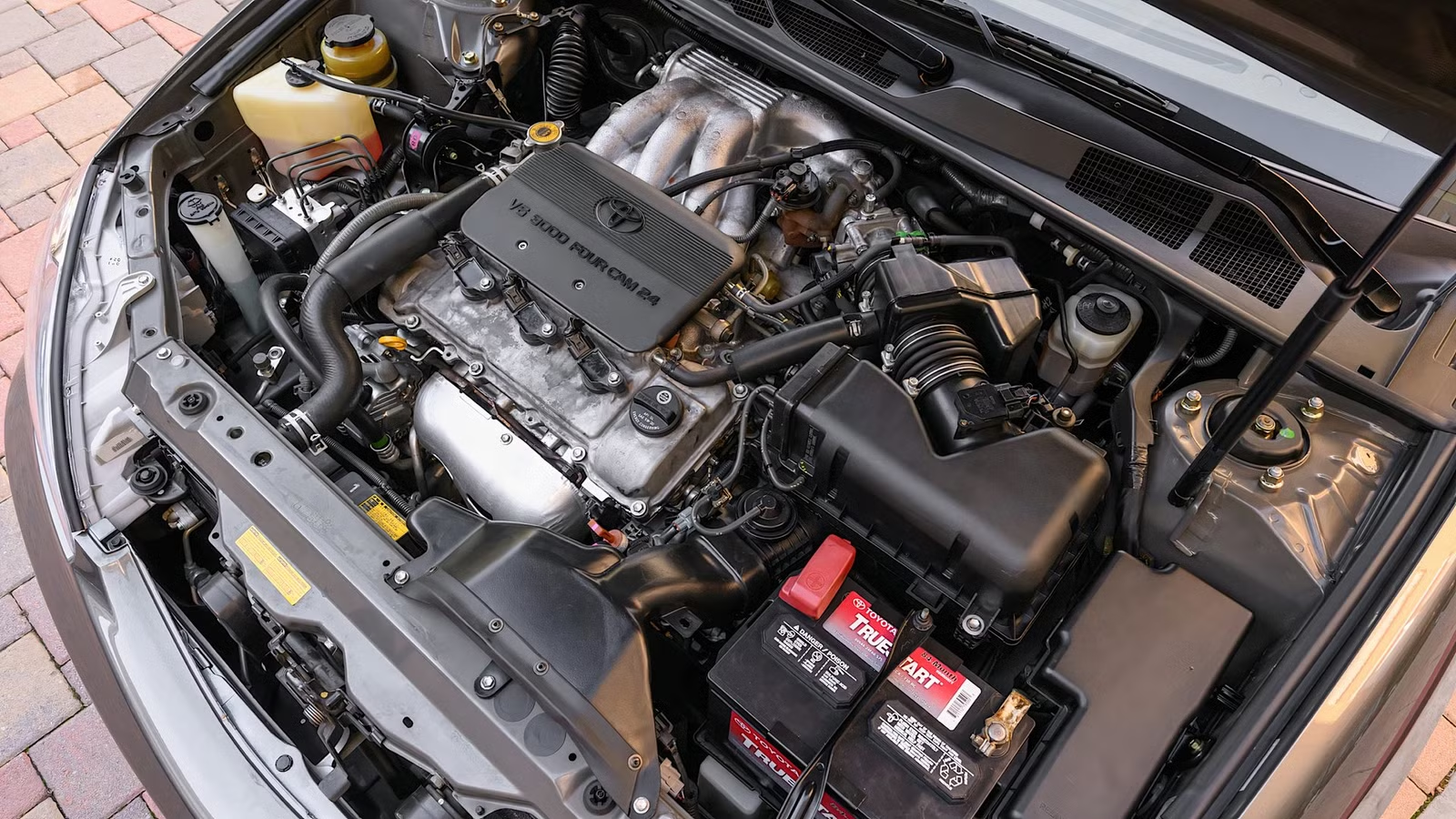
Close-up shot of 2018 Toyota Avalon engine bay showing 2GR-FE V6Toyota
The engine responsible was the 2GR-FKS, and its specs alone justified the sleeper reputation. 301 horsepower at 6,600 rpm and 267 pound-feet of torque at 4,700 rpm, delivered without a turbocharger, a supercharger, or a hybrid battery doing any of the work.
In an era increasingly dominated by smaller turbocharged fours and electrified assistance, a naturally aspirated V6 making those numbers in a mainstream family sedan was already unusual. What elevates the 2GR-FKS beyond just a strong number on a spec sheet, though, is where else that engine has turned up.
Shot of the Toyota-sourced V-6 engine in the Lotus EmiraLotus
This engine family has powered everything from the workhorse Toyota Tacoma to the Lotus Emira, a genuine mid-engine British sports car built purely around driving enjoyment. That’s a remarkable range for a single engine architecture to span, from towing a boat to powering one of the last analog sports cars from a boutique manufacturer obsessed with steering feel and chassis balance.
It puts the Camry’s V6 in the same engine family as a car enthusiasts genuinely lust after, which is not the kind of pedigree buyers typically expect to find bolted into a mainstream family sedan. That shared DNA is exactly why the XSE V6 deserves to be talked about in more serious terms than a footnote in Toyota’s model history. It wasn’t just a strong engine for a Camry, it was a strong engine, full stop.
The 2026 Hybrid Gains MPG But Gives Up A Second To 60 MPH
2024 Toyota Camry Hybrid XSEToyota
That engine is gone now, and it isn’t coming back. Toyota officially killed the V6 for the Camry starting with the 2025 redesign, moving to a strictly hybrid-only lineup that carries over unchanged into 2026. The TRD performance trim, which had also leaned on V6 power, was discontinued in the same transition.
The replacement strategy is undeniably efficient: the new hybrid powertrain is rated up to 51 mpg, a figure that would have been unthinkable for a V6-powered sedan, but the performance trade-off is stark and impossible to spin as anything other than a step backward for driving enthusiasts.
2026 Toyota Camry AWDToyota
The 2026 Camry produces 225 horsepower in front-wheel-drive form or 232 horsepower with all-wheel drive, and the AWD model needs 6.8 seconds to reach 60 mph. Set those numbers against the old V6’s 301 horsepower and 5.8-second sprint, and the gap is undeniable.
A full second slower to 60 mph, and nearly 70 horsepower down at the top of the range. Toyota didn’t trim the V6’s performance incrementally the way manufacturers often do when tightening emissions rules. It deleted the entire concept from the Camry lineup in one generational leap.
None Of This Has Hurt Toyota’s Business
Side profile shot of a 2021 Toyota Camry Hybrid XSEToyota
The Camry remains one of the best-selling passenger cars in America even in hybrid-only form, proof that the vast majority of buyers were never cross-shopping for 0-60 times in the first place. But that sales success is exactly why the V6’s disappearance matters so much to the small slice of buyers who did care. The Camry didn’t need to be fast to sell. Toyota built a fast one anyway, for a little while, almost as an aside, and that’s precisely the kind of thing that becomes conspicuous once it’s gone.
Why The Last V6 Camry Could Become A Future Japanese Sleeper Classic
2023 Toyota Camry XSE V6 interior shown in Cockpit Red leather trim.Toyota
That deletion is precisely what makes the outgoing XSE V6 worth paying attention to right now, while it’s still just a used Camry and not yet a cult object. It wasn’t a limited edition or a halo trim wrapped in an asterisk. It was a mainstream Camry, sold through ordinary Toyota dealerships to ordinary buyers, with a genuinely quick, naturally aspirated engine shared with a proper sports car tucked underneath. That combination, mainstream volume, genuine pace, and a pedigree engine, doesn’t happen twice in an era of tightening emissions regulations and electrification mandates.
Toyota has committed to hybrid power across the Camry range for the foreseeable future, and there’s no indication that a naturally aspirated performance variant is waiting in the wings for a future refresh. That makes the 2GR-FKS-equipped XSE genuinely the last of its kind. The final naturally aspirated, V6-powered Camry Toyota will likely ever build.
2024 Toyota Camry Hybrid XSEToyota
2024 Toyota Camry Hybrid XSEToyota
Cars that quietly out-perform their reputation tend to age well with enthusiasts once that performance becomes structurally unrepeatable, and the V6 Camry checks every box that collector-adjacent interest usually requires. Genuine mechanical pace, a real engineering pedigree shared with a car enthusiasts already respect, and a badge that nobody would ever expect it from.
None of that guarantees the used-market interest that collector cars eventually attract, and it would be premature to claim the XSE V6 is already commanding a premium. That kind of demand tends to build slowly, and often only becomes obvious in hindsight.
Toyota
What is clear right now is the underlying case. A genuinely fast, reliable, naturally aspirated Toyota sedan with a Lotus-adjacent engine, built in meaningful numbers, that will never be replicated under Toyota’s current hybrid-only strategy. That’s the exact profile of car that quietly appreciates once buyers realize what they’re actually looking at. For now, it’s simply a very good used Camry hiding in plain sight, which, fittingly, is exactly what it was designed to do from the beginning.









No Comments