
This Forgotten Mid-Engine Masterpiece Proves The 426 Hemi Can Be Elegant
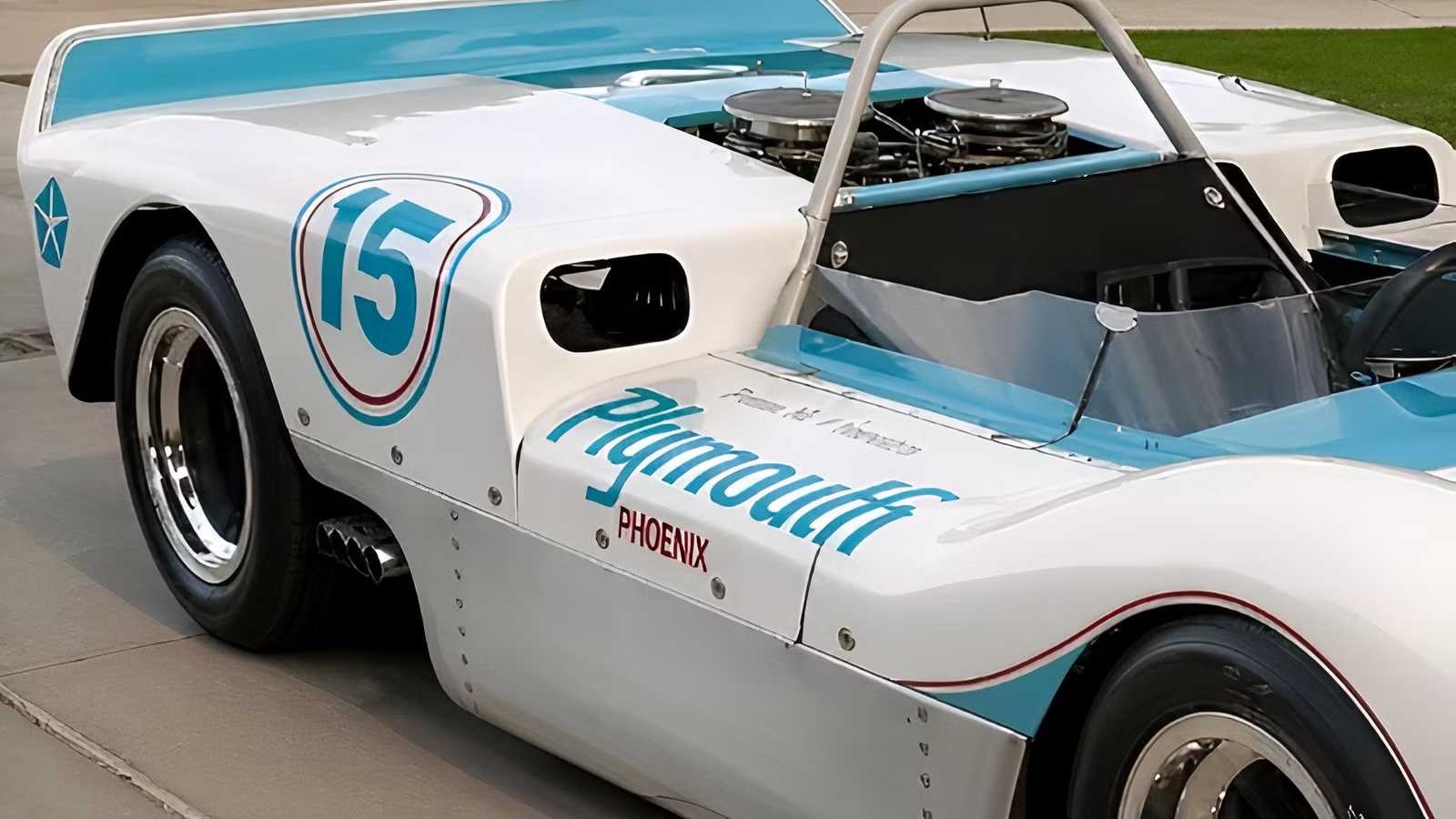
If you pair the two paradigms of “mid-engine” and “426 Hemi,” people in the know immediately conjure an image of the Swiss Monteverdi Hai 450 SS supercar. Among the list of obscure automobiles that used a Gen-II Hemi motor outside the Dodge/Plymouth family, the Hai 450 SS is generally seen as the cream of the crop. Still, the Hai 450 SS wasn’t the only mid-engine masterpiece to use the Hemi engine at the height of its influence. In fairness, the car in question wasn’t a road car. Instead, it was a hidden gem inside one of America’s most exciting under-the-radar racing series, forged by an equally underappreciated automotive savant.
Can-Am in the ‘60s: Racing in its Purest Form

If auto racing in 2026 is a bore to you, might we suggest checking out some highlights from the original iteration of the Canadian-American Challenge Cup, or Can-Am series, from the mid-1960s through the early-to-mid 1970s. Back then, the rule book was so paper-thin that it might as well have not existed at all. So long as the car had two seats, four wheels, enclosed wheels, and a human being with a body temp somewhere in the upper 90s behind the wheel, just about any motor vehicle could enter the series. Scheduled in the fall at first to avoid conflicts with F1 and Indycar, a who’s-who from the American racing scene battled in what was effectively an unrestricted automotive arms race.
Famous faces like Parnelli Jones, Jim Hall, and even Bruce McLaren himself made the Can-Am series their personal playground when they weren’t burdened by stuffier, more established sanctioned racing series the rest of the year. Given that you could run front-engine or mid-engine setups with engines from GM, Ford, Mopar, or elsewhere, with whatever braking or suspension hardware you wanted, how could you blame them? More intense than NASCAR and far less self-serious than Grand Prix, the Can-Am series was a race for antiheroes before that was part of the common lexicon.
Interestingly, Can-Am racers could even be faster off the line and pack more horsepower than equivalent F1 cars. Especially in later years, particularly toward the end in the mid-1970s, some of them were producing well north of 1,000 hp when F1 was limited to around 500 at the best of times. At least in a straight line, a top-tier Can-Am racer would easily outpace an F1 car of the period and make a NASCAR Cup Car look pedestrian by comparison. Yet, not every one of Can-Am’s iconic racers is well-remembered or celebrated. Some slipped under the radar, and one in particular deserves your attention, not the least because of the man who designed and built it.

Bob McKee: A Different Breed of Auto Racer

He may have never been a household name, and if we had to guess, this is the first time you’ve even heard of the man. Even so, Bob McKee is a name worthy of respect, mostly because he seemed to care less about the rules of Can-Am than the sanctioners themselves. Based out of Palatine, Illinois, Bob McKee Engineering was a boutique racing fabricator that used McKee’s years of expertise to build truly groundbreaking cars. In the 1960s, McKee was one of America’s only road racing–optimized race engineers at a time when oval tracks and superspeedways dominated the scene.
Among his other achievements, McKee worked alongside NASCAR technician Bill Smith to build one of the first Pontiacs to reach Cup competition back in 1955. Beyond that, McKee’s engineering expertise extended to fabricating lightweight tube-steel spaceframes, making him one of the most respected independent chassis builders in the country by the mid-1960s. Before the first Can-Am green flag dropped in 1966, McKee was cutting his teeth in the similarly themed but less outlandish USRRC (United States Road Racing Championship).

At the time, USRRC was the Sports Car Club of America’s (SCCA’s) premier sports car series, but when Can-Am arrived, it gave Bob McKee express permission to cut loose. When he did, he unleashed one of the most exotic and special racing cars ever to come out of an American garage. It was brash, unconventional, and powered by an engine so outsized for the period that people thought McKee had lost his mind. Whether he did or not was debatable, but what can’t be argued is how amazing the end result was.
McKee Mk 5 Plymouth Special: A Hemi Warrior With the Engine in the Middle

Before the late 1960s, the prospect of a dedicated road racing car running a 426-cubic-inch Hemi engine was nothing short of absurd. Forged in the crucible of the drag strip and the super speedway, the 426 was an absolute elephant of an engine; a tall deck, deep skirt, and cylinder walls thick enough to shrug off an artillery shell. While fantastic in a front-engine layout that didn’t involve much lateral weight transfer, that roughly 750-pound behemoth could easily throw a road racer into a wicked fit of snap oversteer.
Bob McKee’s solution? Simply place a race Hemi in the middle of one of his trusty tube-steel spaceframes, fabricate a lightweight aluminum skin around it, and position a cockpit with a steering wheel somewhere toward the front. Dubbed the McKee Mk 5, this uber-unique racer was commissioned by a Phoenix-based Plymouth dealer named Bob Montana. Montana’s ambition was to bring the Mopar racing Hemi to the realm of road racing at a time when Chrysler only seemed to care about stock cars and dragsters. When Montana and McKee brought the Mk 5 to the USRRC and later to the earliest days of Can-Am, it was the polar opposite of the sensitive, finicky European prototypes and small-block American muscle on the grid.

Under the hatch was the latest evolution in the 426 race engine, lovingly dubbed the Elephant for obvious reasons. The Mk 5 generated in the neighborhood of 600 hp, but given that official numbers were rarely reliable at the time, it could have easily been more. Meanwhile, Bob Montana wasn’t just the guy slinging the checks while someone else drove the car. He was more than happy to strap himself into this mid-engine rolling noise violation starting with the 1965 USRRC season, rolling right into the inaugural Can-Am campaign with all the momentum in the world. For his efforts, and with some of the best in the world racing against him, Montana netted two SCCA regional class victories and consistent middle-of-the-pack finishes against some of the stiffest competition in America between 1965 and ’67. For a non-factory-backed operation, that was a remarkable achievement.
A Long-Forgotten Hemi Legend

In the end, only three McKee Mk 5s were ever built, and only one with the big Hemi. By the turn of the ‘70s, factory-backed operations with unlimited budgets rendered the Mk 5 obsolete, and Bob Montana was tragically killed along with his wife and two sons in a private plane crash in 1971. From there, the sole Hemi-powered Mk 5 was relegated to storage for the better part of 35 years. In the late 1980s, the car was purchased by the wealthy enthusiast James Rasmussen, but by then, the old Hemi had been swapped out for a slightly larger 440 RB Wedge engine.
Over the next decade and a half, the car was painstakingly restored, gaining a period-correct race Hemi in the process with the help of Bob McKee himself. The restoration was complete by 2004, and the car was subsequently sold at the 2014 Russo and Steele auction in Scottsdale, Arizona, for $260,000. Meanwhile, Bob McKee remains a living legend.
Sources: Hagerty, Museum of American Speed

Related posts




Latest Post


No Comments