
The Corvette’s Signature Styling Is Actually A Totally Ripoff Of A Pontiac Concept Car
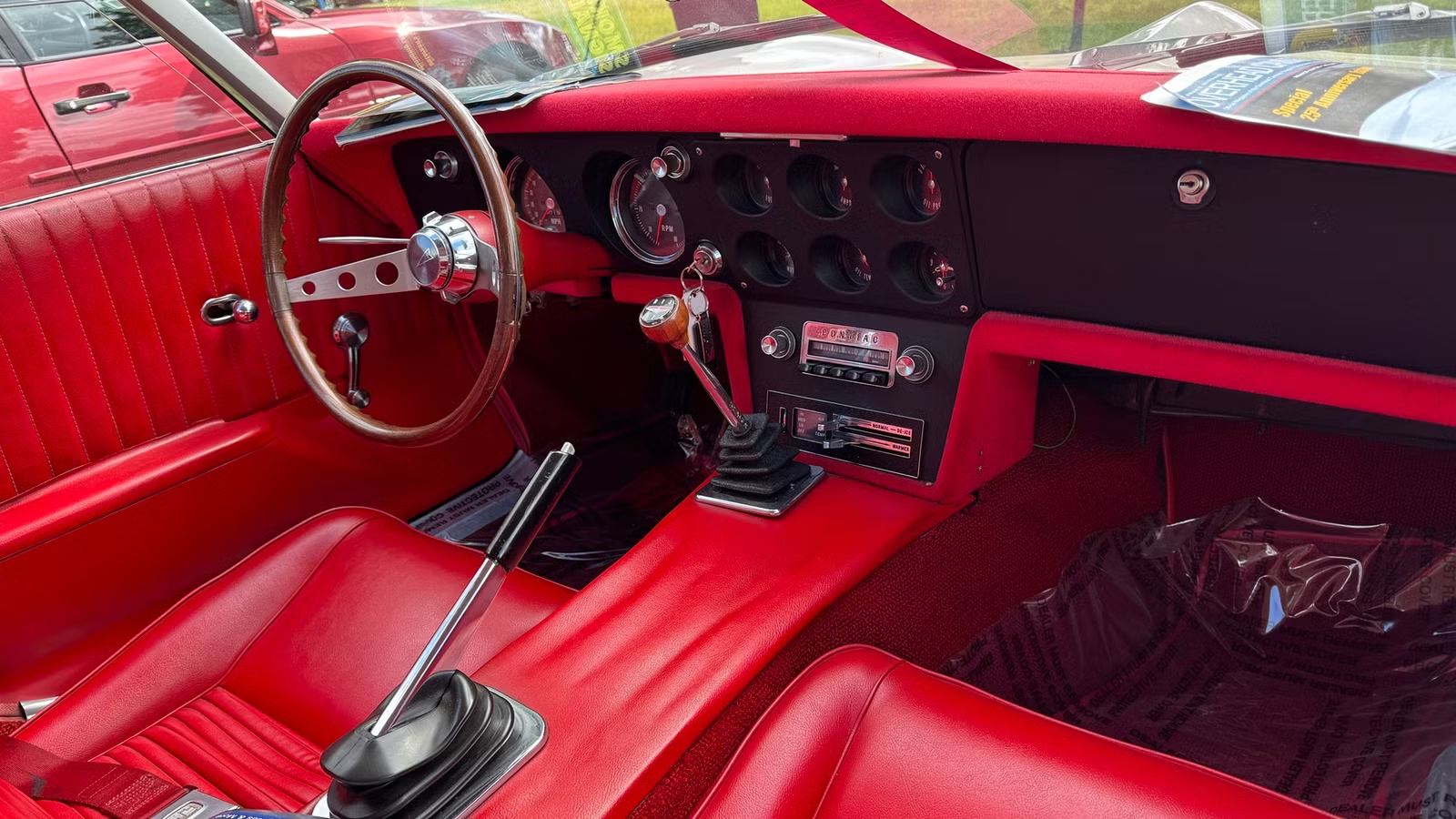
General Motors has given us some of the most iconic American sports cars from the different brands they own. Pontiac was one of them and a key player in the golden era of American muscle. At that time, there was a project Pontiac was working on headed by John DeLorean that would have sent shockwaves throughout the automotive industry. But Pontiac’s new sports car threatened to steal the spotlight from Chevrolet’s premier sports car, so they killed the project. But what Chevrolet rolled out just a few years later, makes it obvious they might have ripped off Pontiac.
Pontiac Tried To Build A Sports Car In The 60s

By the early 1960s, Pontiac wanted to change its brand image. Pontiac was the conservative brand with cars that looked like they were made for older people. Under the guidance of engineering mastermind John DeLorean, they wanted to get rid of this image and appeal to a younger crowd that liked high-performance cars. DeLorean wanted Pontiac to be GM’s undisputed performance powerhouse, a goal he partially achieved by dropping a massive V8 into the Tempest that later created the legendary GTO.
Despite having cars that dominated the street-racing scene and even tearing up the drag strip, Pontiac’s lineup still needed a true halo vehicle. DeLorean knew that Pontiac needed more than just muscle cars to be seen as a performance brand. The brand needed a dedicated, two-seater sports car built from scratch. A car that could go fast in a straight line but was also very capable in the corners.
DeLorean’s Two-Seater Was A Problem

DeLorean’s vision was very ambitious but feasible. He wanted to build a practical, lightweight, nimble sports car designed to beat European sports cars at their own game while staying affordable for the average American driver. GM already had the parts needed to make such a car, so by using an existing lightweight chassis, components, and fiberglass body, Pontiac could keep both weight and production costs exceptionally low.

However, this brilliant vision didn’t sit well at GM’s corporate level. A lightweight, affordable, highly capable two-seater posed a massive internal threat. GM corporate executives instantly realized that if Pontiac built a stylish, lower-cost sports car, it would directly cannibalize Chevrolet’s flagship model: the Corvette. Inside GM, the Corvette was seen as the corporation’s halo car and was seriously protected by Chevrolet executives who would never allow a sister division to steal its spotlight.
The XP-833 Was The Sports Car GM Refused To Let Pontiac Build

DeLorean wouldn’t give up just yet, and his team quietly pushed ahead with development under the secret project codename XP-833. A car people would later come to know as the Pontiac Banshee. The 1964 Pontiac XP-833 was nothing short of a design masterpiece. It had a long swooping hood, hidden headlights that gave the front fascia a sharp look, pronounced body lines, and a short rear deck. This was a striking car to look at. Pontiac even built a fully functional, driveable prototype to prove the concept was market-ready.
Two Engine Options Were Available For The XP-833

To show GM leadership that the XP-833 wasn’t just a track toy, Pontiac developed two distinct operational prototypes catering to different buyers. First was a silver coupe, which would be the entry level sports car. This version was powered by Pontiac’s overhead cam inline-six (OHC-6) engine, which made 165 hp in road cars, mated to a four-speed manual transmission. This was meant to be the efficient car: the one you could drive every day without breaking the bank.
Next was the white Roadster, which was the high-end car with a punchy 326 cubic-inch V8 pushing 280 horsepower. Both cars were made out of fiberglass and weighed nearly 500 pounds less than the C2 Corvette. The V8 prototype had a mind-blowing power-to-weight ratio that threatened to give Chevy’s flagship a run for its money on the road and on track. But despite how promising this car was, GM shelved the project for obvious reasons. It was a better-looking Corvette rival and was sure to steal some sales away from the Vette as it was the only car of its kind at the time.
The C3 Corvette Looked A Lot Like The XP-833

When Chevrolet unveiled the third-gen Corvette (C3) in 1968, everyone seemed to experience a sense of deja vu. First off, the C3 Corvette had a striking design with its revolutionary “shark-like” looks. From the long, sloping hood line, pronounced fender arches, coke-bottle waistline, and crisp cut-off rear end, it was a great-looking car. But this car had been seen before. It was almost like a carbon copy of the Pontiac XP-833 prototype that GM executives had ordered DeLorean to kill just a few years prior. Sure, there were some changes, but there was no doubt that Pontiac inspired the creation of this new Corvette.
This resemblance wasn’t a coincidence; it was a deliberate act of corporate politics, and it happens more often than one might expect. When GM leadership ordered Pontiac to end the XP-833 program, its design didn’t just go to waste. Key design elements were used by Chevrolet’s design team. GM realized the XP-833’s aesthetic was futuristic and stunning, but rather than letting Pontiac launch an entirely new line that would hurt Corvette sales, they suppressed the Pontiac project and handed its signature design cues to Chevrolet to serve as the blueprint for the C3 Corvette.
Pontiac Tried To Bring The Banshee Back Twice

Even after the first Banshee, Pontiac refused to give up on that dream, and John DeLorean was ready to give the project another try. In 1968, Pontiac introduced the Banshee II. Built on a modified Firebird chassis, the Banshee II still used fiberglass body panels with a low, wedge-shaped design, a long hood, sharply angled nose, a short deck, and no roof. The car’s smooth looks, aerodynamic surfaces, and pop-up headlights gave it a futuristic look, while the wide stance and pronounced wheel arches made it look more like a European exotic than a traditional Pontiac. But it still retained a powerful 400 cubic-inch V8.
Despite its aggressive and futuristic styling, GM rejected this one also. But Pontiac was still making sports cars, and by 1968, the first production Firebird was already on the road, Chevrolet had the new C3 Corvette, and GM saw no reason to disrupt that balance.
GM Still Didn’t Approve The Banshee III

By 1974, Pontiac tried a third time with the Banshee III, but this time John DeLorean had already left Pontiac. It was designed as a sleek, futuristic two-door coupe with a long, low hood, sharply angled nose, covered headlights, flowing bodywork, and a distinctive wraparound rear end. This one had a massive 455 Super Duty V8 and the styling previewed the aerodynamic look Pontiac wanted for future performance cars. The Banshee III was based on the second-gen Pontiac Firebird/Trans Am platform, but its heavily redesigned body made it look far more exotic than the production Firebird.
Predictably, GM killed the project once more as the fuel economy crisis and emissions became an issue. Decades later, in 1988, Pontiac unveiled the Banshee IV. This time, it wasn’t a secret attempt to steal the Corvette’s crown, but a sleek futuristic design study. While the car itself was never produced, its sleek, elongated shape was passed directly down to the fourth-generation Pontiac Firebird and Chevrolet Camaro, known as the catfish.
Pontiac Never Built The Banshee, But Its Influence Didn’t Disappear

Although the original XP-833 Banshee was denied its place on the assembly line, it refused to die quietly. Both original 1964 prototypes survived. Rather than being crushed by GM as was standard protocol for concept cars, sympathetic engineers managed to buy them out of warehouses in the 1970s. The Silver Coupe is currently Napoli Indoor Auto in Milford, Connecticut, in the private collection of Len Napoli. The white roadster has been part of the private Bortz Auto Collection since 1988, owned by Chicago automotive collector Joe Bortz.
Furthermore, bits and pieces of the Banshee’s design language made it into production vehicles for years. The front-end styling inspired the 1967 Firebird’s taillights and nose, while the long-sloping hood lines made their way onto various Grand Am and Trans Am models throughout the 1970s.
The Banshee Would Have Changed Pontiac

This is one of those corporate decisions that makes you wonder what a brand like Pontiac would have been. Had GM allowed John DeLorean to release the XP-833 in 1965, it could have fundamentally rewritten the brand’s history. Pontiac wouldn’t have just been GM’s “muscle car” division; it would have evolved into a respected, global sports car brand capable of battling European imports and American icons alike. We saw the impact the C3 Corvette had; it became an undisputed legend of American design. The signature style that made the C3 famous was originally born under a Pontiac badge.
Sources: General Motors, Napoli classics,

Related posts




Latest Post


No Comments