
The 1966 Ford Compact That Hid A Mustang 289 Without The Badge
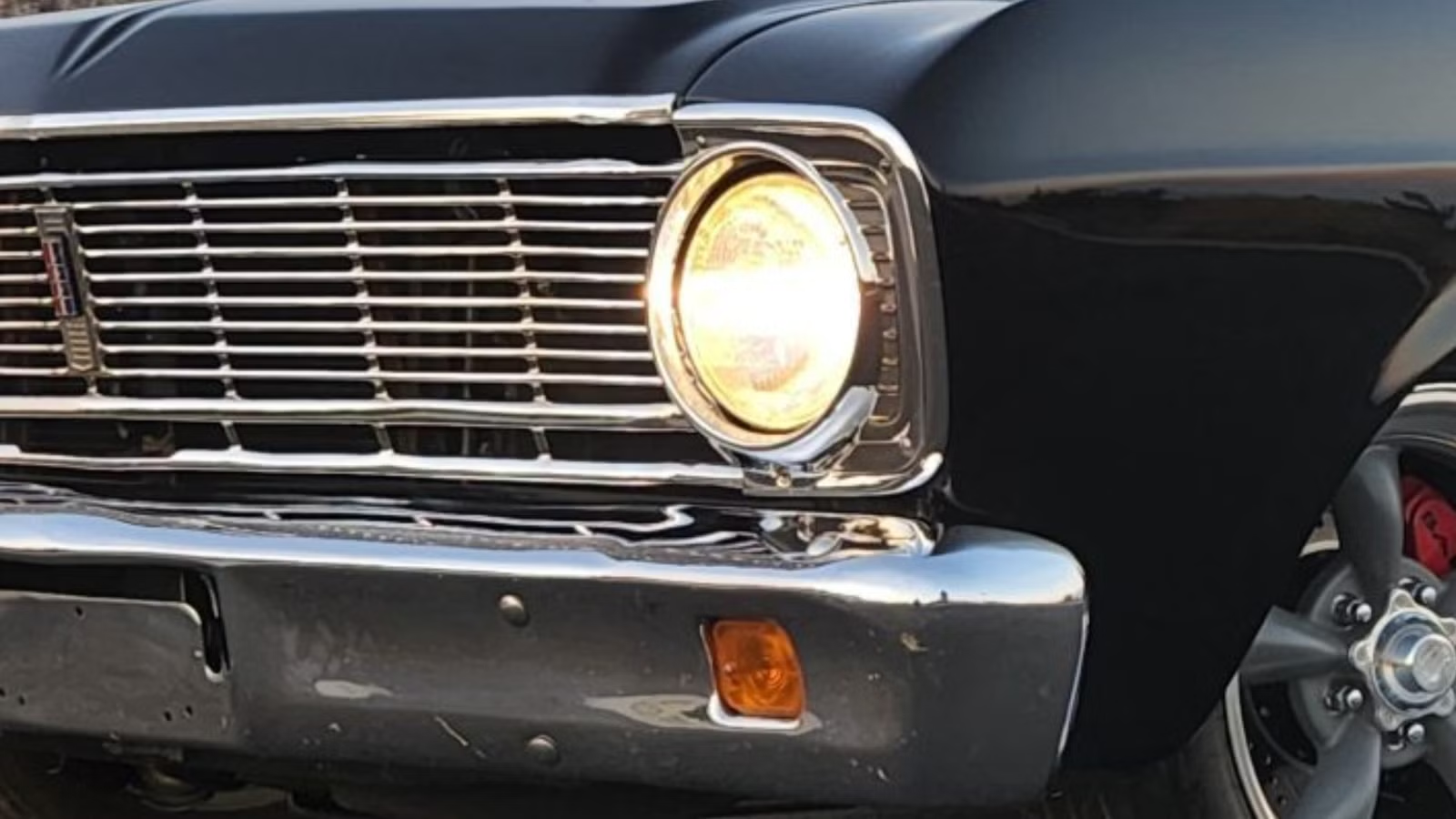
More than anything else, the muscle car wars of the ’60s weren’t just a story of numbers, of horsepower, torque, and quarter-mile times. Instead, the first great muscle car renaissance was a story of narratives. Narratives about who did what and when, and who claims the title of first among its respective niche. Well, here’s a narrative we want to challenge, that the first fast Ford of the decade was the 1964 ½ Mustang. If you do even a cursory amount of digging, the whole line of thought pretty easily falls apart.
The Mustang: A Great Car, But Not a God on Four Wheels

When the Ford Mustang made its North American debut in the spring of 1964, it’s fair to say no car made quite as much of a stir at any point before or since. Youths and their parents alike lined up outside Ford dealerships just to get a look at a Mustang, including a fresh-faced 14-year-old Jay Leno, as the covering sheets were pulled off. Never mind that other great cars that fit the pony car mold, like the Plymouth Barracuda, debuted the same year, often within weeks of the Mustang. At the end of the day, the Ford product ruled them all.
The Mustang simply had everything it needed to succeed: an aggressive, sporty design, the choice of a thrifty straight-six or a powerful small-block, a $2,400 base MSRP equal to under $25,000 in modern money, and a broad appeal that attracted young and old alike. In its first full model year of 1965, Ford sold a grand total of 409,260 Mustang hardtops in all manner of different trim and powertrain configurations, not counting convertibles. For some context, it takes Ford roughly eight to ten years to sell that many Mustangs nowadays. That is, they don’t sell that many over an entire generation, let alone in 12 calendar months.

In the annals of history, that first year of Mustang production represented a phenomenon effectively impossible to replicate again. Simply put, modern sports cars of its type are too complicated, too heavy, and far too expensive to replicate that lightning-in-a-bottle feeling. Yet, for all its achievement, all the fanfare, and all the profits for FoMoCo, the Mustang was hiding a big dirty secret underneath the skin. When the bodywork came off, what you found underneath wasn’t all that special. At least, compared to the skin on top, it really wasn’t. Ford likely never wanted you to know, but the Mustang really wasn’t a Mustang at all in its core components.

Pony Car on Top, Honest Commuter Underneath

Beneath that long hood, the Mustang emblem, and enough pizazz to star on Broadway, the Mustang had the same chassis, suspension, and basic floor pan as Ford’s humble little family runabout, the Falcon. Established as a small, more affordable alternative to larger Fords and Mercurys in the lineup, the Falcon traces its roots back to the mid-1950s—back to a time when the company began to worry that foreign brands like Fiat, Toyota, and Volkswagen were undercutting the domestic Big 3 with small, inexpensive grocery-getters that did a better job of hauling people and their belongings around efficiently.
The Falcon was one of several American cars to debut in the ‘60s that followed the same formula, flanked by the Plymouth Valiant, Dodge Dart, Chevy Corvair, Rambler American, and the Studebaker Lark. Yet when the Falcon made its formal debut in 1959 for the 1960 model year, it differed from the competition by offering Americans one of its first tastes of true-to-form compact muscle. After 1962, Ford introduced an optional 260-cubic-inch, 4.3-liter small-block V8 to a lineup of frugal Mileage Maker straight-sixes, along with an optional four-on-the-floor manual gearbox for extra sporting flavor. By the time of the short-lived second model generation of 1964 to ’65, a 289-cubic-inch Windsor V8 was also available, proving that Americans weren’t totally ignorant of the small-car, big-power formula. Such was the impetus for the Falcon Sprint, one of the most agile American cars of the era.

This mentality finally reached its crescendo in 1966, with the introduction of the Gen-III Falcon. By this time, the Mustang had already sapped whatever momentum a sporty Falcon could have hoped to maintain by simply being better at it. To illustrate the discrepancy between the two, Ford sold just 2,806 Falcon Sprint hardtops the year before the Gen-III Falcon was introduced. That’s just a fraction above 0.5 percent of the Mustang hardtop’s total sales volume from the same model year. Knowing this, it should come as no surprise that the Falcon Sprint nameplate was dropped altogether for 1966. With that said, the concept of a sporty Falcon didn’t disappear entirely. If anything, it simply evolved: bigger, better, and above all else, faster.
1966 Falcon Futura: The Falcon’s Yin to the Mustang’s Yang

If there was one attribute the Falcon maintained over the Mustang in those years, it was its lighter, slipperier, and more agile body. Coming in at 2,877 pounds, the Falcon two-door Sports Coupe had what it took to accommodate the same V8 engines that made the Mustang famous in its day. Should you option it, Ford would happily fit a C-code 289 cubic-inch small-block V8 with four-on-the-floor, optional power front disc brakes, and an independent short/long arm coil-spring front suspension with upper and lower control arms, plus an anti-roll sway bar.
For an American car of the period, that was some pretty impressive hardware, even more so with the 289 V8 optioned. With that box checked, you gained stiffer front springs, heavy-duty rear leaf springs, a thicker front stabilizer bar, five-lug hubs, and an eight-inch rear axle. With 200 hp on offer at 4,400 rpm, plus 282 lb-ft of torque at 2,400 rpm, these hot-rod Falcon Futuras could sprint to 60 mph in the high eights and pass the quarter-mile in roughly 14.5 seconds at close to 90 mph. At the time, the Falcon Futura 289 was the closest thing to a Civic Type R or a Golf GTI that you could buy in the United States, a bona fide family hauler that could deliver real performance when called upon.

There were no giant hood scoops, no racing stripes, no testosterone-coded performance badging that indicated anything beyond the Falcon’s status as a regular family car. Perhaps this limited its appeal among buyers browsing the same dealer lots as Mustangs with K-code packages. Yet the Falcon Futura still had its place in the Ford lineup—a purpose-built intermediary between the mundane and the performance class that could fulfill both roles far better than a Mustang could on its own. Still, Ford only managed to sell a hair over 19,000 Futura Sports Coupes in 1966, roughly three percent of the 600,000-plus Mustangs sold over the same 12 months. At that time, the Mustang really was helping Ford keep the lights on across its vast network of North American factories. All the while, the Falcon Futura lasted only a few more years, snuffed out by Mustangs of ever-increasing speed and power, as well as the Torino muscle car, after the 1970 model year.
Rare, Valuable, But Not on the Same Level as a Mustang

Because only a small percentage of buyers ever optioned a 1966 Falcon Futura to the hilt with the 289 and all the trimmings, finding one in this configuration, numbers-matching, and with all the paperwork, is exceptionally rare. When they do roll across the auction block, they tend to be overshadowed by the same Mustangs and other pony cars that forced the model out of production in the first place.
Sad as that is, it means they can sell for not much more than the price of a certified pre-owned Honda or Toyota these days. Can the same be said of the equivalent Mustang? Given that sellers are asking $25,000 to $30,000 for deteriorated 289 Mustang examples, it’s fair to say the answer is quite clear.
Source: Classic.com

Related posts


Latest Post


No Comments