
The Legendary Kawasaki Two-Stroke That Hid GP Race Engineering In Commuter Clothing
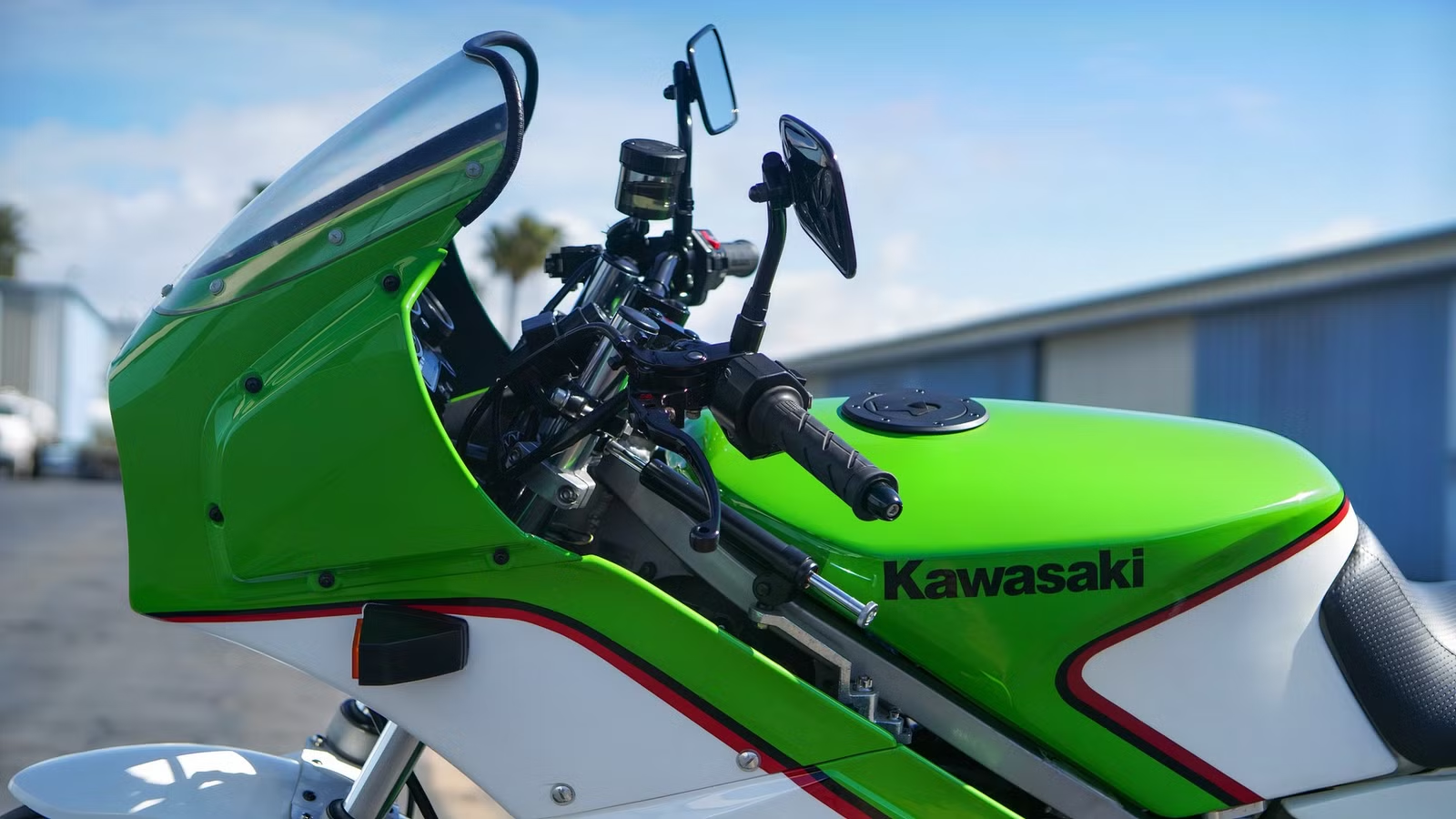
Viewed casually, it looked like the kind of tidy Japanese 250 you’d park outside a train station, ride through weekday traffic, and forget about until the next fuel stop. The bodywork was slim, the stance was neat, and nothing about it screamed superbike ferocity. At the time, that was the idea Kawasaki was going with.

Underneath, Kawasaki had hidden one of its strangest two-stroke ideas in a road bike that seemed almost too docile for its own engine. This was hardly a smoky brute built to scare traffic lights into submission. It was a compact, clever, street-legal 250 with a layout shaped by the same kind of thinking that had made Kawasaki a Grand Prix force.
Kawasaki’s Two-Stroke Legacy Became Too Obsessed With The Triples
Kawasaki’s two-stroke reputation is usually filtered through the H2 and H1 triples, and it’s not hard to see why. Those bikes had the noise, speed, drama, and enough worrying decision-making baked into them to keep old-school riders talking for decades. They were simple to mythologize because subtlety wasn’t part of the package, and good on them for that.

That version of Kawasaki history is fun, but it also flattens the brand’s two-stroke story. Kawasaki was building crazy road machines with big reputations, but it was also experimenting with packaging, cooling, crankshaft layouts, and engine architecture in ways that made perfect sense on a race track and very little sense to anyone who just wanted a normal motorcycle.
That’s where this forgotten 250 waltzes into the chat. Don’t tag it as a baby H2, because it wasn’t one, and it didn’t try to cash in on the same street-fighter image. Its cleverness sat deeper, inside an engine layout that had more in common with the racing world. This bike was a technical footnote worth reading twice.
Yamaha Built A V4 Two-Stroke That Shook The World To Its Core
This Yamaha exploded onto the motorcycling scene and changed bikes forever
The GP Tandem-Twin Idea Was Too Clever To Stay On Track

Kawasaki’s Grand Prix tandem twins were odd, narrow, and effective. Instead of placing two cylinders side by side, the layout stacked one behind the other, giving the bike a slim frontal area and strong ground clearance. In small-capacity Grand Prix racing, where every mph and every inch of width mattered, that had its obvious advantages.
The race machines used two crankshafts, liquid cooling, and an arrangement that demanded solid development. Early versions used a 180-degree setup, but vibration eventually pushed Kawasaki’s racers toward a 360-degree ‘twingle’ configuration. Pardon the engineering trivia, but in a two-stroke race bike, firing order can shape everything from traction to feel to how much the engine tries to buzz your fillings loose.
Certified Little Missile

For all its strangeness, the results made them worthwhile. Kawasaki’s 250 and 350 racers became championship machinery from the late 1970s into the early 1980s, with Kork Ballington and Anton Mang turning the tandem-twin idea into trophies. Its vitals were impressive, and we’ll get into them in detail, but it’s safe to say that for a 250, it was proper little-missile stuff.
The street bike that followed shared the stacked-cylinder idea. Kawasaki essentially took the shape of a winning concept and made it liveable enough for real riders, which is a much harder trick than slapping race stickers on a fairing and calling it a day.
The Kawasaki KR250 Hid Race Thinking Inside A Street Bike

|
Engine |
Power |
Torque |
Top Speed |
|
249cc tandem twin |
45 hp |
26.7 lb-ft |
112 MPH |
The Kawasaki KR250 arrived in 1984 as a street-legal two-stroke built for the same quarter-liter world as the Suzuki RG250 and Yamaha RZ250. Those bikes were already fast, sharp, and popular in markets where 250cc two-strokes were treated as serious performance machines. The KR250 joined that fight with a layout that immediately made it the oddball at the table.
Its tandem-twin engine used two crankshafts geared together inside a common crankcase, with one cylinder sitting behind the other. The road bike ran a 180-degree firing order, unlike the GP racer’s later 360-degree setup, and used a shock-dampened split clutch gear as part of the drivetrain. That gave the KR250 a narrow, compact engine with genuine technical theater hidden behind very restrained bodywork.
Power was roughly 45 hp, sent through a six-speed transmission, while dry weight sat at about 293 pounds (depending on the spec). That put it in the right neighborhood for a Japanese 250 two-stroke of the period, but numbers alone don’t explain the appeal. The KR250 was chasing balance, packaging, and a very particular kind of engineering cool.
The Strange Hardware Made The KR250 More Than A JDM Curiosity
The engine’s dimensions showed how focused Kawasaki was on revs. Its bore and stroke measured about 2.20 x 1.99 inches, making it over-square compared with the more square layouts used by key rivals. That helped the engine chase rpm while keeping piston speed under control, which is the kind of detail that makes you want to lean over it with deep curiosity in a garage.
The intake and exhaust packaging were even stranger. The KR250 mixed rotary-disc and reed-valve thinking, while the pipes had to work around the front-and-rear cylinder layout. One expansion chamber ran under the engine, while the rear cylinder’s pipe exited high near the seat, complete with heat shielding so the rider wasn’t gently roasted. ‘Cool’ barely begins to describe this sort of thinking.
Quirky Fun

The KR250 also used Unitrack rear suspension with a horizontally mounted single shock, anti-dive front forks, triple disc brakes, a 16-inch front wheel, and an 18-inch rear wheel. That gave the bike a spec sheet that looked much more serious than its commuter-like shape suggested.
It wasn’t flawless, though. The riding position could feel cramped, the small front wheel could make the handling lively on rough roads, and the rear brake could be grabby. Still, those quirks don’t ruin the story. They make the KR250 feel like a real ’80s performance two-stroke, built by engineers who were clearly given a little too much latitude.
The Forgotten Honda V3 Two-Stroke Built To Honor Freddie Spencer’s GP Title
Honda’s small V3 two-stroke made GP fantasy less terrifying, which is precisely why it has relevance now.
The Forgotten Kawasaki Two-Stroke Is Finally Being Noticed

The KR250 had more than bench-racing credibility. In Australia, it was aimed squarely at 250cc production racing, where the Suzuki RG250 and Yamaha RZ250 were already competing. On debut at Calder Raceway in 1984, Team Kawasaki Australia put the new bike straight into the fight, with a strong front-running performance and a class lap record from machinery that was close to showroom condition.
The class moved quickly, though, and the KR250 soon faced tougher opposition from newer machinery. Honda’s NS250 joined the fight, Yamaha’s later TZR250 raised the pace, and Kawasaki eventually moved toward the more conventional KR-1 and KR-1S. The tandem-twin road bike became a short, intriguing chapter rather than a long-running dynasty.
Collector Special

The Kawasaki KR250 has the right mix of ingredients for modern collectors: rare engineering, Grand Prix connection, two-stroke performance, and a story that hasn’t been flattened by endless H1 and H2 nostalgia. A recent example sold for $8,239, which suggests buyers are beginning to notice what the bike always was.
Sources: TopSpeed, Classic Racer, Motorcycle Specs, Old Bike Mag, Classic Motorbikes, Iconic Motorbikes Auctions.

Related posts






Latest Post


No Comments