
The Hidden Gem Sports Car Nobody Cross-Shops
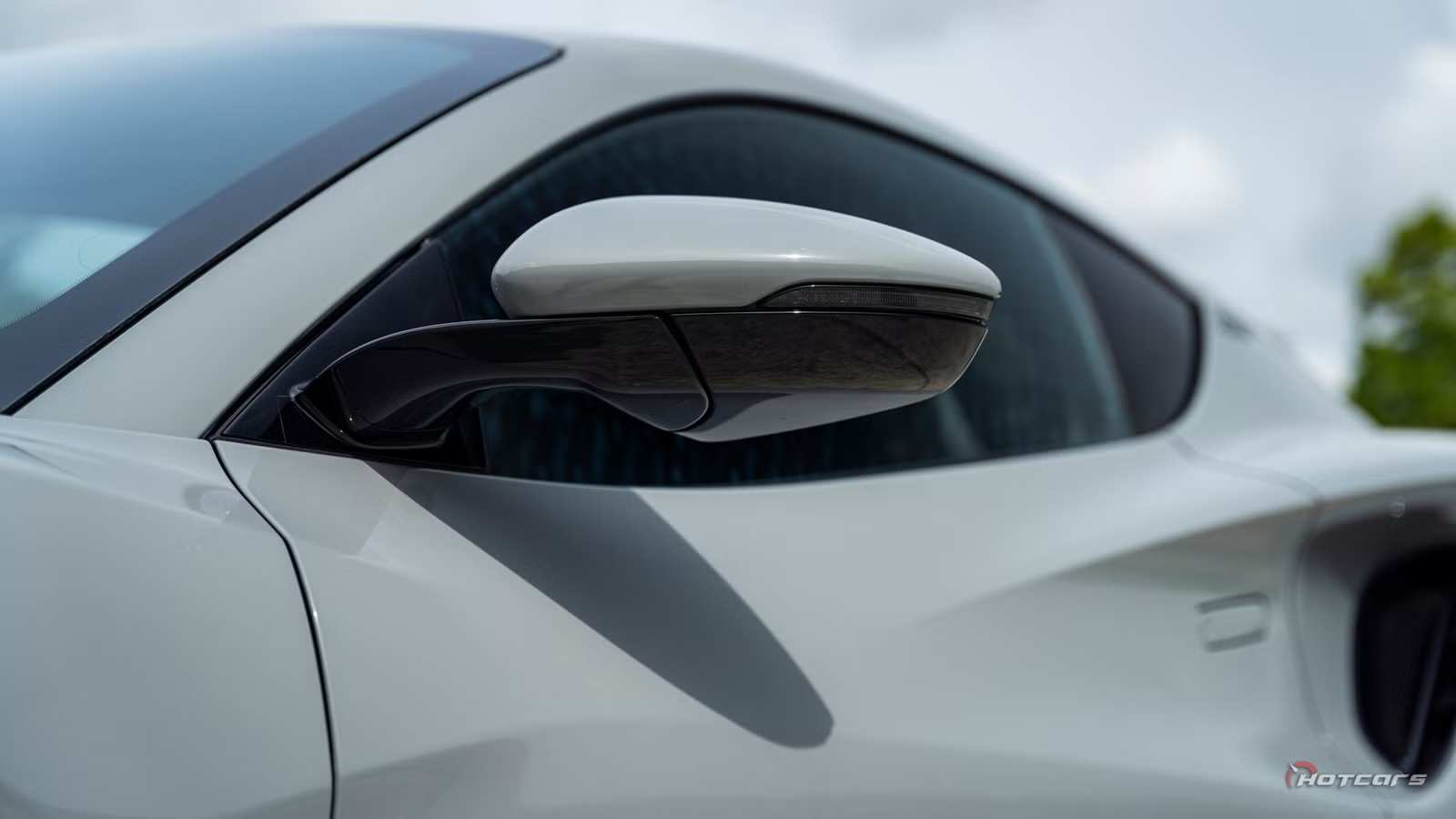
Anyone in the market for a sports car in 2026 already knows the segment is more polarized than ever. With new car prices on the rise every year, there seem to be fewer great-value options to choose from, while true enthusiast cars are slowly being phased out. Yet at the same time, brands seem to be introducing their new million-dollar supercars and hypercars left and right – even budget ones like Toyota, which just recently revealed its upcoming GR GT supercar. Something doesn’t add up.

When it comes to affordable and intermediate options, the vast majority of buyers gravitate to just a handful of the most popular models, such as the Porsche 911, Chevy Corvette, or budget Japanese sports cars like the Mazda Miata. This leaves several incredible sports car options vastly overlooked, but one brand-new option currently stands head and shoulders above the rest, combining virtually everything gearheads seem to be looking for in a sports car into one package: mid-engined design, manual transmission, exotic looks, great reliability, simple maintenance, and an amazing exhaust note. And despite being sold new in 2026, it remains a hidden gem that no one cross-shops.
What The Most Popular Sports Cars Tell Us About The Market
When it comes to which sports cars dominate the popularity charts, you would think that fun, budget Japanese options such as the Toyota GR86 and Mazda Miata would easily top that list. Especially considering they’re some of the highest-rated sports cars on sites such as U.S. News, combining analog driving experiences with near-bulletproof reliability. And yet, that’s not even remotely the case. Instead, the new Corvette outsells them several times over, with as many as 24,533 examples finding homes in America in 2025 alone.

The legendary Porsche 911 is a close second, at 13,574 units. Despite starting at over $125,000, its fame and legacy have made it a default choice for anyone considering a more premium sports car. Meanwhile, the Miata and GR86 sold 9,940 and 8,727 units, respectively. Almost as popular is the Porsche 718, which starts at over $72,000, followed by the Nissan Z and Supra, which are slightly cheaper and sold only 5,487 and 2,953 units last year.

What this all tells us is that at least around 50,000 Americans bought a new sports car that cost over $70,000 last year, and yet most of them gravitated toward the same few options. It is not surprising, but gearheads in the know have good reason to choose other, less popular sports cars, such as the incredibly premium and reliable Lexus LC500.
The data also tells us that, while gearheads on a budget prefer safe ownership, analog fun, and reliability, those with $70k or more to shell out on a sports car prefer mid-engined performance, such as in the Corvette and Cayman, and sheer luxury and heritage, such as the Porsche 911. Buyers who spend a lot on sports cars also prefer to buy from European brands. However, there is one purebred sports car gem on the market right now that is even less popular than the overlooked—and admittedly hefty—LC500, despite satisfying every single one of the criteria mentioned above:the Lotus Emira.
The German Wagon Nobody Bought Is Secretly More Luxurious Than Modern SUVs
This German wagon makes every argument, ticks every box, and outclasses modern SUVs on every metric that matters.
The Lotus Emira Is The Sports Car Market’s Biggest Hidden Gem

Launched in 2021 as Lotus’s latest and greatest mid-engined sports car, the Emira offers the mid-engine purity and engaging dynamics buyers say they want, wrapped in a rare package that looks like a Ferrari and remains relatively attainable and reliable at roughly $100,000, depending on the trim. Despite that, almost no Corvette, Cayman, or 911 buyer is even considering it.

In 2025, Lotus sold a grand total of 1,968 Emiras globally. The brand does not reveal how many of those were sold in America, but they do reveal that out of 6,520 models sold in general, only 1048 were sold in the U.S. and Canada combined – less than a sixth. By that logic, it’s safe to assume only a few hundred Americans bought the Emira over something like a Porsche Cayman or a Supra.
What sets it apart is Lotus’s focus on driver connection over lap times. It features striking baby Ferrari looks, a two-tone leather-wrapped cabin that is more refined and livable than any Lotus before it, two venerable 400-hp engine options sending power to the rear wheels, and thoughtful gearhead-oriented touches such as the exposed linkage on the manual gearbox and a customizable 12.3-inch digital gauge cluster. In fact, it’s by far the most refined and luxurious interior in a Lotus. When we reviewed the Emira, we described it as “a significant departure from the brand’s traditionally simple and straightforward cabins, offering a more refined, comfortable and spacious environment.”
Mid-Engined Performance Meets Toyota Reliability

|
Engine |
Power |
Torque |
0-60 mph |
Top Speed |
|---|---|---|---|---|
|
3.5-liter supercharged V6 |
400 hp |
310 lb-ft |
4.2 seconds |
180 mph |
One of the most polarizing aspects about the Emira is its standard supercharged 3.5-liter Toyota 2GR-FE V6. It is either the reason you would buy this car or the reason you would steer clear. Here’s why the former makes a lot more sense. First off, it’s not a fresh experiment. In fact, that supercharged V6 is probably the oldest part in the Emira, used and perfected in the Exige and Evora since as far back as 2010. The same engine also appeared in the Toyota Camry, Avalon, and even the Lexus RX350, earning a reputation for near-bulletproof reliability along the way.

Lotus did not just slap on the Edelbrock supercharger and call it a day, either—it also revised the V6 with a new intake and exhaust, new exhaust camshafts that provide higher valve lift, and Emira-specific factory ECU tuning. These changes completely transform the 2GR-FE’s character from an economy car engine into a screaming, rev-happy performance mill. The Emira’s V6 has linear throttle response and pulls all the way to 6,800 RPM. It makes exactly 400 hp and 310 lb-ft of torque – enough to slingshot the 3,175-lb baby supercar to 60 mph in just 4.2 seconds with a manual transmission, which is on par with the 500-hp Mustang Dark Horse and something like a Porsche 718 Cayman S. It will also cover the quarter mile in 12.6 seconds.
11 Most Reliable Sports Cars Built Over The Last 10 Years
Aside from offering serious power and fun, some of these sports cars will easily last 300,000 miles.
Lotus Also Caters To Boost Enjoyers

|
Engine |
Power |
Torque |
0-60 mph |
Top Speed |
|---|---|---|---|---|
|
2.0-liter turbo I4 |
360 hp |
317 lb-ft |
3.8 seconds |
171 mph |
|
2.0-liter turbo I4 |
400 hp |
357 lb-ft |
3.4 seconds |
180 mph |
Lotus also offers the Emira in a radically different turbocharged inline-4 version, which borrows its massively boosted engine from the Mercedes-AMG A45 and similar variants. It’s already the most powerful production four-cylinder in the world, but Lotus made some tweaks to that engine, too. Apart from rotating it to fit behind the cabin, the brand added its own bespoke intake and exhaust, remapped the ECU, and calibrated the 8-speed dual-clutch automatic.
Base turbo versions push “only” 360 hp and 317 lb-ft but offer more low-end and total torque than the supercharged ones. Meanwhile, the Turbo SE trims push the four-pot to 400 hp and 354 lb-ft. With the dual-clutch transmission doing its job, this one launches the Emira to 60 mph in a scarcely believable 3.4 seconds—quicker than everything from a Porsche 911 to a Cayman S and GTS, and almost as quick as the 490-hp base Corvette C8. The quarter-mile comes in at just 11.7 seconds. That performance comes at the cost of a worse exhaust note and no manual transmission. But at $106,900 for 2026 models, the Turbo SE is actually cheaper than the standard V6 SE at $112,900.
Where the Emira especially shines, though, is in its mid-engined balance and driver engagement. It boasts nearly the same wheelbase as a Porsche 911 or a Cayman at just 2,575mm – significantly shorter and better for agility than many supercars. But how reliable is it?
How Reliable Is The Emira?

Early ownership data and owner testimonials paint the Emira as surprisingly dependable for a Lotus. This sports car has already been on the market for a solid five years, meaning all the minor gremlins have been worked out. But even so, owners have nothing but praise for its quality and reliability, reporting minimal drama beyond routine maintenance.
Owners commenting on forums are also quick to point out that any issues they had were minor electronic problems, that none of those ever stemmed from the engine, and that it is incredibly reliable. That tracks, since the 2GR-FE features an incredibly robust cast aluminum block with six main bolts per bearing journal to minimize block flex and a forged crankshaft and connecting rods. The race-proven Mercedes-AMG M139 inline-4 is also not a new engine, and one that has proven itself relatively reliable over the years.

Still, the main drawback of going with any Emira over something like a Toyota Supra or a Corvette C8 is that it is, after all, a rare, hand-built exotic. With that being the case, even routine service and parts can be expensive, with some owners reporting service shops charging as much as $960 for oil and filter changes. Because of that, you’ll often see owners recommending going to a private shop or even changing your own oil instead. Some owners claim to be paying as little as $50 for oil changes per year this way.
We searched forums for annual maintenance cost estimates for the Emira, and most fall in the $600 to $1,200 range. Also for reference, owners of older Evoras that featured the same 3.5-liter supercharged 2GR-FE engine claim that maintenance usually sets them back around $1,500 or more per year. Based on all of this, it’s safe to assume that an Emira is definitely not the cheapest sports car to maintain, but it may very well be the most affordable mid-engined manual one.
See, while the C8 Corvette is definitely cheaper to maintain at just $2,799 over 5 years (about $560 per year) if you ask CarEdge, and $727 per year according to RepairPal, it doesn’t offer a manual transmission. Another mid-engined option includes the Porsche Cayman, but RepairPal estimates its maintenance at a steep $1,135 on average.
With a starting price north of $100,000, the Emira is definitely a premium sports car option, but as shown above, one that very much justifies its price tag. It’s definitely not for everyone, but it may be the absolute perfect sports car choice for a gearhead who isn’t deterred by less cut-and-dried maintenance and appreciates an analog driving experience over a Porsche badge or a Corvette V8.
It’s also a great option for anyone who enjoys that mid-engined Italian supercar vibe without having to go used or spending several hundred grand to own a new one. Finally, it’s an obvious option for an enthusiast who simply wants something unique and different. The Emira is, and always will be, a conversation starter. Whether you opt for the DCT-equipped, torquey AMG four-pot or the purist V6, it will allow you to completely bypass the ubiquity of the Corvette and 911 and stand out from the crowd without having to join a waiting list.
Used Emiras are already proving great resale value options, with Classic.com quoting an average price paid of $90,352. That’s just over $10k shy of the Emira’s MSRP. A quick browse through current online listings reveals buyers are not quick to part with their Emiras. Even the highest-mileage examples on Edmunds, with over 22k miles on the clock, start in the mid-$80k range. In fact, the cheapest one that sold in the last year sold for $75k, and that was a huge outlier. The market is definitely there, and with proper sports cars being slowly phased out, the Emira’s prices may very well continue to climb.

Related posts



Latest Post



No Comments