
The Inline-Four Honda Motorcycle That Quietly Gets Everything Right
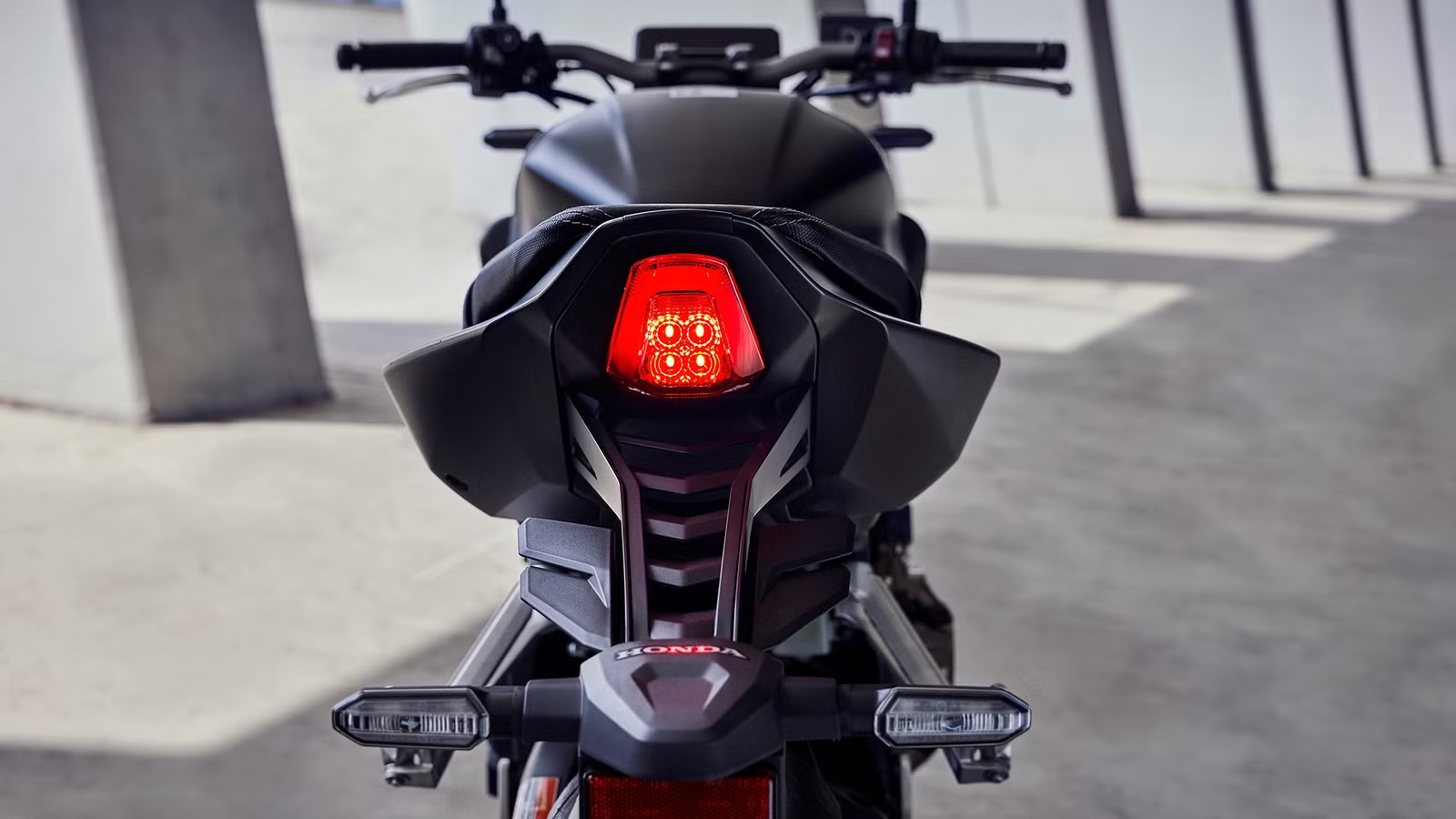
The middleweight naked motorcycle segment has quietly settled into a comfortable formula. Pick a Yamaha MT-07, Kawasaki Z650RS, Suzuki GSX-8S, or Triumph Trident 660, and you are generally getting a compact engine that makes useful torque without needing to chase the tachometer. It is a sensible recipe, and there is nothing wrong with it. However, there is another kind of sensible. The kind that starts with an old-school inline-four, keeps the smoothness and character riders love, then finds a way to remove the one part of manual motorcycling that can become tiresome in traffic. This is a recipe Honda nails today, beating all of its contemporaries.
The Middleweight Inline-Four Is Slowly Vanishing

Spend five minutes searching for a middleweight and the pattern becomes obvious fast. Easy-going parallel-twins are the new norm wherever you look. The Yamaha MT-07 leans on a 689cc parallel-twin that’s practically synonymous with the segment at this point. The Kawasaki Z650RS uses a slightly smaller CP2 engine borrowed straight from the Ninja 650. Suzuki’s GSX-8S went bigger, but still has a 776cc parallel-twin.

Slowly, four-cylinder engines lost this fight for reasons that made sense on paper. More cylinders mean more parts, more machining, and more weight to lug around, plus a powerband that traditionally wanted 8,000-plus rpm before it felt alive — not exactly ideal for a typical weekday commute spent crawling behind a delivery van. Add in the old assumption that an inline-four’s clutch needs constant babysitting at every stoplight, and it’s easy to see why most manufacturers quietly stopped building fours at this price point altogether.
Honda Is The Only One Keeping The Inline-Four Flag Flying

Between all that, there’s only one brand keeping the inline-four middleweight flag flying. We’re talking about Honda, which, unlike its rivals, offers a duo of middleweight inline-four bikes. They aren’t age-old and neglected bikes, either; they’ve had recent updates that bring them up to date. More importantly, Honda just slashed the prices to make them even cheaper than parallel-twin rivals. Between them, the naked quietly gets the balance right.

The Honda CB650R E-Clutch Is The Middleweight Unicorn In A Sea of Parallel-Twins
Base Price: $8,699

Meet the Honda CB650R E-Clutch, the last inline-four naked bike standing anywhere near this price bracket in the U.S. market. The “R” designation traces back to 2019, when Honda folded the outgoing CB650F into its Neo Sports Café family — round LED headlight, a stubby tail section, minimal bodywork, and just enough exposed engine to remind onlookers what’s actually doing the work underneath. It shares its platform and its 649cc engine with the fully-faired CBR650R, but strips away the fairing for a rawer, more upright stance. Also, for 2026, Honda dropped the base price to $8,699, a full $700 less than the previous year’s $9,399, without touching a single mechanical component. Same engine, same chassis, same E-Clutch hardware.
A High-Revving Inline-Four That Doesn’t Ask For A Track Day
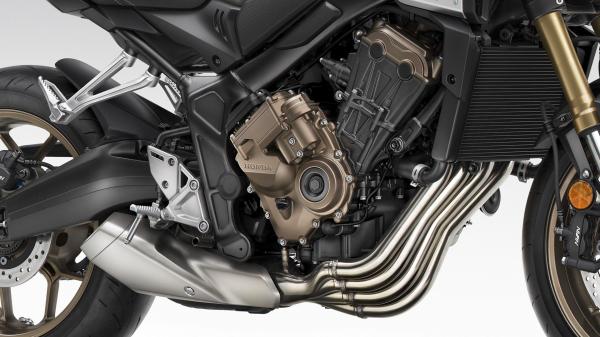
At the CB650R’s heart sits a 649cc, DOHC, liquid-cooled inline-four — the exact engine found in its faired sibling, the CBR650R — with a 67.0mm bore and 46.0mm stroke that favors revs over raw low-end torque. Honda says the middleweight naked is tame and entirely manageable down low, easy to short-shift through a parking lot, then it noticeably wakes up past 8,000 rpm and keeps pulling toward a top-end rush no twin at this price point can convincingly fake. That’s traditionally where inline-fours punish daily riders: a hand cramping from clutch work in stop-and-go traffic just to earn access to that top-end thrill on the weekend.
Analog Simplicity Meets Modern Control

The CB650R still feels like a conventional motorcycle at its core. There is a normal six-speed gearbox, a familiar foot shifter and a conventional clutch lever that remains available whenever the rider wants it. The engine’s PGM-FI fuel injection uses 32mm throttle bodies, maintaining the direct throttle response expected from a modern naked bike. The electronic assistance is deliberately restrained. Honda Selectable Torque Control, or HSTC, monitors conditions and manages engine output to reduce rear-wheel slip, and dual-channel ABS is standard.
The Honda E-Clutch Redefines The Ride

You also get Honda’s E-Clutch. This isn’t a DCT wearing a disguise, and it’s not a centrifugal auto-clutch either. Inside the right-side engine cover sits a compact motor control unit (MCU) running two small 32mm electric motors, wired into the same clutch mechanism a conventional manual bike already uses. The system continuously reads engine rpm, throttle position, shift-pedal load, gear position, and wheel speed, then commands those motors to open or close the clutch at precisely the right moment during a shift — all without a finger ever touching the lever. It’s a genuinely clever piece of engineering hiding in plain sight, and one that took Honda years to get right.
Stall-Proof Commuting and Seamless Up/Down Shifts

Roll to a stop, and E-Clutch quietly releases clutch pressure so the engine keeps idling instead of dying underneath you. Pull away again, and it re-engages with the same smoothness Honda borrowed straight from its DCT playbook, no lurching or hesitation. Riders still work the gear lever with their left foot exactly as they always have — E-Clutch just erases the physical clutch input, and with it, the single biggest reason a four-cylinder naked bike used to feel like a chore in gridlock.

Grab the clutch lever at any point, for any reason, and E-Clutch instantly hands over full manual control back — no menu to dig through mid-ride, no mode to disable first, no compromise. That instant override is the detail separating it from a conventional quick-shifter, which only ever manages half the job and still requires a working clutch hand, or from Honda’s own DCT, which removes the clutch lever from the equation entirely. E-Clutch does neither. It sits quietly in the background until it’s actually needed, then gets completely out of the way the moment a rider decides they’d rather do the shifting themselves.
A Chassis Built For Real Roads, Not Just Showrooms

Up front, a 41mm inverted Showa Separate Function Fork Big Piston (SFF-BP) unit handles 4.7 inches of travel, paired with a single rear shock offering 5.1 inches out back. Braking duty falls to dual 310mm front discs gripped by radial-mounted four-piston calipers, backed by a single 240mm rear disc, with standard ABS running both channels. None of this is exotic, race-spec hardware, and Honda never pretends otherwise. However, all of it is tuned toward being predictable and confidence-inspiring rather than flashy on a brochure.
Ergonomics Remain Upright And Comfortable

A 31.9-inch seat height and a manageable 456-pound curb weight keep the CB650R approachable for riders who aren’t pushing 6-foot-plus, while a naked-bike riding position — upright enough for commuting, aggressive enough for a canyon run on a Sunday morning — splits the difference nicely between the two. A 5-inch color TFT display with Honda RoadSync brings turn-by-turn navigation and phone connectivity to the bars, while full LED lighting rounds out a tech package that, spec-for-spec, quietly undercuts pricier naked rivals without feeling like Honda cut a single corner to get there. That’s the trick this bike keeps pulling off, one unremarkable detail at a time.
Source: Honda Powersports

Related posts



Latest Post


No Comments