
The Muscle Car V8 That Kept Hauling Motorhomes Into the 2000s
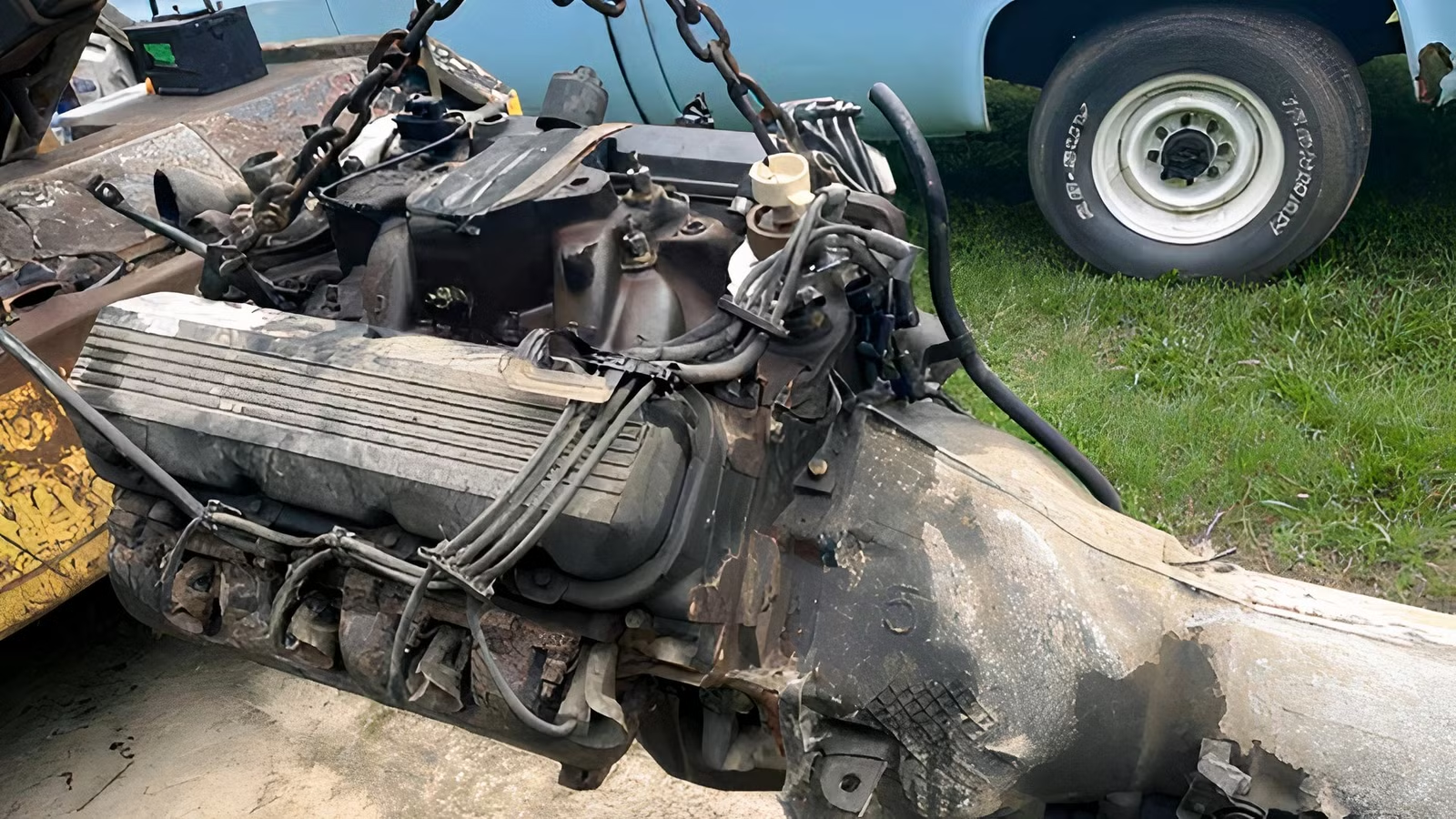
The first great muscle car renaissance ended in about as tragic of a way as you could possibly imagine. In the span of just a few years, an industry segment priding itself on big engines, high compression, and even bigger power saw every single facet of itself regulated into oblivion. By all accounts, the age of gigantic engines in American cars should’ve ended after 1973, but we all know that’s not how the story went down. Even if cars couldn’t pack engines the size of continents anymore, there was nothing stopping other ends of the market from doing just that. In fact, if you want to source a great muscle car engine these days, a great place to start is an old RV.
On the Drag Strip, and at the RV Park, Big American Engines Ruled Supreme

In those glory days of the 1960s, there was more than one motorized revolution taking place in the United States. On one side, we had the well-remembered and well-respected muscle car wars. It’s the side that’s well celebrated, to the point that even the minutiae have books, internet articles, and sometimes feature-length documentaries dedicated to it. Yet, on the other, you had the emerging medium of American recreational vehicles.
The first American RVs had their origins in the early 1900s, a time when the motor car itself was still a fairly new phenomenon. Over the years, eccentric inventors like Glenn H. Curtiss, William Stout, and Brooks Stevens refined the idea of a large, spacious living quarters with a motor vehicle attached to it. Starting in roughly the early 1960s, the medium transformed into a full-blown market segment for post-war GIs and their families to travel the country. Companies like Winnebago, Airstream, and FMC either had their start or came into their own during, or soon after, this period.
On the backs of perfectly normal stripped commercial truck chassis like the Dodge M-Series or the Chevy P30 step van, each manufacturer would fabricate bespoke fiberglass or aluminum bodies with provisions for sleeping, cooking, and family entertainment from front to back. In the same driveways as Chargers, Toronados, and Torinos, these massive ten-ton RVs were nearly as common a sight as the best and brightest muscle cars from the period. Ironically, what was needed to power these titans was fairly similar to a muscle car beneath the skin.

High Compression and Heavy Hauling: A Shared Blueprint

When a purpose-built muscle car drag machine needs gobs of low-end torque, it’s in the pursuit of the quickest quarter-mile launch from a dig that’s humanly possible. Well, an RV needs just as much torque to lug five to eight tons of aluminum, steel, fiberglass, and shag carpeting down the road at something approximating highway speeds. It’s for this very reason that the iron blocks, heavy-duty internals, and general indestructibility of 60s muscle car engines went hand in hand with the needs of a big RV.
In those years, you could spec your RV with the exact same big-block motors found in muscle cars, and they were often the standard engine that came with them from the factory. All three of Detroit’s big OEMs supplied V8 engines to RV makers at one point or another, occasionally offering their most iconic muscle car blocks with a bare minimum of changes or modifications from their configurations in passenger cars. Dodge, for instance, offered its beloved 413 and 440-cubic-inch RB wedge big-block V8s in its M-Series Chassis, while Ford distributed its 460-cubic-inch, 385-series V8 to a wide range of RV manufacturers across several different classes. Save for a different coat of paint, and maybe a change in the carburetor setup, there really wasn’t much of anything different between these motors in a muscle car and how they were presented in an RV.
In those golden years of both disciplines, giant V8s flowed like a river down a waterfall. That was, until roughly 1973. At that time, newly-minted emissions regulations and fuel economy standards driven by a massive global oil crisis abruptly brought an end to the muscle car era. At the same time, many RV makers decided to opt for different, smaller engines; fare like small-block V8s, diesels, and even gas V6s tried, and often failed, to squeeze as much fuel economy out of gigantic platforms as possible. In short order, big-block V8s were soon phased out of RV production, not long after they fell out of favor in passenger cars. Well, that’s true for most Ford, Chrysler, and even most GM options. That is, save for one Chevy big-block that managed to defy the odds.
Chevy Big-Block 454 Mk4/5/6: The Lone Survivor

The Mk4 Chevy big-block 454 V8 made its global debut in 1970, under the hood of the Chevelle SS LS6. In that configuration, the car made a healthy 450 gross horsepower and 500 lb-ft of torque. In the twilight of the muscle car wars, this special breed of the 454 was one of the final GM halo engines of the period. When the time came for the era to end, and while all its competition found itself sunsetted and obsolete, the Mk4 Chevy 454 didn’t go quietly into that good night. Instead, it simply adapted, very slowly, and very surely. From then on, the engine took on a new life, strictly as a heavy-duty commercial truck or van engine, and as a powerplant for large motorhomes.
This role largely kept the engine exempt from the crippling emissions restrictions that the last of the giant American big-block passenger car V8s suffered with. This allowed GM to keep refining the engine, first with the Mk5 and its one-piece rear main seal, revised oiling passages, and four-bolt mains. Hitting the scenes in 1991, the Mk5 454 big-block outlived its rivals by as much as two full decades. With 290 horsepower and 410 lb-ft of torque, these late big-blocks were very different beasts from the Chevelle powerplants they used to be. Yet, they were just what the doctor ordered to pull a 10,000-pound motorhome over a mountain pass without breaking.
Even then, GM still had one more revision in the cards, and in 1996, the Mk6 454 became the final act in a story that should’ve ended decades ago. With multi-port sequential fuel injection, a hydraulic roller camshaft, and a revised cylinder head that breathed better than the ancient castings of older engines, the Mk6 454 was far removed from the screamer it once was. Still, the Mk6 found itself a stalwart of the RV scene, appearing as an option in classics of the era like the Safari Trek, the Fleetwood Bounder, and the Winnebago Chieftain. Dubbed the Vortec 7400 with an internal code of L29, the motor made just as much power as its Mk5 predecessor, but with far more efficiency. All the while, the L29 continued to serve in heavy-duty truck roles, like the GMT400 Suburban and Silverado 3500 all the way until 2000, when the 8.1-liter Vortec 8100 replaced it.
The 30-Year Survival Story No Modern Engine Can Match

At a time in history when engines are routinely replaced every few years, the 454’s three-decade production run stands as an unbeatable feat of American continuity. Few engines have ever successfully transformed from a high-octane boulevard bully into a reliable, high-mileage highway cruiser, but the 454 did so with remarkable skill.
The undisputed king of Chevrolet muscle motors never truly died when the golden era of muscle met its premature end. Instead, it simply changed its uniform, quietly hauling generations of holiday road-trippers on the exact same iron backbone that once ruled the drag strip. Today, those same RVs serve as a perfect donor platform for folks looking for big-blocks, and the Turbo 400 gearboxes commonly paired to them, to swap into restomods and full muscle car restorations. Even then, they don’t have to do much to them in terms of modifications to turn them back into the fire-breathing drag machines they used to be all those years ago.
Source: gmt400.com, Hemmings

Related posts




Latest Post


No Comments