
This American Motorcycle Still Has Something No One Else Does
Modern liter-class sport bikes have reached a point where the differences can sometimes seem smaller than the spec sheets suggest. Some scream through inline-fours, others bark through V4s, and nearly all rely on similar solutions for chassis design, braking, aerodynamics, and electronics. Yet one American manufacturer is still building a genuine liter-class sport bike around something the rest of the industry has largely abandoned: a big, high-output V-twin with legitimate superbike intent.
The V-Twin Liter-Class Sport Bike Has Almost Disappeared

V-twins certainly aren’t extinct. They’re everywhere in cruisers, naked bikes, adventure bikes, and sport-tourers, and smaller high-performance twins remain common across the market. What has practically vanished, though, is the big V-twin wrapped inside a full-on sport-bike chassis and asked to fight in the same performance territory as contemporary liter-class machines.
That makes the absence particularly noticeable because this formula once produced some of the most charismatic superbikes around. Ducati’s earlier superbikes built entire generations of performance machinery around two cylinders, while Honda briefly went hunting with the RC51. Today, the serious end of the category has moved elsewhere. So if somebody still wants a full-size sport bike driven by a large V-twin, the list of options becomes very short very quickly.
Even American Bikemakers Rarely Think About V-Twin Superbikes


That scarcity becomes even stranger when you look at the US market. America arguably has a stronger cultural association with V-twins than any other motorcycle market, yet those engines are overwhelmingly tied to cruisers, baggers, and increasingly muscular performance cruisers. The idea of an American-built liter-class sport bike was unusual even before you started asking what sort of engine should power it.
This is where the story gets more interesting. Instead of trying to build an American interpretation of a BMW S 1000 RR or Kawasaki Ninja ZX-10R, one small manufacturer has stuck with its own philosophy. The engine layout is familiar in an American context, but almost alien in a modern superbike one. Better yet, that refusal to follow convention extends far beyond the powerplant.
The Buell Hammerhead 1190 Is The V-Twin Liter-Class Sport Bike Nobody Else Builds

That motorcycle is the Buell Hammerhead 1190, and its defining feature is right there in the middle of the chassis. The Hammerhead uses a 1,190cc liquid-cooled 72-degree V-twin, placing it in an increasingly lonely corner of the sport-bike world. Buell rates it at 185 horsepower and 102 pound-feet of torque, so this isn’t a nostalgic throwback dressed in modern bodywork. It’s a proper high-output liter-class machine.
Then you get to the front wheel, and things become even more unusual. Rather than using the pair of conventional brake discs found on virtually every comparable sport bike, the Hammerhead has a massive 386mm single perimeter rotor paired with an eight-piston Accossato caliper. The disc mounts around the outer portion of the wheel rather than close to the hub, giving the bike one of the most immediately recognizable front ends in production.

The idea isn’t weird just for the sake of looking weird. Buell’s perimeter brake layout allows the motorcycle to use one large rotor rather than two conventional discs, while placing braking loads closer to the rim instead of transmitting them through the spokes in the usual way. It’s classic Buell thinking: take a component everyone considers solved, question the basic premise behind it, and come back with something that looks like it wandered in from another branch of motorcycle evolution.
Its Frame Is Doing More Than Holding The Motorcycle Together

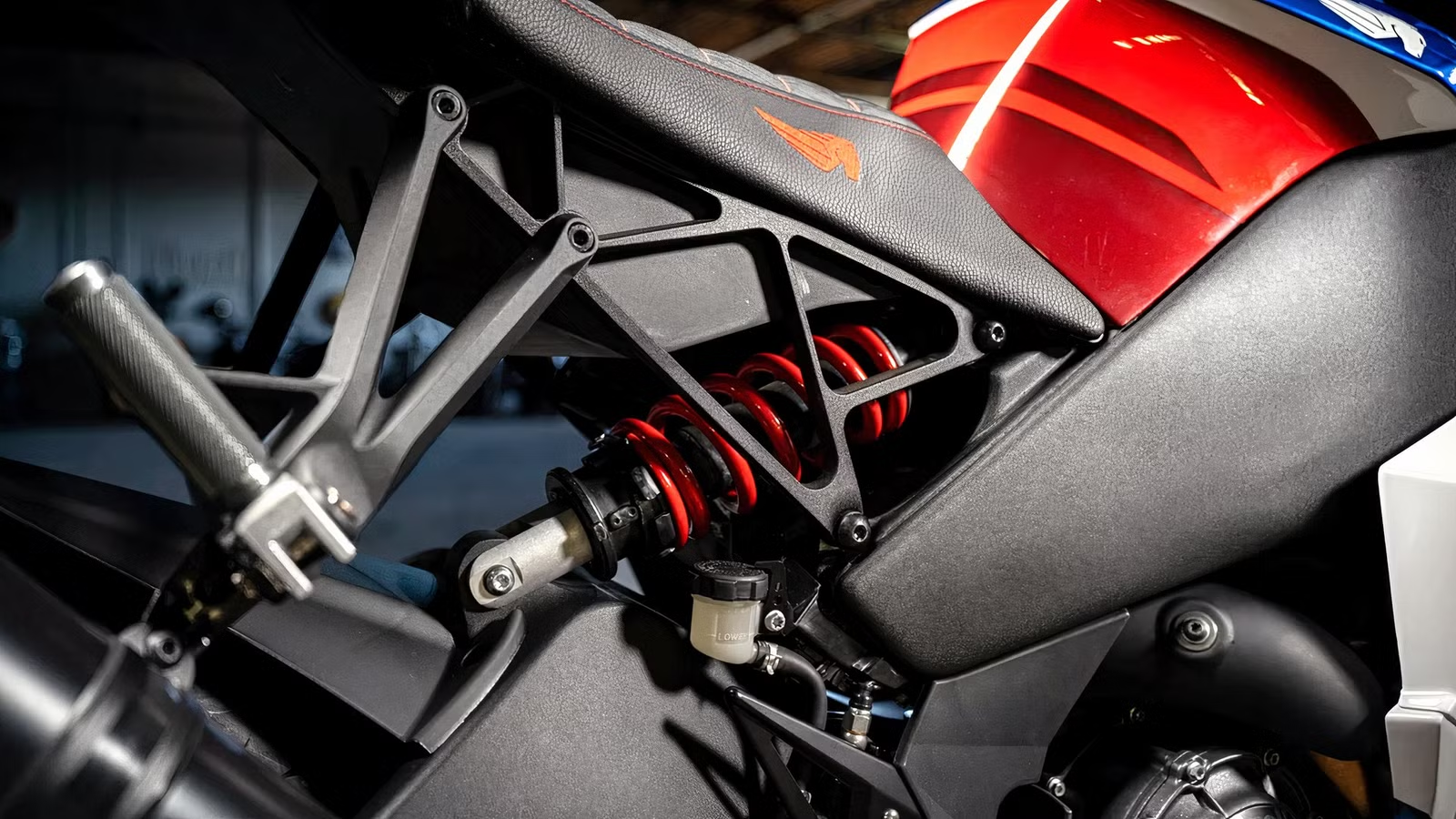
The same thinking continues with the chassis. Buell has long been obsessed with mass centralization, and the Hammerhead’s aluminum frame doubles as its fuel reservoir rather than relying on a conventional tank sitting above the engine. That packaging keeps a meaningful amount of mass lower and closer to the center of the motorcycle while freeing Buell from one more piece of conventional sport-bike architecture.
Taken individually, the V-twin, perimeter brake, and fuel-carrying frame could sound like a collection of engineering trivia. Together, they’re the reason the Hammerhead has such a distinctive identity. This isn’t a motorcycle that takes an accepted superbike platform and adds unusual styling. Its engine layout, braking system, and basic packaging all come from a company that has spent decades asking whether conventional motorcycle design really has to be conventional.
There’s A Serious Superbike Underneath The Unusual Formula
None of that would matter much if the numbers were mediocre, but they’re not. The 1,190cc V-twin produces its 185 horsepower at 10,600 rpm, while peak torque arrives at 8,200 rpm. Power goes through a six-speed transmission and hydraulic slipper clutch, and Buell lists the Hammerhead at just 419 pounds wet without fuel. That’s a pretty serious power-to-weight ratio for something built by a comparatively tiny American manufacturer.
The rest of the hardware is similarly purposeful. Up front is a Wilbers inverted big-piston fork, while a Showa shock handles the rear, and a Buell steering damper adds another layer of chassis control. The bike rolls on 17-inch aluminum wheels wrapped in Dunlop Sportmax Q5A tires, while the rear brake uses a 220mm disc with a two-piston caliper. Carbon-fiber bodywork is standard rather than an expensive optional upgrade.

Ergonomically, Buell lists a 32.5-inch seat height and 4.7 inches of ground clearance, numbers that leave little doubt about the Hammerhead’s sport-focused purpose. Its engine was originally developed for AMA road racing, too, which helps explain why this American V-twin behaves nothing like the lazy, low-revving stereotype normally associated with the configuration. This is a twin designed to rev hard enough to make 185 horsepower, not one intended to spend its life thumping along at the bottom of the tach.
Being Alone In Its Class Is The Hammerhead’s Biggest Strength And Biggest Gamble

The Hammerhead 1190 starts at $20,995, which puts it directly against extremely polished performance machinery from manufacturers with much larger dealer networks, deeper racing programs, and considerably more money to throw at development. Buell offers the bike in Carbon, Miami Knight, Freedom Edition, Racer Red, White, Grabber Orange, and Utah Blue finishes, with carbon fiber remaining standard across the lineup.
That price means the Hammerhead can’t survive on novelty alone. Buyers shopping strictly by electronics, dealer accessibility, refinement, or the reassurance of a massive global support network will probably find easier choices elsewhere. But those motorcycles also won’t give them this particular combination of hardware. Nobody else is currently packaging a 1,190cc American V-twin, a fuel-carrying frame, a perimeter front brake, and carbon-fiber bodywork into quite the same kind of liter-class sport bike.

That’s ultimately what makes the Hammerhead interesting. Plenty of modern superbikes are faster, more sophisticated, or backed by longer racing résumés. Several offer staggering horsepower figures and electronics packages that would have sounded like science fiction two decades ago. But almost none can claim to occupy their own category. The Hammerhead basically can, and in a performance-bike market where so many manufacturers have arrived at similar answers, being the strange one may be Buell’s strongest card.
Source: Buell Motorcycle

Related posts




Latest Post


No Comments