
10 Reliable Cruisers That Can Outlive Their Owners
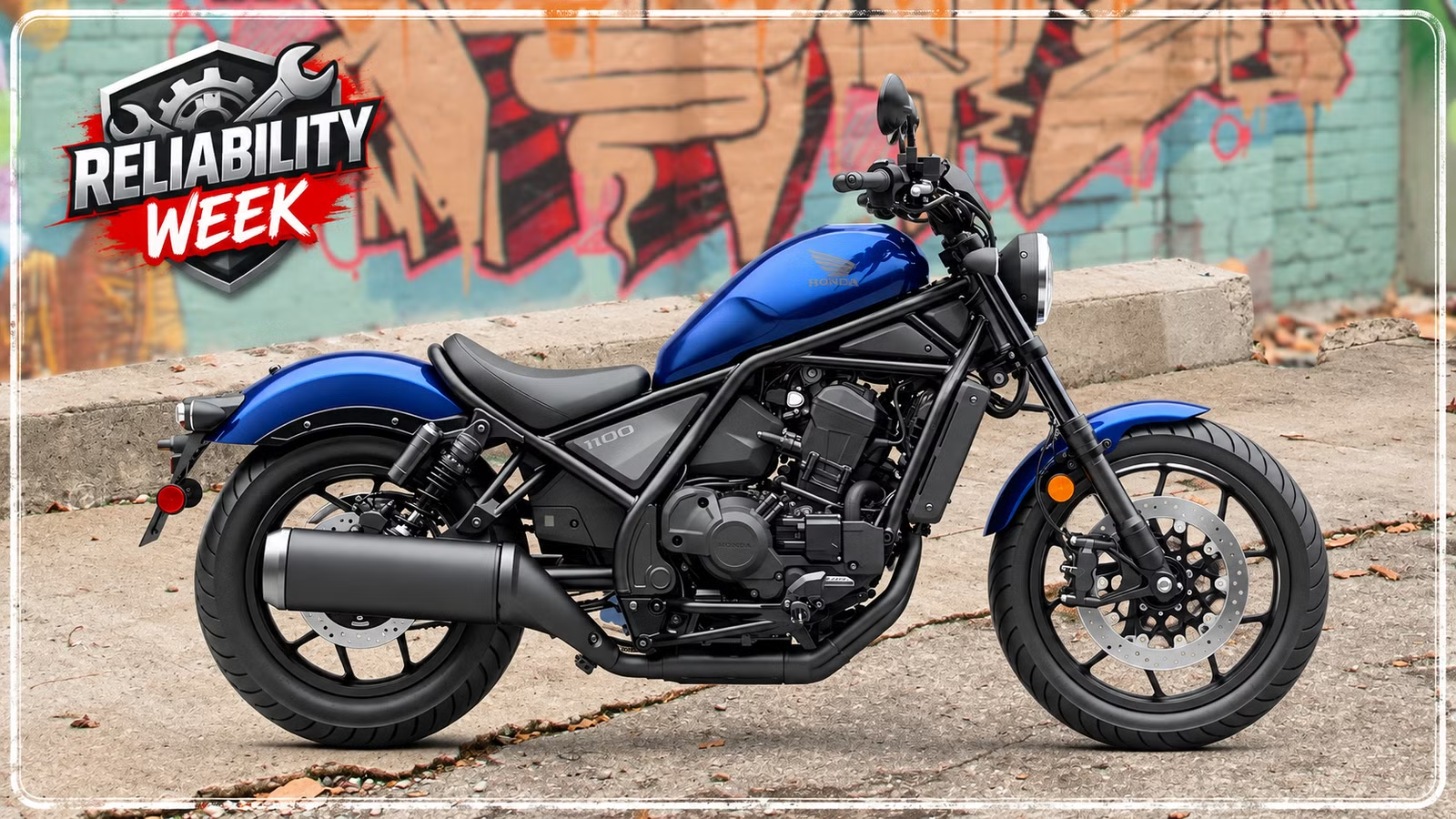
Reliability is an integral element for a cruiser motorcycle. After all, these are expected to do everything from getting you to your office to spending days on the freeway during road trips. But as you’d expect, not every cruiser is built the same, and some examples are understandably better than others. That’s exactly the kind of cruiser bike we’re focusing on here. Either of these 10 machines will outlive you, and the list comprises everything from a single-cylinder option to an American-made Hollywood icon.
Royal Enfield Meteor 350
Price: $4,899

The Meteor 350 is the only sub-$5,000 cruiser here. So the equipment is all as basic as you’d expect. That works in its favor, however, as there are barely any complex elements and failure points to begin with. There are plenty of high-mileage examples across the world to back that up as well.

As for details, the J-Series engine is the crown jewel. It has air cooling, a single-cylinder, and a relaxed compression ratio to produce 20 horsepower and 20 pound-feet. That helps the mill chug along effortlessly for years and years with regular maintenance.
Honda Shadow Phantom
Price: $8,699


The Shadow was Honda’s answer to Harley-Davidson V-twins upon its arrival. Today, it sits in a niche of its own alongside mid-weight metric cruisers and well under Harley’s smallest offering. On paper, there’s nothing special about it. But dive into ownership portals, and you’ll realize the USP is its reliability.

The engine, suspension, chassis, and feature list are all kept simple to not only outlive the owner, but to technically last forever. Honda also updated the bike with a rear disc, ABS, and blacked-out mechanicals a couple of years ago. So it’s not an entirely neglected product like some of its Japanese rivals.
Yamaha Bolt R-Spec
Price: $8,999

As it stands, there’s no MY26 version of the Bolt R-Spec. So this might be your final chance to take one home. And you should consider doing that if you like the Harley-Davidson Evo Sportster but still want Japanese engineering. This is precisely what the Bolt R-Spec was designed to offer, which is why it looks and feels a lot like the Evo Sportster.

Underneath, this is properly Japanese. There’s a liquid-cooled V-twin engine at its heart, topped with high-quality parts like petal discs and alloy wheels. A blacked-out design with minimalistic bodywork rounds things off. At almost $9,000, it does feel a fair bit pricey, considering this has been largely unchanged for decades.
Kawasaki Vulcan 900
Price: $9,599

The Vulcan 900 follows the same exact recipe as the Phantom above. So you get simple underpinnings and features, topped with a relaxed liquid-cooled V-twin powerhouse tuned for low-end oomph. Thus, the reliability and long-term dependability are comparable to the Honda, if not the same.

What sweetens the deal is the option for two other variants. Kawasaki sells a chopper-like Vulcan 900 Custom and a touring-ready Vulcan 900 Classic LT, along with the base bike. These bring the same mechanical reliability, albeit in different flavors to attract more riders.
Honda Rebel 1100
Price: $9,699

When you strike gold with something, it’s only fair you try to replicate it. That’s what the Rebel 1100 is about. It’s based on the highly proven and unbreakable Africa Twin platform, with the same parallel-twin engine and a similar chassis. At the same time, the engine tune is even more understressed here, and the suspension is even simpler (you don’t even get USDs).

So the package should outlive you with ease and basic maintenance. It’s still a new-age metric cruiser elsewhere, though. A TFT sits in the cockpit, there’s a handful of rider aids, and the aesthetic has barely any chrome. Oh, and there’s a DCT on offer, too!
Triumph Bonneville Speedmaster
Price: $14,795

Triumph’s modern-classic Bonneville lineup is known to accumulate thousands of miles with ease and last for eternity. If you want this dependability in a cruiser-like package, the Speedmaster is your best bet. That’s courtesy of a low-slung saddle, curvy handlebars, and forward-set footpegs, which help set it apart from its roadster siblings.

As for the nitty-gritty, the 1,200cc parallel-twin is the centerpiece, getting you 77 horsepower and 78 pound-feet. All that is low in the RPMs for brilliant tractability. Suspension-wise, telescopic forks and dual rear shocks join up with a sturdy double-cradle chassis. Triumph has also paid attention to modernity by throwing in cruise control, a six-axis IMU, ABS, and ride modes.
Harley-Davidson Street Bob
Price: $14,999

The Street Bob has been around for a while, and it’s one of the most trustworthy names in the Softail lineup since its inception. A driving force behind that has been its engine. Harley has always given the Street Bob one of its milder and more reliable powerhouses, which remains the case in 2026 with the Milwaukee-Eight 117 Classic.

This works in tandem with a proven chassis and suspension package, all focusing on long-term dependability first and pizzazz later. There is more technology than ever, though. So technically, the failure points here are higher than in its previous version.
Indian Chief
Price: $14,999

In Indian’s motorcycle lineup, there are only two engines proven to last well over 100,000 miles. We’re talking about the air-cooled Thunderstroke 111 and 116, and the Chief is your cheapest way to experience this dependability. The 111 sets you back by $14,999, while the 116 bumps the price to a sizable $18,499.

You do get extra features on the latter, though, which helps justify the moolah. Elsewhere, simplicity remains the name of the game, be it in the chassis department or the electronics department. A double-cradle chassis, simple suspension, and single disc brakes are shared on the two variants.
Harley-Davidson Fat Boy
Price: $22,599

The current Fat Boy is based around one of Harley’s most credible engines in recent times: the Milwaukee-Eight 117. That joins up with a proven chassis package–comprising the Softail frame and Showa suspension–to create a properly reliable machine. This is backed up by owner reports claiming these bikes keep running fine with basic maintenance.

The price of admission is high, though. At $22,599, the Fat Boy sits at the premium end of the Softail lineup. That’s just the base price, too. If you want one of the fancy colorways, the MSRP rises by around $1,000.
Harley-Davidson Iron 883
Used Price: ~$7,000

A conversation about reliable cruisers that last forever can never be complete without mentioning the Evolution-powered Sportster. And the Iron 883 is your cheapest ticket here. This engine is known to breeze past 100,000 miles with regular maintenance.

Considering that’s more mileage than most riders accumulate in their lifetime, this will easily outlive most of us. Oh, and if you’re not comfortable getting a used one, Harley is planning to resurrect the Evo Sportster soon. It is said to have the same trustworthy 883cc powerhouse, updated to meet new norms.
Source: Various Manufacturers

Related posts

Latest Post


No Comments