
The Motorcycle That Gives Riders A Taste Of Superbike Performance For Less
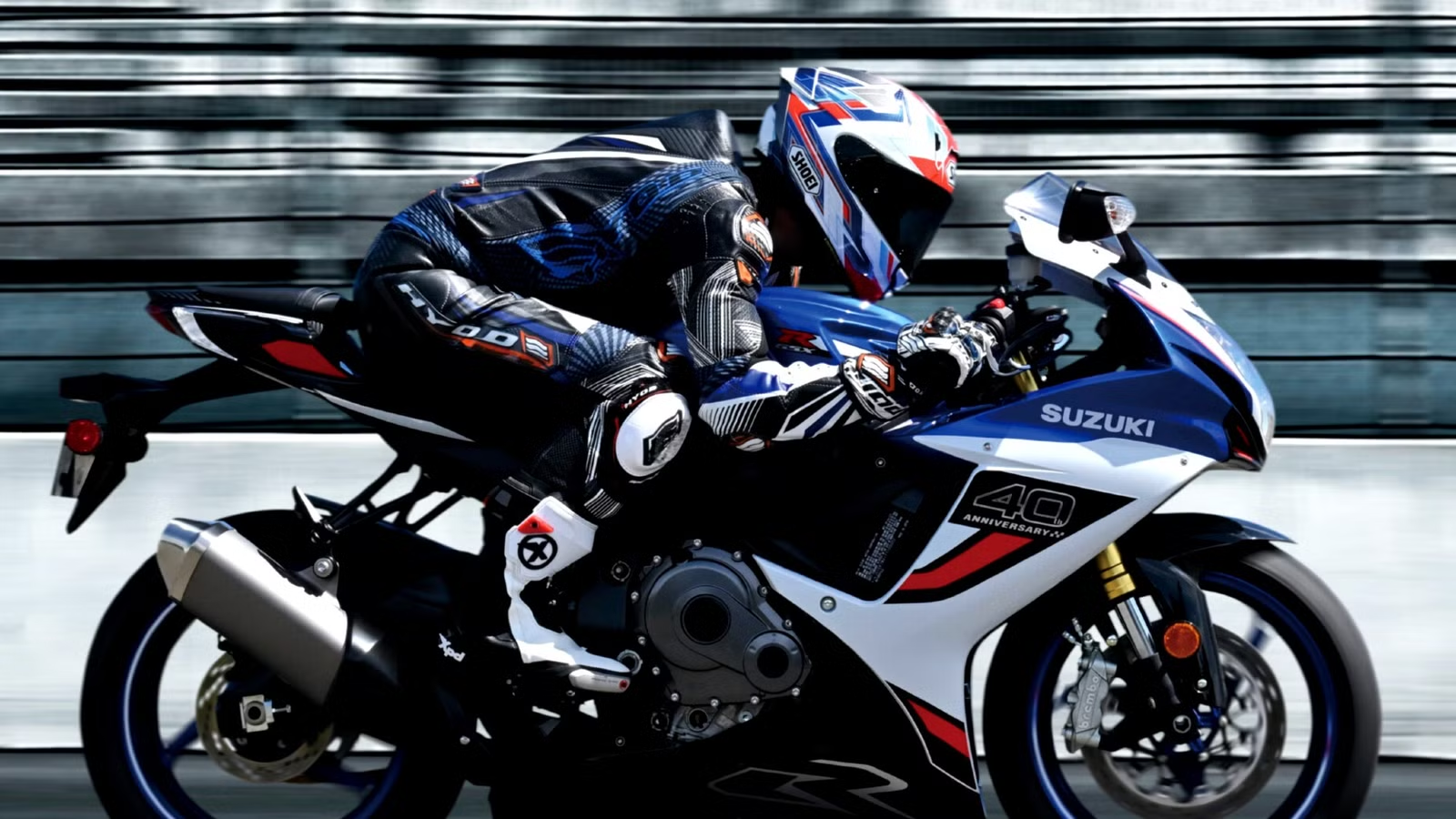
Getting into genuine high-performance sport bike territory has become an increasingly expensive proposition. Liter-class machines now routinely live well into the mid-to-high teens, and that’s before destination charges, insurance, riding gear, and whatever track-day toys inevitably find their way onto the credit card. A logical solution seems to be modern middleweights. They are cheaper, get you usable performance for most purposes, and are easier to live with. But many trade away the screaming top-end character that made traditional supersports so addictive. Then, what do you do if you want superbike kinda jolt without paying $20,000? Well, there’s a solution from Suzuki.
New-Age Middleweight Sports Bikes Don’t Quite Fill The Same Role

Today’s flagship superbikes are engineering monsters. Outputs around or beyond 200 horsepower are no longer particularly shocking. That’s incredible on a racetrack, but on public roads, you’re paying for a huge amount of capability that you’ll rarely get anywhere near using. And that’s where the definition of performance starts getting interesting. Less outright power doesn’t automatically mean less excitement. In some ways, having performance you can actually explore makes the whole experience more rewarding.

Plenty of excellent sport bikes now occupy that space below the liter class. The Yamaha YZF-R7 focuses on accessible twin-cylinder torque, while the Suzuki GSX-8R takes a similarly usable approach with a comfortable chassis and broad power delivery. The Aprilia RS 660 adds considerably more electronics and sophistication, and Honda’s CBR650R keeps the inline-four alive without becoming an uncompromising supersport.
They’re great motorcycles, but none quite recreates the old formula of a compact race-bred chassis wrapped around a screaming engine with substantially more muscle than a 600. That middle ground used to make perfect sense. Riders could step above the narrow powerband of traditional 600s without committing to the cost, weight, insurance, or outright insanity of a 1,000cc superbike. Amazingly, there’s still one motorcycle in America built around exactly that idea.

The Suzuki GSX-R750 Delivers More Performance Than You’d Expect

The Suzuki GSX-R750 remains one of the strangest survivors in modern motorcycling, and that’s precisely what makes it so compelling. At its center is a 750cc liquid-cooled, DOHC inline-four, fitted into a compact aluminum chassis that helps keep curb weight to just 419 pounds. Suzuki’s entire pitch is essentially 750cc performance in the lightweight dimensions of a 600-class supersport, and remarkably, nobody else currently offers quite the same combination.
For 2027, the GSX-R750 carries a $13,549 base MSRP, excluding Suzuki’s $750 destination charge. That puts it above smaller middleweights, naturally, but still comfortably below the price of many modern liter-class machines. The latest model is available in Candy Daring Red or Metallic Matte Black No.2, and beneath those updated colors sits a motorcycle whose fundamental formula has barely changed in more than a decade.
Its Inline-Four Is The Heart Of The Argument

The oversquare four-cylinder uses a 70.0 x 48.7mm bore and stroke, a 12.5:1 compression ratio, and Suzuki Dual Throttle Valve fuel injection with eight fine-spray, eight-hole injectors. A four-into-one stainless exhaust terminates in a titanium muffler and incorporates Suzuki’s Exhaust Tuning valve to improve low- and midrange response. Power reaches the rear wheel through a close-ratio six-speed transmission, wet multi-plate clutch, and chain final drive.
The GSX-R750 produces around 150 horsepower and about 64 pound-feet of torque. Those figures help explain the defining advantage of 750cc: where and how the engine delivers its performance. There’s more shove down low and through the midrange than you’d expect from a traditional 600, yet it still rewards revs rather than relying entirely on an early torque hit. You get that escalating inline-four rush without needing a full liter of displacement to make things interesting.

The transmission is similarly track-focused. First gear is comparatively tall, while Suzuki uses shorter second, third, fourth, and sixth ratios to improve acceleration and drive out of corners. A back-torque-limiting clutch helps settle the chassis during aggressive downshifts, another reminder that this isn’t a road bike dressed up to resemble a supersport. The fundamentals were developed around fast riding first, with everyday usefulness coming afterward.
The Rest Of The Bike Is Still Proper Supersport Hardware
That philosophy continues with the chassis. A twin-spar aluminum frame connects the steering head to the swingarm pivot, paired with an aluminum swingarm and a Showa Big Piston Fork up front. At the rear sits a link-type Showa shock with a remote reservoir, externally adjustable rebound and compression damping, and adjustable ride height. It’s the kind of hardware intended to give experienced riders meaningful setup options rather than simply offering a few electronic presets.
Braking duties are handled by twin fully floating 310mm front discs grabbed by radial-mount, four-piston Brembo Monobloc calipers, with a single-piston Nissin setup at the rear. An electronically controlled steering damper reduces assistance at low speeds for lighter steering and increases damping as speed rises. The 17-inch wheels wear 120/70ZR17 front and 180/55ZR17 rear tires, maintaining the compact proportions expected of a proper supersport.
It Doesn’t Fix What Isn’t Broken

This is where the GSX-R750 starts looking its age, depending on whether you consider that an insult. Suzuki Drive Mode Selector provides two engine maps, while the instrument cluster includes a programmable shift light, lap timer, stopwatch, and gear-position indicator. You also get an LED taillight. There’s no giant TFT, no enormous menu of configurable rider aids, and none of the electronic complexity that defines today’s flagship superbikes.
The reason is simple: the basic GSX-R750 architecture has remained largely unchanged since the current generation arrived more than a decade ago. In an industry obsessed with constant reinvention, that sounds almost ridiculous. Yet its frame, suspension, brakes, engine layout, and overall concept were already designed around the things that matter most when riding quickly. Suzuki has essentially kept building the same answer while everyone else moved on to different questions.
There Still Isn’t Much Else Quite Like It

The numbers reinforce just how focused it remains. Seat height is 31.9 inches, wheelbase measures 54.7 inches, ground clearance is 5.1 inches, and overall length and width come in at 79.9 inches and 28.0 inches, respectively. Fuel capacity is 4.5 gallons, dropping to 4.2 gallons on California models. Three-position adjustable footpegs and an adjustable shift lever let riders fine-tune ergonomics, while the passenger seat can be swapped for an optional solo cowl.
That’s ultimately why the GSX-R750 still matters. Spending less than full superbike money doesn’t require buying something that merely looks sporty while behaving like an everyday road bike. For $13,549, you still get a high-revving four-cylinder engine, committed riding position, adjustable performance suspension, Brembo brakes, low weight, and the mechanical character that defined an entire generation of supersports.

The GSX-R750 isn’t the cheapest sport bike, the fastest sport bike, or remotely the most technologically advanced one. Its trick is more specific than that. It gives riders much of what makes a superbike intoxicating without demanding superbike money or 200 horsepower to make the experience worthwhile. After all these years, Suzuki’s refusal to abandon the 750 might be the very reason it remains so difficult to replace.
Source: Suzuki Cycles

Related posts



Latest Post


No Comments