
BMW Says Young Buyers Want Voice Controls — But Here’s What The Data Says About Distracted Driving
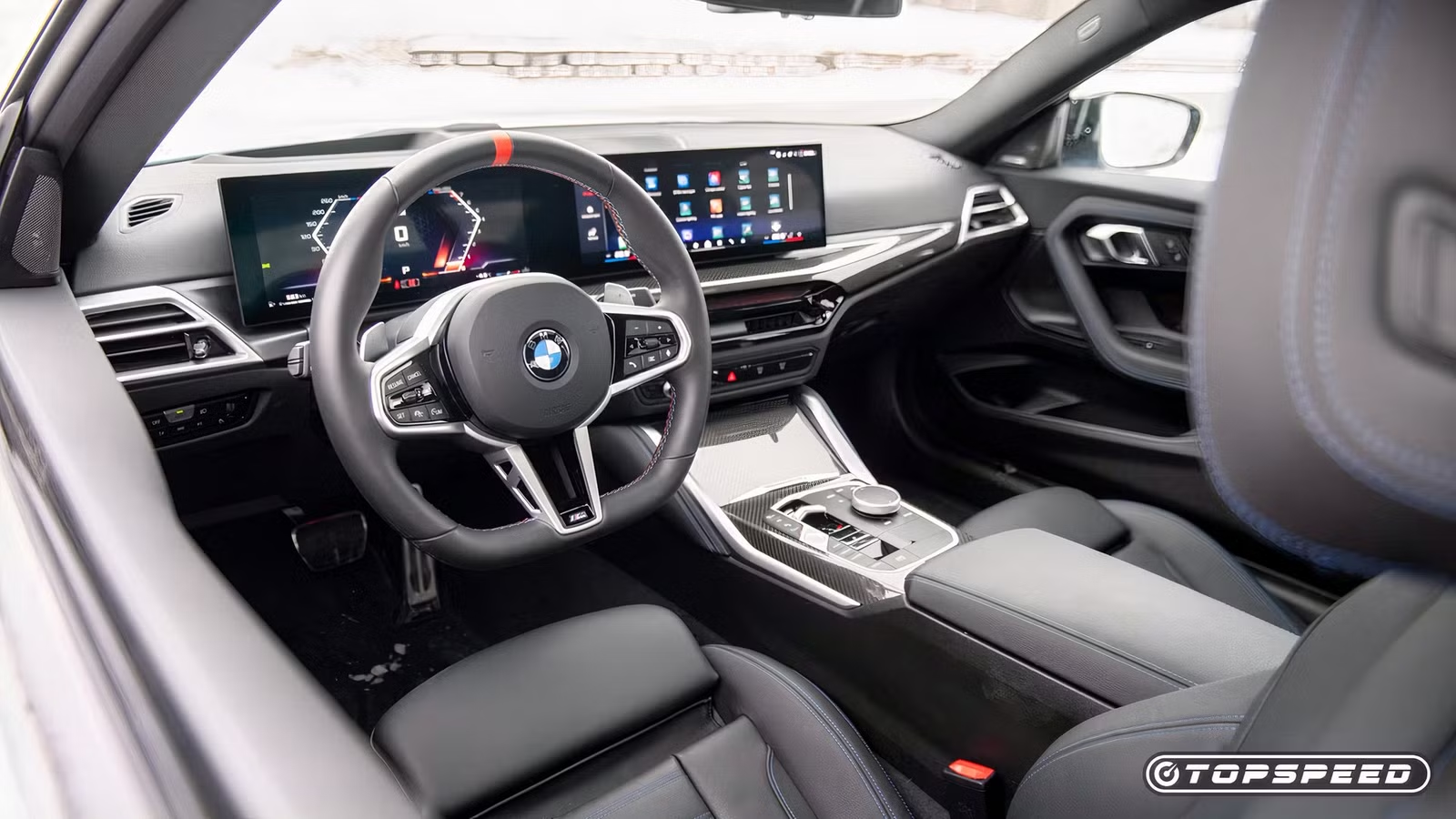
BMW is doubling down on a nearly buttonless interior for its Neue Klasse lineup — the i3 sedan, iX3, and X5/iX5 — and the company’s justification is generational. BMW Group Australia CEO Vikram Pawah put it plainly in a recent interview: younger drivers, those 45 and under, are already living in a voice-and-touch world, and BMW’s interiors should reflect that. “They want things done quickly and they’re multitasking,” Pawah said.

It’s a confident position. It’s also one that runs headlong into a body of highway-safety research suggesting that touchscreens and voice interfaces — the very tools BMW is betting on — carry measurable distraction costs that physical buttons largely avoid.
What BMW Is Actually Building Into Its New Models
The Neue Klasse vehicles represent BMW’s most aggressive step yet away from conventional controls. Gone is the iDrive rotary dial that defined BMW cockpits for two decades — it has already been removed from compact models and is disappearing across the range with each successive replacement. What remains in the new lineup is a touchscreen, a voice assistant, and haptic steering-wheel keys. A handful of physical controls survive — window switches, a volume knob, column stalks — but the architecture is clearly designed around digital interaction as the primary mode.

Pawah’s framing positions this as a response to real consumer behavior rather than a cost-driven choice. BMW isn’t saying buttons are bad; it’s arguing that fewer of its customers will miss them. Whether that distinction holds up under scrutiny depends on what the safety data actually shows.
What Safety Researchers Have Found About Touchscreens and Voice

NHTSA’s distraction research program has consistently found that secondary tasks requiring visual attention — navigating a touchscreen menu, reading on-screen labels, confirming a voice command — pull a driver’s eyes off the road for meaningful durations. A widely cited benchmark from NHTSA’s naturalistic driving studies identifies two seconds of eyes-off-road time as the threshold at which crash risk begins to climb significantly. At highway speeds, two seconds of inattention covers roughly 175 feet.
Touchscreen interactions tend to exceed that threshold for anything beyond a single tap on a large, well-placed target. Tasks that require menu navigation — adjusting climate zone settings, for instance, or switching audio sources — routinely demand three to five seconds of divided attention in controlled testing. Physical buttons, by contrast, benefit from muscle memory: an experienced driver can adjust volume or fan speed without shifting gaze at all.
Voice commands introduce a different category of risk. Research from the AAA Foundation for Traffic Safety found that even hands-free voice interaction produces measurable cognitive load — what researchers call “inattention blindness” — where a driver’s eyes are nominally on the road but their attention is partially elsewhere. Voice systems also carry a practical failure rate: misrecognition, confirmation prompts, and multi-step command sequences can extend the cognitive demand of a simple task well beyond what a button press would require.
The Industry Is Divided — And BMW Knows It

BMW is making this bet at a moment when several rivals are moving in the opposite direction. Audi and Mercedes have both announced plans to restore more physical controls following consumer complaints about touchscreen-heavy cabins. Renault has publicly committed to keeping buttons even where they cost more to produce. Polestar, which leaned hard into minimalist touch interfaces early in its existence, has begun adding physical controls back in response to owner feedback.
Those reversals are primarily UX and satisfaction stories — customers found the all-touch experience frustrating, not necessarily dangerous. But the safety dimension runs parallel. If drivers are spending more time correcting voice misinterpretations or hunting through touchscreen menus, the distraction exposure compounds regardless of whether the frustration registers as a complaint on a satisfaction survey.
BMW’s counter-argument is implicit in Pawah’s framing: the younger cohort of buyers has grown up with touch and voice interfaces and may be meaningfully faster and more accurate with them than older drivers are. That’s a reasonable hypothesis. It’s also largely untested in the specific context of in-car use at speed, where the cognitive environment is considerably more demanding than unlocking a phone.
Whether the Technology Can Close the Gap

The honest answer is that BMW’s approach could work — if the voice recognition is fast and accurate enough to handle natural-language commands reliably on the first attempt, and if the touchscreen’s interface is shallow enough that common tasks never require more than a single interaction. Those are meaningful engineering targets, and BMW has the resources to pursue them seriously.
The risk is that real-world voice systems still fall short of that bar often enough to matter. A driver who asks the car to raise the temperature and gets a misrecognition response now has to decide whether to repeat the command, tap the screen, or let it go — none of which is as fast or as safe as turning a knob. BMW is betting that the technology gap will close as the Neue Klasse generation matures. Safety regulators are watching whether it already has.
BMW’s generational argument isn’t wrong on its face — preferences are shifting, and voice interfaces are genuinely improving. But preference and safety aren’t the same metric, and the distraction research doesn’t disappear because a younger demographic is more comfortable with the modality. The question BMW needs to answer isn’t whether its buyers want voice controls. It’s whether those controls are safe enough, reliable enough, and fast enough to replace what muscle memory used to do for free.

Related posts




Latest Post




No Comments