
Riders In Their 50s And 60s Are Buying The Two-Strokes They Couldn’t Afford Young
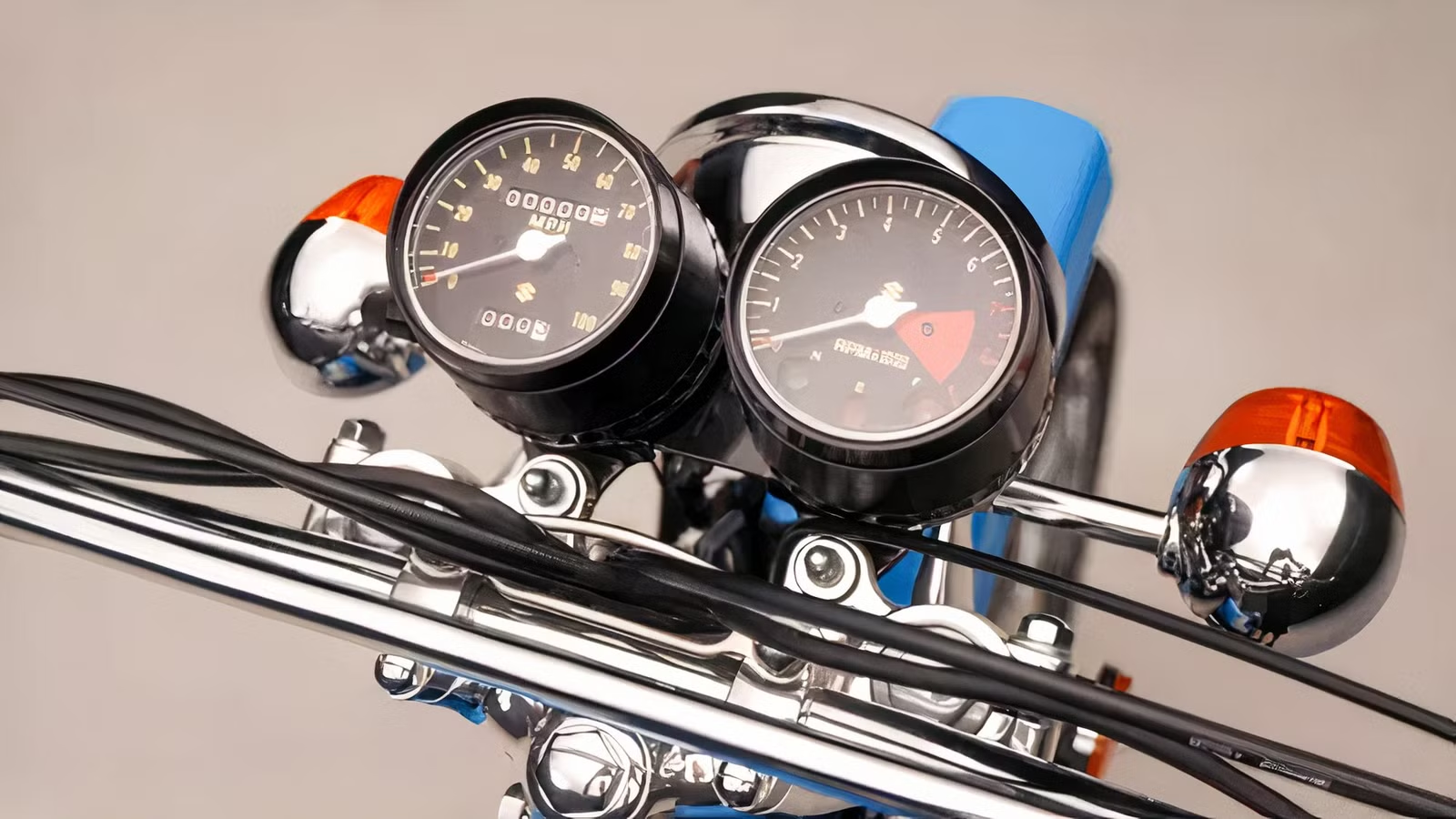
If you loved bikes in the ’70s, life was a cruel joke. Japanese two-strokes were all over the streets with that intoxicating powerband surge, but if you were a kid with no cash, you were stuck watching someone else ride off into the blue smoke. There was always somebody nearby with a machine you could only dream of owning.

Fast-forward to 2026, and those same starry-eyed kids are now in their 50s and 60s with full bank accounts and zero self-control. The grey-hair brigade has the money. The heavy-hitters like Yamaha’s RD series and Kawasaki’s Triples have crossed into full-blown collector territory, complete with eye-watering price tags. But you don’t need to drop a small fortune to get a hit of vintage two-stroke smoke. Some street-legal machines are still within reach, including a 250cc Suzuki built around half of a much bigger engine.
The Two-Stroke Price Run-Up Hasn’t Hit Every Bike
Some of the big names have become expensive toys. Take Yamaha’s legendary RD350. A few years back, you could pick up a decent daily rider for around $5,000, while clean, highly original examples or correct restorations sat in the $5,500 to $6,000 ballpark.

Then there’s Kawasaki’s “widowmaker” H2 Triple. While a tired, high-mileage runner will still run you about $16,000, an immaculate survivor from that initial 1972 run will easily blow past the $20,000 mark. And don’t think you can hide out in the 1980s, either. The entire market is on fire right now, with showroom-quality Grand Prix replicas like the iconic Yamaha RZ500 routinely hovering around $18,500 today.
But if you look past the headline-grabbing poster bikes, there’s a chance for good news waiting for you. There are still lesser-known models and less sought-after versions worth considering, even if they don’t have the same following as the big names. Of course, this doesn’t mean mint-condition ring-dingers are going for pocket change. But it proves you can still jump into the classic two-stroke scene without wiping out your savings account.
This Suzuki Was Built Around Half A T500 Engine

When Suzuki rolled out the TS250 in 1969, Yamaha’s DT-1 had already blown the trail-bike market wide open. Suzuki wanted a piece of that action, but marketing departments around the globe couldn’t agree on an identity. State-side buyers got a tank badge proclaiming it the “Savage,” Japanese dealerships pushed it as the “Hustler,” and over in the UK, Suzuki’s folks clearly gave up on the flair and just stamped it “TS250.”
The Suzuki TS250 was built for real-world dual-sport riding, packing a 246cc two-stroke engine producing 23 horsepower with Posi-Force oil injection. With 9.5 inches of ground clearance, adjustable rear shocks, and a five-speed gearbox, it was ready for dirt and pavement alike. Surprisingly tall gearing also allowed it to cruise at 70 mph under 6,000 rpm, making it just as comfortable on the highway as on open trails.
23 Horsepower And Around 80 MPH From A 250

On paper, the TS250 cranked out a factory-rated 23 horses. Depending on who you ask, top speed sat somewhere between a screaming 75 and 80 mph.
The early 1969 bikes were absolute tanks, tipping the scales at roughly 280 pounds. Suzuki slowly realized lighter was better, trimming weight year after year until the 1976 TS250A hit a svelte 240 pounds. A reed-valve setup showed up in 1977, giving the engine a much nicer, torque-rich midrange instead of a light-switch powerband. By 1980, the ER models were even pulling double duty state-side as the DS250.
Ask old-timers about its off-road cred today, and you’ll start an argument. Critics will tell you it was way too heavy, with a tall first gear that made slow, technical trail crawling a nightmare. On the other hand, some remember it as a friendly, forgiving alternative to Suzuki’s terrifying, purebred motocrossers like the infamous TM400. Compared to an unguided missile like that, the TS250 was practically a family golden retriever.
A $3,300 TS250 Shows Why It Still Matters

To put that in perspective, a nicely refurbished 1970 TS250 recently crossed the auction block for just $3,300. Now if you compare that to the $4,000 to $5,000 you need for a clean Yamaha RD350, or the absurd $20,000-plus people drop on a museum-grade Kawasaki H2, the modest Suzuki starts looking like a stroke of genius. Actually, make that two strokes.
And honestly, that straightforward appeal is exactly why these bikes still matter. Nobody is claiming $3,300 is pocket change for a machine older than most people’s mechanics, and clean examples aren’t just sitting on every corner. But compared with the more famous Japanese two-strokes, it offers a relatively accessible way into the hobby.
Mind you, top-tier examples can still command real money. An exceptionally clean 1972 J-model recently fetched $7,899 at auction. That’s a big jump from $3,300. But again, it shows how much condition, originality and restoration quality can affect prices.
Small Two-Strokes Are Still Flying Under The Radar

If you dig beneath the headline-grabbing legends, small-displacement singles anywhere from 50cc to 400cc are where the real fun-per-dollar lives. Small-displacement two-strokes such as the Suzuki TS50 Gaucho, Honda MB5 and Kawasaki AR50 are also worth looking into. Although prices and parts availability will depend on the model and condition.
First up is Suzuki’s TS50 Gaucho, which arrived in 1971 billed as the only 50cc machine built like a proper motorcycle. With a rotary-valve engine putting out 5 horsepower, a five-speed transmission, and an upswept pipe, it could buzz up to 60 mph if you were light enough. Honda MB5, offered in the US exclusively for 1982. The 49.5cc reed-valve engine featured oil injection, a 10,500 rpm redline, and a five-speed transmission, recording a top speed of 53 mph. The Kawasaki AR50 stands out as perhaps the most advanced of the trio. It incorporated a front disc brake and Kawasaki’s Uni-Trak single-shock rear suspension.
The Affordable Way Into A Vintage Two-Stroke

The TS250 delivers that raw, old-school Japanese two-stroke hit without forcing you to remortgage your home like an RD350 or Kawasaki H2 build would. Its 246cc single, five-speed gearbox, and dirt-and-street versatility pack enough soul to instantly remind you why we all fell in love with two-stokes in the first place.
Top-shelf survivors can push $8,000, so nobody is calling it a scrap-heap bargain. But market watchers point to the same magic in 1980s trail bikes: they’re light, easy to wrench on, and absurdly fun. If you spent your youth staring at showroom glass you couldn’t afford, the TS250 is your ticket. It brings back the blue smoke, exhaust crackle, and pure 1970s nostalgia without torching your savings. Just respect its age… it still expects a little mechanical sympathy.

Related posts



Latest Post



No Comments