
This Mopar Runs Carbs, Kicks Butt, And Makes Modern Muscle Look Overcomplicated
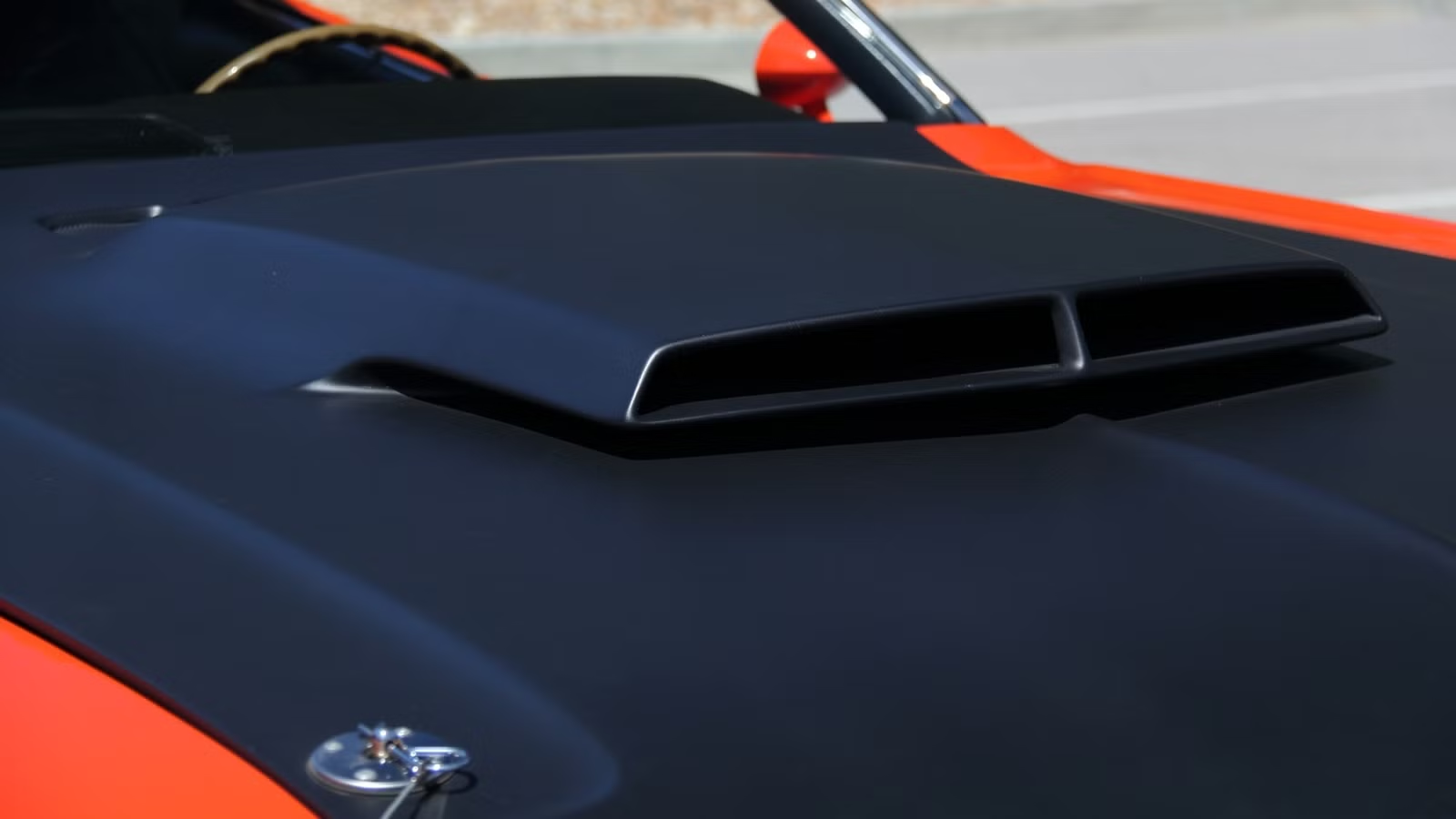
When it comes to muscle cars, bigger is always better, right? This means higher displacement, wider tires, larger brakes, high-flow exhaust systems, and, of course, bigger carburetors. The truth isn’t so simple. Chrysler Corporation, the company that planted a flag in big-block Mopar muscle early, later went against the grain. It pioneered a performance small-block nearly as fast as its big-block cousins, proving everyone wrong about carburetors. And in the process, it made even muscle car fans wonder whether sometimes smaller is better.
Why Bigger Carburetors Can Make An Engine Slower

During the carburetion era, choosing the right carb size remained an engineering dilemma. A larger carburetor, rated to flow more cubic feet per minute (CFM), could reduce restriction while an engine was running flat out. But it could cause trouble when the engine was moving less air.
Think of a carburetor throat like a river. Force the same volume of water through a narrow channel, and it races. Let it spread across a wider channel, and it slows. A carburetor needs that speed: Air rushing through its venturis creates the pressure drop that draws fuel into the airstream. If its passages are too large for the engine’s demand, that metering signal weakens.

At low rpm, an oversized carburetor can make an engine feel lazy when the driver floors it. Rather than accelerating cleanly, it may hesitate or bog. Holley cautions that both over- and under-carbureting can impede performance. Bigger helps only when the engine can use the extra airflow.

Motorheads may be thinking, Then link several carburetors that open progressively as I floor it. This was a well-established strategy by the 1950s. But pedal position alone cannot reveal an engine’s true airflow demand, which also changes with rpm and load. By the late 1960s, Chrysler was hard at work on an engine that knew the difference.
Chrysler Developed A Triple-Carb System For Its Legendary Big Block

For decades, Chrysler Corporation’s motto might as well have been, “In displacement we trust.” Chrysler introduced its FirePower V8 for the 1951 model year with 331 cubic inches. Displacement grew to 392 cubic inches for the 1957 model year. In 1958, Chrysler Corporation introduced its new B engines, with wedge-shaped combustion chambers and displacements up to 361 cubic inches. In 1959, the raised-block variant increased maximum displacement to 413 cubic inches. The legendary 440-cubic-inch raised-block debuted in 1966.
The 440 debuted with a 350-horsepower/480-lb-ft rating then rose to 375 horsepower as things heated up. But that wasn’t enough. So, for 1969, the A12 Dodge Super Bee and Plymouth Road Runner received a tuned version with three two-barrel carburetors. The 440 Six Pack/6-BBL claimed 390 horsepower and 490 lb-ft.

This thing had one 350-CFM center carburetor and two 500-CFM outboards, each with two barrels. At full blast, the big-block engine made good use of all that airflow. With it, a ’69 A12 Road Runner clocked a 12.9-second quarter on stock tires with Ronnie Sox behind the wheel.
At the same time, Chrysler Corporation offered a performance tune of its small-block V8. It had a sensible amount of carburetion for the engine’s size—four barrels, to be exact. But Mopar had something less sensible brewing.
The 340 Six Pack Broke All The Rules

For the 1970 model year, Chrysler Corporation released a Six-Pack version of its 340-cubic-inch V8. Despite being on a smaller engine, it had the same basic architecture as the 440 system: one 350-CFM center carburetor and two 500-CFM outboards, all Holley 2300-series two-barrels. The list numbers and calibrations differed, but the apparently absurd airflow capacity remained. Here’s the kicker: It worked. Despite what carburetor calculator’s suggest and benchtop tuners swear by, these 340’s were seriously mean with a carburetor setup that flows somewhere in the neighborhood of what a 900-950 CFM Holley four-barrel would. Mind you, CFM measurements are imperfect, so these things don’t flow up to 1,350 CFM, despite what basic math would suggest.
The key was the technology Chrysler used. During ordinary driving, the 340 V8 got the air it needed through its 350-CFM center carburetor. Stomping the accelerator didn’t mechanically fling all six throttle blades open at once. Instead, a vacuum signal brought the outboard carburetors into play as airflow demand increased. This kept the entire system from overwhelming the engine at low rpm and helped prevent bogging.
Chrysler Corporation released the engine in the Dodge Challenger T/A and Plymouth AAR ‘Cuda. Dodge promotional materials called the 340 Six-Pack “THE CHILLER” and promised it would “put the chill on competitors.” But the advertised rating didn’t tell the whole story.
Chrysler’s 290-HP Rating Hid Serious Potential

Chrysler Corporation released the 340 Six-Pack with a factory rating of 290 horsepower at 5,000 rpm and 345 lb-ft at 3,400 rpm. But those numbers were suspicious, to say the least.
First and foremost, the regular 340-cubic-inch V8 was rated at 275 horsepower. So swapping on an aluminum intake and six-barrel setup similar to the 440 Six-Pack could be expected to add more than 15 horsepower. Second, drivers familiar with the ¼-mile times of 340 Six-Pack cars will call bull on those power numbers. Finally, Detroit notoriously underreported horsepower during the late 1960s and early 1970s.
Dennis Manner, a retired Buick engineer, revealed that the 1970 455 Stage 1’s V8 made 372 hp at 5,200 rpm on the dyno but got an official rating of just 360 hp. “The shipping weight of the car was 3,603 pounds, and we wanted to get it into a [racing] class that factored 10-to-1 pounds per hp.” Historians have also cited insurance premiums and internal model hierarchy as possible motives for conservative ratings.
How Powerful Is A 340 Six-Pack Truly?

Hot Rod magazine journalists were curious how much power the Six-Pack induction could unlock. The test engine was bored 0.040 inch over and used aftermarket rods and pistons, light bowl work, roller rockers, beehive springs, and electronic ignition, so it was not factory stock. With a factory four-barrel and iron exhaust manifolds, it made 320 horsepower at 5,500 rpm and 368 lb-ft at 3,500 rpm.
With Six-Pack induction and the same exhaust manifolds, the engine made 356 horsepower at 5,500 rpm and 382 lb-ft at 4,000 rpm—a 36-hp gain. Adding 1-7/8-inch headers raised the result to 376.1 horsepower and 408.9 lb-ft.
Why The 340 Six Pack Was A Genuine Giant Killer

The 340 Six Pack’s improvements didn’t end at carburetion. It also got reinforced main-bearing webs, revised head castings, and improved exhaust ports. The Challenger T/A featured a 3.55 Sure-Grip rear end, TorqueFlite or close-ratio four-speed, front and rear sway bars, and Rally suspension with staggered E60/G60 tires.
The Challenger T/A and AAR ‘Cuda were homologation specials, but the street and race engines weren’t identical. SCCA Trans-Am rules capped displacement at 5.0 liters, so Dodge’s race car used a 305-cubic-inch V8 with a single four-barrel. The street cars got the larger 340 Six-Pack: Chrysler Corporation’s swing at a relatively nimble muscle car that nearly produced big-block power from a lightweight small-block. And it worked.

Period testing showed a four-speed AAR ‘Cuda, clocking a 14.3-second ¼-mile at 99.5 mph. In a separate test, the Hemi Challenger ran a 1/4-mile in 14.1 seconds at 103.2 mph. The 340 Six-Pack/6-BBL proved it could hang with the big boys.
The overpowered small-block wasn’t a silver bullet. The AAR ‘Cuda still suffered from 56/44 weight distribution. But published engine-weight estimates put a fully dressed 340 about 145 pounds below a 440, and the fiberglass hood trimmed additional weight. In a separate test, a Hemi Challenger carried 58.9 percent of its weight over the front wheels. With front disc brakes, the AAR ‘Cuda stopped from 80 mph in 220 feet.
The 340 Six Pack’s real giant-killing trick was offering near-big-block performance without the weight and cost of a big block. It approached the 440 and HEMI’s performance by managing airflow more intelligently, not merely adding displacement.
Sources: Hot Rod magazine, Mopar1, and Dodge

Related posts





Latest Post


No Comments