
2026 Lexus ES 350h Vs. Toyota Crown: Is Luxury Worth The Extra?
If you want a car that gets the job done and will last, Toyota is always near the top of the list. If you want a more luxurious version, but still want the job done and want reliability, Lexus is the one to go for.

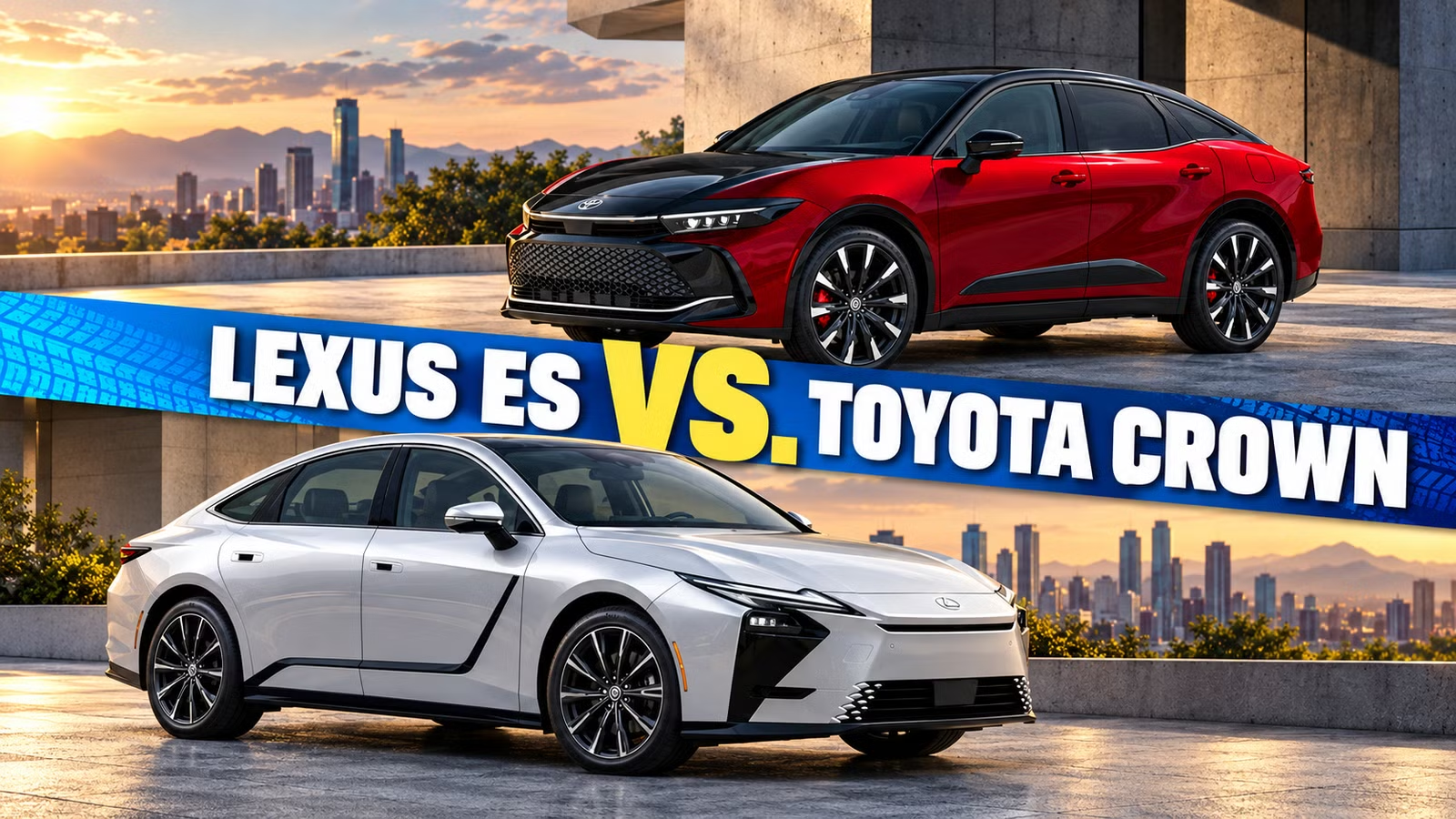
The 2026 Toyota Crown and the 2026 Lexus ES 350h share a lot of the same bones, and there are some striking similarities between them, so is it worth spending the extra money on the Lexus?
Same Platform, Different Pedigree — And A Surprising Reliability Gap
Being the luxury arm of Toyota, Lexus tends to take what is good about the ever-trusted Toyota and add a touch more finery. This year, both the ES 350h and Crown are built on Toyota’s GA-K platform, are available with a 2.5-liter inline-four paired with a hybrid system, and have already been rated highly for dependability.

The ES 350h is higher rated, with a J.D. Power reliability rating of 89 out of 100, but the new Crown is not exactly a lemon, with a J.D. Power quality and reliability rating of 82 out of 100. The Crown has only been available in the U.S. in its current form since 2023, so there is no data from iSeeCars yet on how long one will last, though they do say it should be good for over 200,000 miles. On the other hand, iSeeCars says the Lexus ES has a lifespan of 167,236 miles.
The ES Is Noticeably Larger, But The Two Are Easy To Confuse At A Glance


At the heart of things, though, both the Crown and ES 350h are hybrid sedans with everyday use in mind. The ES 350h is noticeably bigger than the Crown, despite sharing the same platform. The ES 350h measures in at 202.4 inches in length; the Crown, 196.1 inches. The ES 350h is also wider than the Crown, at 75.6 inches wide compared to the Crown’s 72.4 inches.
If you squint, it is relatively difficult to distinguish between the two as they come down the road. They both have high-end LED headlights, full-length LED taillights, hidden exhaust outlets, a similar body shape, and a fastback rear. However, the ES gets a body-color spindle grille, while the Crown gets a mesh grille; the ES gets flush door handles; and the Crown is available with larger 21-inch wheels compared to the ES’ 19-inchers.
The 2026 ES 350h Starts Around $50,000

The first noticeable difference between the two is the price. There are four trims of the new ES 350h: the Premium, the Premium AWD, the Premium+, and the Premium+ AWD. Starting prices for the Premium are $51,095; for the Premium AWD, $52,495; for the Premium+, $55,895; and for the Premium+ AWD, $57,295.
The new Toyota Crown is also available in four trims: the XLE, the Limited, the Nightshade, and the Platinum. Prices are a lot less, though, with the XLE costing $41,400, the Limited costing $45,950, the Nightshade costing $48,765, and the Platinum costing $54,990 .
244 HP And Up To 46 MPG Give It A Useful Balance

Both lineups use a 2.5-liter inline-four (except for one Crown model), but the way they are configured differs quite a bit. The new ES 350h gets an inline-four and two electric motors for FWD models, and an extra motor on the rear axle for AWD models.
Power is sent through an eCVT, maximum horsepower is 244, and maximum torque is 175 pound-feet. This translates to 0–60 mph times of between 7.2 and 7.4 seconds. On top of that, FuelEconomy.gov estimates that the new ES 350h can achieve 44 combined mpg (47 mpg city/42 mpg highway) when equipped with AWD, while FWD models can achieve 46 combined mpg (48 mpg city/44 mpg highway).
Premium+ Trims Brings A Long List Of Luxury Features

As standard, the new ES 350h is a nicely kitted-out hybrid sedan, with features like 19-inch alloys, NuLuxe interior trim, Thematic ambient lighting, heated and ventilated front seats, a power tilt-and-slide moonroof, and a 10-speaker Lexus Premium Sound System. For most of us, that is enough.
Then there is the most expensive trim, the Premium+. The extra cash here gets you a 17-speaker Mark Levinson audio setup, a HUD, the Driver Monitor system, Panoramic View Monitor, Digital Rearview Mirror, and Advanced Park with Remote Park. All trims also get the Lexus Safety System+ 4.0 setup, so you are well covered for both luxury and everyday use.
ES 350h Vs. Toyota Crown: Where The Money Goes


It’s not like buying a Toyota Crown is a downgrade in the sedan world, and there are plenty of good reasons to buy one over a Lexus ES. However, if you are in it for power output and the absolute best fuel efficiency, the extra money does get you ever so slightly more.
The new Crown XLE, Limited, and Nightshade are equipped with a naturally aspirated inline-four paired with a hybrid rig good for 236 horsepower. Power is routed through an eCVT, but importantly, to all four wheels via AWD as standard. The EPA says this setup can achieve 41 combined mpg (42 mpg city/41 mpg highway).
The Crown Platinum is different. The top trim is equipped with a 2.4-liter turbocharged Hybrid MAX inline-four good for 340 horsepower and 400 pound-feet of torque. You also get a Direct Shift six-speed automatic. Fuel consumption is worse, at 30 combined mpg (29 mpg city/32 mpg highway), but you do get 0–60 mph times of around 5.7 seconds.
Crown Costs Less While Sharing Much Of The Same Philosophy

Horsepower is only slightly less and, if you don’t count the expensive Platinum, fuel efficiency isn’t that far off. Crucially, though, for the most part, it is far cheaper than the ES lineup. Overall, the 2026 Crown is rated 80 out of 100 on J.D. Power’s Consumer Verifirs score and 4.5 out of 5 by owners on Kelley Blue Book, with 75 percent recommending it.
The ES 350 is rated 83 out of 100 overall on J.D. Power. However, on Kelley Blue Book, currently, there has been only one owner review, which rates it 2 out of 5 overall. One shouldn’t read too much into that, as it doesn’t give a fair view against the ten or so Crown reviews. What it does show is that, despite the large price difference, the Crown performs very well.
The Crown Blurs The Line Between Sedan And SUV — The ES Stays Traditionally Low

Despite their shared roots, the Crown also represents a slightly different proposition. It has a raised ride height of 5.8 inches of ground clearance, making it sit slightly higher than your conventional sedan, while the fastback roof and taller body give it some crossover flavor. Toyota says it is a sedan, but it has a driving position that makes you wonder if there is some SUV in the build.
The ES 350h does what Lexus is known for, and gives us traditional luxury. It sits lower to the ground, has the long hood and three-box proportions you expect from a proper luxury sedan, and is designed around a more settled position. The ES offers the kind of road-going character we associate with a conventional sedan, while the Crown sits in a more unusual cross-breed middle ground.
What You Get By Spending More On The Lexus

The ES 350h is more powerful than the first three trim levels of the Crown, and it is more fuel-efficient; you also get the bragging rights of a Lexus over a Toyota. Then there is the general fit and finish. Lexus takes some beating here, and while Toyota is hardly cutting corners, there is something to be said about the cabin of the ES.
A Larger Cabin And 14-Inch Screen Raise The Comfort Factor

All new ES 350h trims are equipped with a 14-inch touchscreen and 12.3-inch driver display as standard. You also get wireless Apple CarPlay and Android Auto, dual-zone climate control, and a memory driver’s seat. So, nicely covered for everyday use.
There is also a generous amount of space for the driver and four other passengers. Up front is up to 38.3 inches of headroom and up to 42.4 inches of legroom, while the back seats offer up to 37.8 inches of headroom and 40.7 inches of legroom. There is also 13.3 cubic feet of storage space.

You are certainly not lacking if you opt for a Crown, but the touchscreen, paired with a 12.3-inch digital gauge cluster, is noticeably smaller. You can opt for a JBL audio system, and you still get wireless phone connectivity, but you have to opt for the Platinum (which costs as much as the ES) to benefit from more advanced features like a HUD and the Panoramic View Monitor.
The Crown’s smaller footprint also takes its toll on interior space. In the 2026 Crown there is 38.9 inches of front headroom and 42.1 inches of front legroom, and 38.9 inches of rear legroom. You do get a bigger cargo capacity of 15.2 cubic feet and 60:40 split rear seats, though, which the ES 350h doesn’t have.
Lexus Beats Toyota By 34 Problems Per 100 Vehicles In Latest Dependability Study

Trust in a vehicle or brand is important, and while neither Toyota nor Lexus are unreliable, Lexus is rated the highest at the moment. According to the 2026 U.S. Vehicle Dependability Study, Lexus models have a reported 151 problems per 100 vehicles (PP100).
Toyota models are behind at 185 PP100, below the likes of Cadillac, Chevrolet, Porsche, and Buick. However, both brands are doing much better than the industry average of 204 PP100.
Is The ES 350h Worth Paying More For?

The ES 350h does make sense if you want a quieter and more polished cabin, a bigger screen, better efficiency, the Lexus badge, and more passenger space. It feels like a complete luxury sedan. But, that doesn’t make the Crown look outclassed.
The new Crown is cheaper and gets AWD as standard, and you do get a larger trunk. But if you are set on spending Lexus money, then the 340-horsepower Platinum brings value, practicality, performance, and a very compelling reason not to upgrade to a Lexus.
Sources: Lexus, Toyota, FuelEconomy.gov, J.D. Power, Edmunds, iSeeCars, and Kelley Blue Book.

Related posts


Latest Post


No Comments