
Rarest Ford Muscle Car Produced In The ’70s
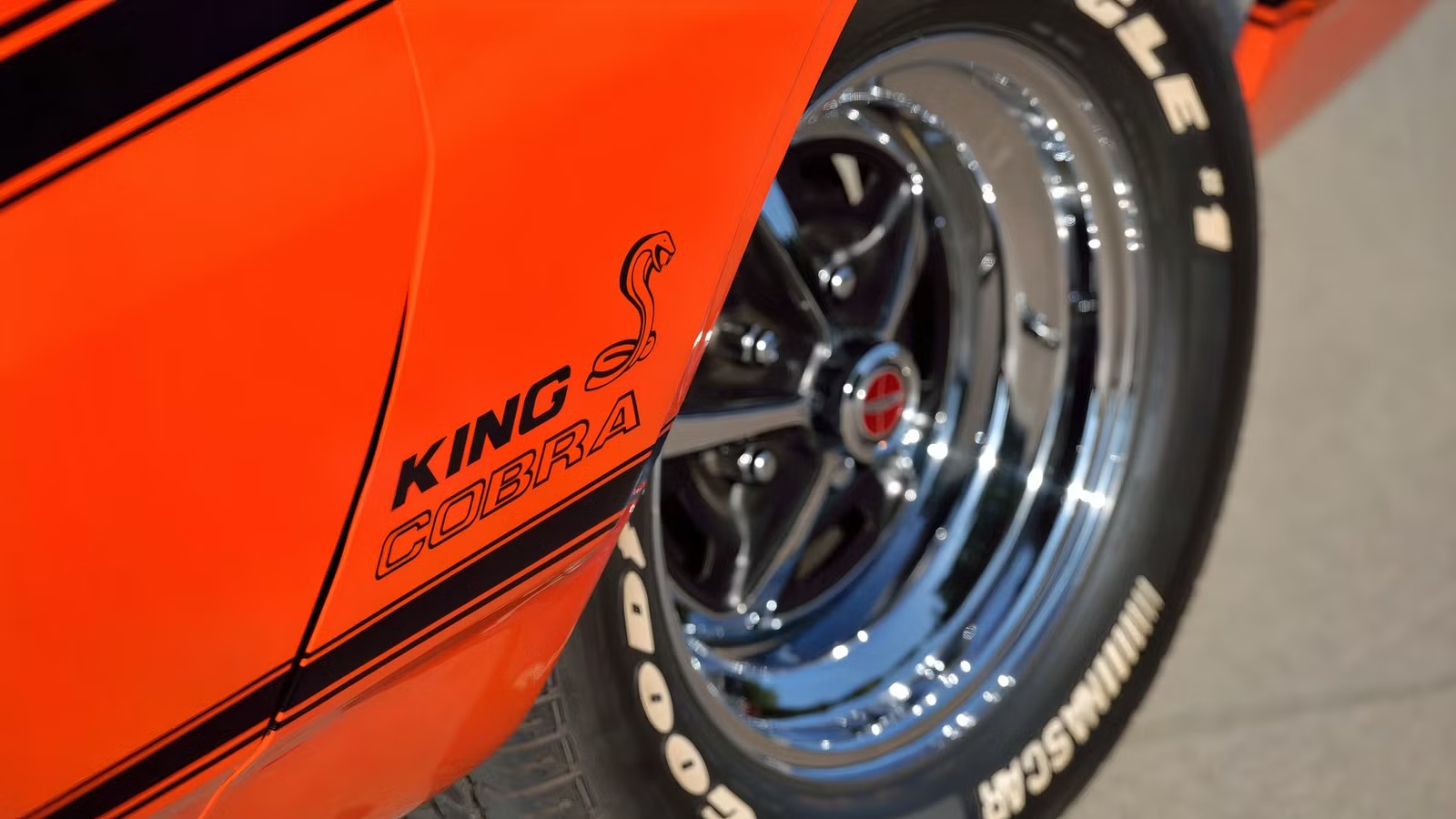
Few chapters in automotive history burn as bright as the muscle car era — and few stories within it are as fascinating as what Ford built, and nearly built, at the dawn of the 1970s. While the golden age of big-block performance was already under siege from tightening emissions regulations, soaring insurance premiums, and a fuel economy reckoning that would only get worse, Ford managed to produce some of its most extraordinary performance machines right as the curtain was falling. We’ve dug through the production records to uncover the rarest Ford muscle cars that rolled off Ford’s assembly lines throughout the 1970s, ranked purely by how few actually made it to showrooms.
Only Three 1970 Ford Torino King Cobras Were Ever Made

The prize for the rarest Ford muscle car of the 1970s goes to a car born right at the decade’s opening. The Ford Torino King Cobra was built specifically to take on Mopar in NASCAR, yet just three were ever produced before the program was canceled. NASCAR homologation rules in 1970 required one road-going version of any competition car to be built for every two dealerships in the US. Had the King Cobra entered full production, it would still have been rare — but on roughly the same scale as the Plymouth Superbird built for the same racing purpose.

The two marques were locked in a battle to crack 200 mph on superspeedway oval tracks like Daytona and Talladega. Ford had won that war in 1969 with its sleek and valuable Torino Talladega, though Mopar looked set to reclaim the crown the following year with its Superbird.
Ford Copies Plymouth’s 200+ MPH Wing Car Formula

Best known for its massive rear wing, the Superbird was capable of reaching 200 mph on the superspeedways, leaving Ford scrambling for an answer. Following Mopar’s lead, Ford tasked its top race engineers with finding a way to make the Torino more aerodynamically competitive.

Their jobs were made more difficult by the inefficient design of the 1970 Torino, primarily due to its wide front grille. Each manufacturer had to build one road car for every two dealerships it had across the US, so a track-only special was never an option. With Plymouth grafting its racer’s ultra-slippery nose cone onto the Superbird road car, Ford needed to find a way to make the Torino superior in that same area.
According to Mecum Auctions, Larry Shinoda, Ford Special Design boss at the time, wanted to shape the nose of the Torino after the GT40 that had carried the brand to victory at the 24 Hours of Le Mans between 1966 and ’69.
The new nose, which stretched the Torino by around six inches, was rapidly developed and fitted to the car for testing. The rocker panels were also rolled to allow the NASCAR version of the Torino to sit an inch lower than the road-going example, helping it slice through the air even more cleanly.
In many ways, the Torino’s evolution into the King Cobra mirrors the Charger 500’s transformation into the Daytona. While Ford’s aero car wasn’t a carbon copy of Mopar’s wing cars, it was shaping up to be a genuine threat. We never got to see it compete, but its targeted performance figures would have put it squarely in the same conversation as the winged Mopars.
NASCAR Spec King Cobra Vs Mopar’s Wing Cars
|
Specs |
Torino King Cobra |
Daytona Charger |
Plymouth Superbird |
|
Engine |
Boss 429 |
426 Hemi |
426 Hemi |
|
Horsepower |
550 HP |
600+ HP |
600+ HP |
|
Top Speed |
200+ MPH (Targeted) |
243 MPH (Chelsea Proving Grounds) |
200 MPH (Superspeedways) |
The Ford Torino King Cobra Had A Dangerous Problem

The redesigned Torino looked absolutely menacing with its sleek King Cobra nose, appearing ready to devour anything in its path. Under the hood sat a 429 cubic-inch Cobra Jet V8 producing 370 horsepower — more than enough muscle to meet Ford’s performance goals. Yet this promising machine harbored a dangerous secret that would ultimately seal its fate. Test drivers who pushed the King Cobra to its limits discovered a terrifying flaw: the front end wanted to take flight at high speeds. At NASCAR velocities, this machine was trying to become airborne, with potentially fatal consequences.

The aerodynamics had gone seriously wrong. The King Cobra’s sleek nose generated around 200 pounds of downforce, which should have kept the front end planted firmly on the pavement. Unfortunately, Ford’s engineers hadn’t accounted for what was happening at the rear of the car. Air flowing over the body found its way into the concave rear light assembly, creating massive downforce that far exceeded what the front was producing — causing the nose to lift dangerously as speeds climbed.
Ford could have addressed these aerodynamic problems with design modifications, but the company never got the chance. Nobody from Ford has ever officially explained why the King Cobra was cancelled, but industry insiders point to two likely culprits: the company had slashed funding for its racing division, and NASCAR reportedly raised the minimum homologation requirement to 3,000 vehicles, turning an already costly project into a financial nightmare.
Whatever combination of factors killed the King Cobra, only three prototypes ever saw daylight. Two of these rare machines packed the 429 Cobra Jet powerplant, while the third received the even more exotic 429 Boss engine that had powered the legendary 1969 Mustang Boss 429. Today, all three survivors rest in private collections, forever representing what might have been in Ford’s muscle car legacy.
Ford Torino King Cobra Specs

|
Engine |
429 Cubic-Inch V8 |
|
Transmission |
Automatic 3-Speed |
|
Horsepower |
370 HP |
|
Torque |
450 lb-ft |
|
Quarter-Mile |
12.2 Seconds (private test) |
Interestingly, one surviving car located in Tennessee is equipped with a two-speed rear end with gear ratios of 3.55:1 and 4.57:1. According to the owner, who drove the car for a period, it could run a 12.20-second quarter-mile. For perspective, a ’69 Charger Daytona with a 426 Hemi would clear the quarter in about 13.5 seconds.
The Rarest Ford That Actually Reached Customers

|
Engine |
Power |
Torque |
Production Numbers |
|---|---|---|---|
|
429 ci V8 |
260-270 HP |
450 LB-FT |
90 Units |
1970 Ford Torino Twister Special Details
The rarest Ford muscle car to actually reach production during the 1970s was another variant of the 1970 Torino. This time, the car was left completely stock from a performance standpoint — no aerodynamic nose treatments required. The Torino Twister Special was created as a limited-run regional promotion sold exclusively through Ford dealers in the Kansas City area.
In a similar vein to cereal makers offering time-limited premiums to move product, Ford used the same playbook with its muscle cars. The brand had already done something similar with the Mustang California and High Country models, which were built exclusively for the California and Colorado markets, respectively.
What Made The Torino Twister Special So Unique

The Torino Twister Special was a Kansas-only variant, with just 90 cars produced during the 1970 model year. A Twister version of the Mustang Mach 1 was offered for the same market, though 96 of those were built. Every Torino Twister came equipped with either the 360 hp 429 ci Cobra or the 370 hp Cobra Jet V8, the latter making more power thanks to a large hood scoop that fed additional airflow to the engine.

The most eye-catching difference from a standard Torino was the bold paint scheme: every car wore Vermilion Red with small Twister decals on the rear fenders. According to Mecum, 30 of the vehicles featured a four-speed manual gearbox, while the remaining 60 came with three-speed automatic units. Offered purely as a marketing exercise rather than a dedicated performance model, none of the Torinos were available with power steering or power brakes.
The original transaction price of the Twister Special is not definitively known, but the base Torino carried an MSRP of $3,208 in 1970. The dealer-installed Twister package would have pushed that figure somewhat higher.
These Rare Torinos Don’t Come Cheap

Due to the exclusivity of both Torino models, collectors looking to add one to their garage should be prepared to spend accordingly. The King Cobra commands prices well north of $500,000, while the Twister can fetch around $250,000 at auction. Fortunately, both cars have the performance credentials to justify their distinctive — and expensive — reputations.
The Mustang Twister Special Was A Force To Reckon With As Well

The Torino wasn’t the only model to receive special treatment from the Kansas City dealer network. The 1970 Ford Mustang was also offered with a Twister Special package, with only about 96 believed to have been built.
Mustang Twister Special Specs

|
Engine |
351 Clevland/428 Super Cobra Jet |
|
Transmission |
4-Speed Manual/3-Speed Automatic |
|
Horsepower |
300/335 HP |
|
Torque |
385/440 lb-ft |
|
Units Built |
96 |
Mustang Twister Specials were equipped with Grabber Orange paint, a signature livery, a shaker hood, and either a 428 Super Cobra Jet or 351 Cleveland engine. All were sold in the fastback body style. Original prices ranged from approximately $2,800 to $3,500. Today, these cars regularly sell for $100,000 or better at auction.
Sources: Mecum Auctions, Ford.

Related posts

Latest Post


No Comments