
The 10 Most Gorgeous Mopar Colors Ever Sprayed in Detroit
Mopar was already kicking all the ass during the Golden Age of American Muscle with the hottest models and most powerful engines, so when they introduced their High Impact paint codes in 1969, it almost seemed like overkill. Dodge and Plymouth Muscle cars were already blowing the doors off of Ford and GM rides and then, with these bold paint schemes, were making them look like chopped liver. Both red and black are reliable performance car colors, but Chrysler blew up the palette with an array of amazing hues that made their exciting lineup positively electrifying. Everyone has their own personal tastes, but we feel like these Mopar High Impact colors are aligned in the correct order from awesome to awesomest.
10
1970 Dodge Challenger T/A
FY1 Top Banana/Lemon Twist
Yellow didn’t use to be a particularly cool color for a car, mostly because they came in a washed-out pale version that looked like it had been sitting out in the sun for a couple of decades. Chrysler fixed that with the Top Banana High Impact paint code in 1970, which was vibrant and really made a muscle car pop. As is the case with most things, Dodge and Plymouth had different names for the same thing, so this color on a ‘Cuda was called Lemon Twist, but it was identical. That ’70 Challenger T/A pictured above looks incredible in Top Banana, with the blackout hood, black side stripes and even the black vinyl roof, which we don’t normally dig. The contrast between the bright yellow and dark black makes for a bold visual that helps accentuate the aggressive style of the ’70 Challenger.
9
1971 Plymouth Duster 340
FJ6 Green Go/Sassy Grass

Another color that never really reached its potential in the automotive world is green, mostly because automakers never really tapped into a pleasing version of it. GM is guilty of saddling its models with sea foam green for much of the ’50s and ’60s, and then everyone kind of latched on to the false notion that people wanted olive-colored cars. Chrysler finally figured it out with Green Go at Dodge and the cheeky Sassy Grass at Plymouth. With a brighter shade, this green looked good on anything, but that ’71 Plymouth Duster is a real eye-catcher in that hue that, again, rocks with the juxtaposition of the black body accents. For the record, the Mopar paint codes give you an idea of when they were introduced. If they start with the letter “F” like the FJ6 Sassy Grass, it came out in 1970, while an “E” indicates 1969, and the “G” codes are 1971.

8
1969 Plymouth Road Runner A12
EL5 Butterscotch/Bahama Yellow

Earth tones are by far the worst colors for a performance ride, or any other car, actually. Next to brown and cream, tan is one of the worst offenders, but Chrysler found a way to make it not only work, but kick ass. In 1969, they added Butterscotch for Dodge and Bahama Yellow for Plymouth, which was an incredibly rich color that redefined earth tones for hot rides. That ’69 Bahama Yellow Plymouth Road Runner A12 couldn’t look any more badass than it already does, and no paint code could make it any less intimidating. The reality is, it really does look like butterscotch and that deliciousness is something that really works on Mopar muscle cars and makes you want to taste what it can do. This might be the origin of people saying something is a “sweet ride,” but after getting smoked by one, they probably soured on it.
7
1969 Dodge Hemi Charger 500
EK2 Go Mango/Vitamin C

Outside of maybe a second-gen Pontiac GTO, the color orange is an underutilized paint scheme, which is a shame because it’s a real head-turner. In 1969, Chrysler introduced Go Mango for Dodge and Vitamin C at Plymouth, which was a bright orange that really complemented the design of any car splashed with it. The 1969 Dodge Charger 500 was an extremely limited edition homologation special that saw just 60 units equipped with the 426 Hemi V8. This ultra-rare Mopar classic has seen many examples listed at auction with awful colors like dark green, bronze (brown), and even white, but the top seller was a Go Mango car that sold for $297,000 at Dana Mecum’s 27th Original Spring Classic 2014, far more than the second-place auction block crosser. There are many factors that go into the price of a classic Mopar, and having a paint code that doesn’t suck is one that drives the bids up.
6
1971 Dodge Charger R/T
GY3 Citron Yella/Curious Yellow

Dodge’s Citron Yella or Plymouth’s Curious Yellow is one of the most complex paint codes of all time. Is it yellow? Is it green? The answer to both of those questions is yes, but also kind of no. A quick glance at that ’71 Charger R/T would have most people just thinking it’s a yellow car, but upon closer examination, it appears to be tinted a bit different. It’s a color that almost nobody can nail down with authority, but it is certainly a striking color, especially on that ride. While the Top Banana ’70 Challenger at the beginning of this list was an aggressive ride, this Citron Yella Charger is almost otherworldly, like a neon extraterrestrial craft. The black graphics only help to give this car an eerie aura that is backed up by its terror-inducing 440 big-block. This is the car that nightmares are made of for anyone sitting at a red light in a copper metallic Chevelle or a Wimbledon White Mustang.
5
1969 Dodge Super Bee A12
EF6 Bright Green/Rallye Green

While Green Go/Sassy Grass was a more playful color, the Chrysler High Impact Bright Green/Rallye Green was a more serious shade that let everyone know they were in for an ass-whoppin’. Still vibrant and exciting, the Bright Green paint code was a little bit more down to business, and that ’69 Dodge Super Bee swimming in it, proves the point. Nobody ever pulled up next to that car and had any hope of beating its 390-horsepower, 490 lb-ft of torque 440 Six Pack V8. The crazy thing about that car is that it actually has the floral vinyl hardtop, which is one of the goofiest options of all time, but with an EF6 Bright Green paint job, is still a credible threat. If you put Mickey Mouse ears on John Wick, he’s still the Baba Yaga (Boogeyman) and will take you out, possibly with a pencil, but definitely with extreme violence.
4
1970 Plymouth AAR ‘Cuda
FM3 Panther Pink/Moulin Rouge

If a survey was conducted of every single person who ever owned an automobile, the least favorite color would overwhelmingly be pink, and yet Chrysler found a way to make that not only cool, but also badass in 1970. The Mopar Panther Pink/Moulin Rouge paint code is one of the most striking schemes ever concocted. With a deeper shade that is almost fuchsia, this is one pink that doesn’t exude little-girl tea parties, but rather big-boy aggression. That Moulin Rouge ’70 Plymouth AAR ‘Cuda pictured above is the epitome of badassery and literally nobody ever snickered at it for being pink. The Panther Pink Dodge version is almost certainly a nod to the Pink Panther cartoon and live action movie series, and they found a way to get it for free. Chrysler actually licensed the Road Runner name and likeness for the Plymouth muscle car of the same name and tried to get the Tasmanian Devil for the Duster, but didn’t have to pay a dime by moving “Panther” in front of “Pink” for this amazing paint code.
3
1969 Dodge Daytona
EV2 Hemi Orange/Tor-Red

Dodge’s Hemi Orange or Plymouth’s Tor-Red is one of the more interesting Chrysler High Impact colors because it’s a tone shifter. It’s already more red than the Go Mango paint code, but depending on the light it can be observed differently. In bright light, Hemi Orange is distinctly orange, while in lower light it looks very red. Because of its name, people assume it’s the same color that the 426 Hemi V8 was painted with, but they are two different colors with Hemi Orange bearing the EV2 paint code and the engine paint being P4349216. Granted, they are very similar, and may even be identical formulas, but they do have different codes. None of that really matters, because it’s a badass color that makes any car painted with it look fast as hell. With the 1969 Dodge Daytona aerocar, there really isn’t a better paint code, and in fact, the “Winged Warrior” almost looks wrong if it isn’t in Hemi Orange.
2
1970 Plymouth Hemi ‘Cuda
FJ5 Sublime/Lime Light

With the grooviest green in Mopar’s color palette, the Plymouth Lime Light and Dodge Sublime truly is sublime. It’s the penultimate High Impact color because it just looks so damn good and stands out in a crowd like most other paint codes could only dream of. This was a 1970-only color but isn’t particularly rare, because it was quite popular, at least on the Plymouth ‘Cuda. 2,547 Plymouth E-body cars left the factory with an FJ5 Lime Light paint job, which includes Barracudas, AAR ‘Cudas, and ‘Cudas, making it one of the most common colors. That’s okay, because as we already mentioned, this was a paint code that really made a car a visual feast, and that shot of a 1970 Hemi ‘Cuda is all the proof you need. While the DayGlo green color is kind of whimsical, a Lime Light Hemi ‘Cuda was all business, and nobody ever chuckled when one pulled up next to them at a red light, they actually shook with fear.
1
1970 Dodge Super Bee
FC7 Plum Crazy/In-Violet

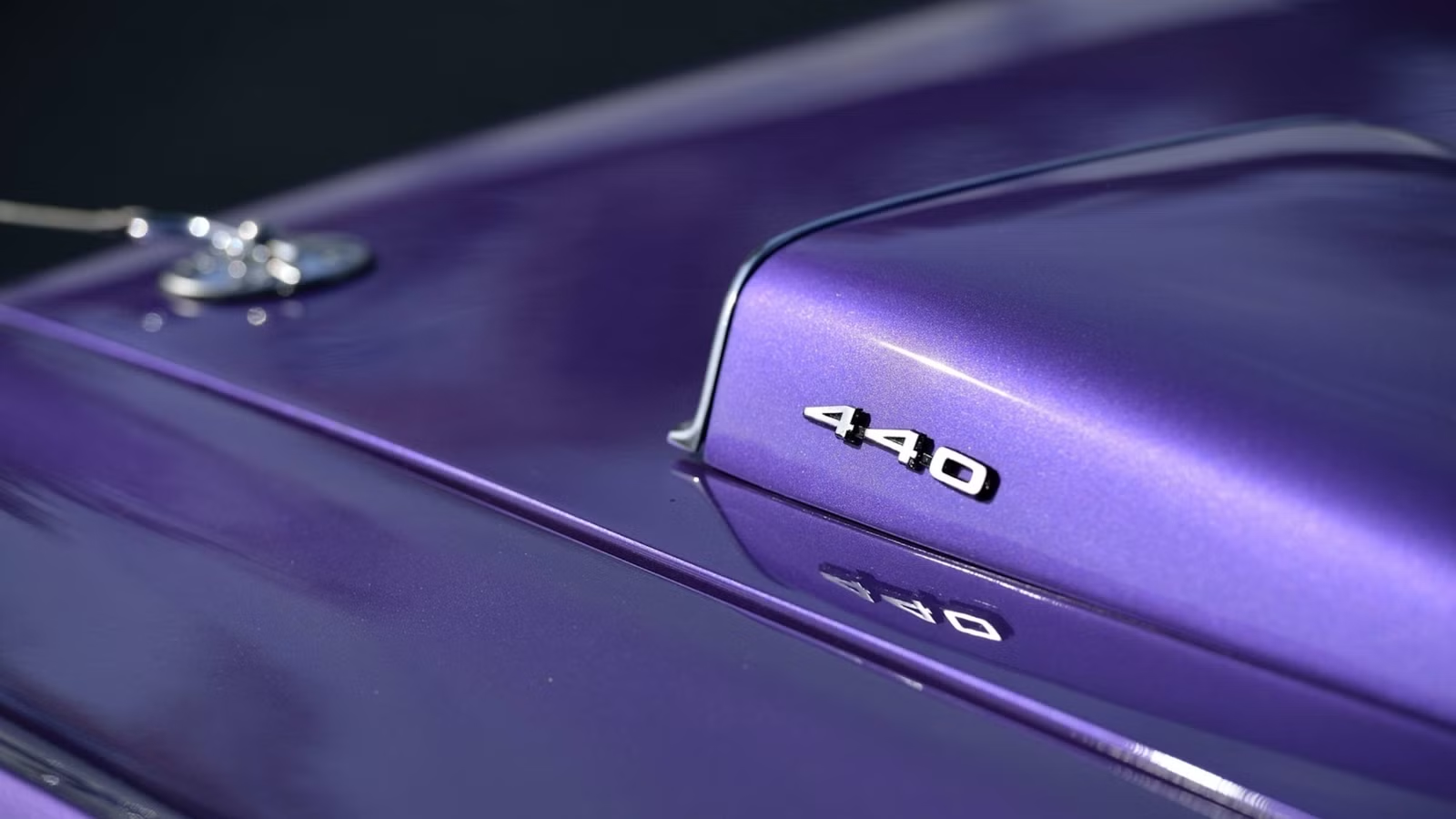
For the top-dog Mopar High Impact color, Dodge definitely got the cooler name with Plum Crazy, over Plymouth’s In-Violet. Had they gone with “In-Violence” it might have been different, but Plum Crazy perfectly sums up this deep metallic purple that gives an unsettling and unpredictable vibe to muscle cars painted with it. Actually, it makes a car look positively wicked like some kind of pimped-out demonic vengeance machine. While Plum Crazy looks fantastic on any Mopar, it’s best suited for the 1970 Dodge Super Bee, which may be the most aggressive-looking muscle car of the entire Golden Age. For ’70, the Super Bee got some slick Coke bottle curves, a sinister split “bumblebee wings” front grille, and optional twin hood scoops added to its already bold stance, making for a car that looked like it was pure evil. The ’70 Super Bee pulled off this intimidating look in any color, but in Plum Crazy was a terrorizer from the pits of Hell. Plum Crazy was a High Impact paint code that really had a high impact on the cars painted with it, bringing out their savage nature in a brutally beautiful kind of way.
Sources: Chrysler, Mecum

Related posts


Latest Post


No Comments