
GM Killed Pontiac’s Corvette-Beater, Then Reused Its Body For The C3
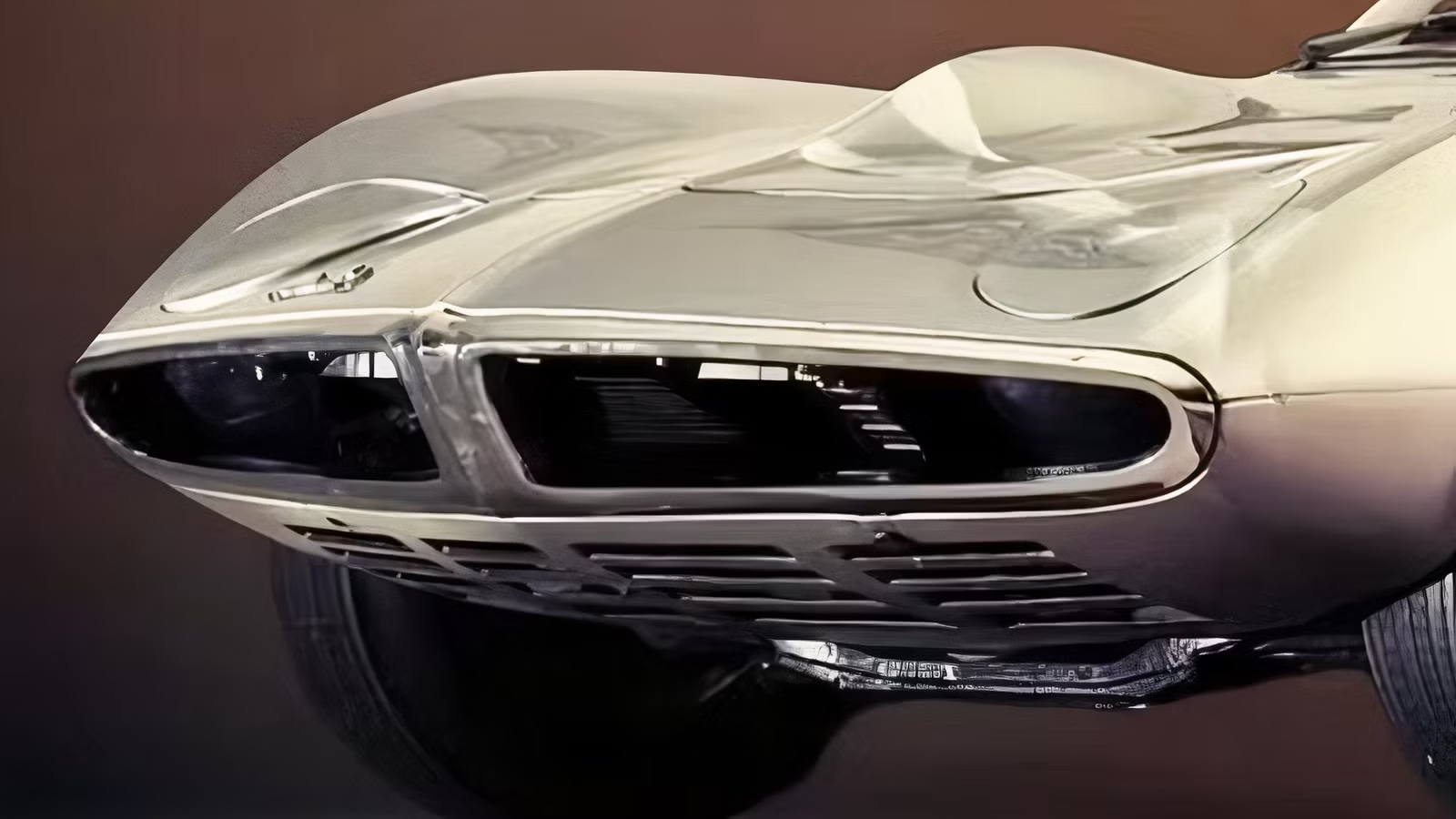
The C3 Corvette ran between model-years 1968 through 1982, making it the longest-running generation of Chevrolet’s flagship sports car. And it was quite a ride, starting at a time when American horsepower flourished but coming under assault from emissions regulations and spiking gas prices during the seventies. Sales remained remarkably strong even as power dropped, though, keeping the C3 alive and well up until ‘82. Stylistically, the third-gen Corvette is widely regarded as one of the most iconic, drawing inspiration from the Mako Shark II concept car of 1965. But a piece of the puzzle is still missing here, and General Motors was never too keen on drawing much attention to it.
For The Corvette To Thrive, Sacrifices Had To Be Made

GM had a bunch of weird, no-fun-allowed rules back in the day, like banning its brands from racing in 1963 and capping engine capacities on mid-sized cars at 400 cubic inches for some time. What’s more, upper management did everything in its power to safeguard Corvette sales against internal competition, even if it meant sacrificing a number of ambitious projects to make that happen. According to some, Chevy’s very own mid-engine Corvair Monza GT concept fell victim to this policy, yet that’s only somewhat true since its story was far more complicated. And, on the other hand, iconic muscle cars like the COPO Camaro ZL1 or Pontiac GTO were only possible because of certain loopholes in GM’s rulebook. However, one particular concept car from Pontiac wasn’t so lucky, seen by the bigwigs as too much of a threat to the Corvette.
Being A Visionary May Come Back To Bite You

Enter the great John DeLorean, a man who wasn’t too happy about GM’s way of doing things. He quickly rose through the ranks during his tenure at Pontiac, becoming chief engineer in 1961 and general manager four years later. The aforementioned GTO was DeLorean’s best-known act of defiance, which actually made it into production unlike the stillborn project we’ll be focusing on today. General Motors didn’t just kill what could have been a fantastic American sports car out of fear that it would outshine the Corvette; it allegedly stole many of its defining traits and had them adapted to the C3 a few years down the road. And even though people will usually reference the Mako Shark II as the third-gen Corvette’s main stylistic influence, this is where it all actually started.

Pontiac Banshee XP-833: The Legendary ‘Vette Slayer That Never Was

During the early sixties and with DeLorean as chief engineer, Pontiac was flirting with the idea of building its own two-seat sports car. Interestingly enough, though, the intention wasn’t to cause internal competition by challenging the Corvette, but to create a sleeker and sportier rival to Ford’s flagship pony car, the Mustang. Funding for the XP-833 project was approved in 1963 and the team got straight to work developing a car that would turn out to be too fantastic for its own good. It had to be lightweight and inexpensive, while incorporating as much existing GM hardware as possible to prevent costs from ballooning. Those ambitions ultimately resulted in the Banshee, perhaps the most notorious “what if” moment in American sports car history.
The first thing that stood out about the Banshee XP-833 was its sharp, streamlined appearance. It had a long hood, short deck, and compact cabin, ironically inspired to a large extent by the ill-fated Corvair Monza GT we’ve mentioned earlier. Development was spearheaded by DeLorean himself together with lead project engineer Bill Collins, and things moved along so fast that a couple of working prototypes had already been built by 1965. One of them was a silver coupe while the other was a white convertible, both utterly breathtaking to look at and almost production-ready. But if we’re to fully grasp why GM saw the XP-833 as such a big threat to the Corvette, we’ll have to take a look at the mechanical side of things.

First, the coupe came equipped with an OHC inline-six powerplant, displacing 230 cubic inches and good for up to 165 horsepower. That may not sound like much by today’s standards, but the car only weighed around 2,200 pounds thanks to its fiberglass bodywork and compact footprint. A wheelbase of just 91 inches made it incredibly compact and nimble, with handling further enhanced by its independent, double A-arm front suspension and coil springs. Things were a lot more conventional at the back, where a live rear axle was used to keep production costs low and avoid challenging the Corvette directly with a more advanced independent setup. Speaking of the ‘Vette comparison, the Pontiac Banshee was considerably lighter than a contemporary C2, which tipped the scales at over 3,000 pounds.
Then there was the convertible prototype, powered by a 326-cubic-inch V8 capable of producing 250 hp. It was much heavier than the inline-six Banshee but still lighter than the C2 Corvette at about 2,862 pounds, while also compensating for the extra mass with a healthy dose of additional power. Besides all that, affordability would’ve been yet another major selling point for a hypothetical production Banshee, which is why the project relied so heavily on Pontiac’s parts bin. By now, it is easy to see what led to the XP-833’s cancellation when it was pitched to GM management, which sought to protect its flagship Chevrolet sports car at all costs. The Banshee was cheaper to produce and buy, lighter than any Corvette variant at the time, and as gorgeous as any European exotic.
GM Deemed Pontiac’s Ambitious Sports Car Too Good To Exist

With the corporate overlords at General Motors refusing to green-light the Banshee XP-833 for production, the project hit a dead end in 1965. But GM didn’t just kill Pontiac’s masterpiece and then forget about it altogether. It also pillaged its stunning design to be adapted for the C3 Corvette, as confirmed by a directive to head of design Bill Mitchell instructing him to repurpose that beautiful aesthetic for the next-gen ‘Vette. Looking at the Banshee and C3 side-by-side, the resemblance is striking. The sweeping silhouette, that long hood and short deck combo, the pop-up headlights — all clearly influenced by the canceled Pontiac.
So as much as people like to bring up Larry Shinoda’s Mako Shark II concept as the primary inspiration behind the third-generation Corvette, it was actually the XP-833 which sat at the base of it all. GM also wanted its subsidiary to get rid of the two existing prototypes, perhaps hoping to remove traces of its dirty move as much as possible. But that didn’t actually happen thanks to Bill Collins, who’d stashed them both away and had no intention of going through with the parent company’s request. His defiance is commendable, because the Banshees have survived to this day and are presently kept in private collections. Had Collins proceeded as instructed by GM management, design sketches and photos might be the only evidence we would have of the XP-833’s existence today.
The Holy Grail Of Collectible American Sports Cars

After they’d eventually resurfaced, the Banshees found their way into the hands of collectors and one of them has crossed the auction block on multiple occasions, though bidders have repeatedly failed to meet the high reserves. One documented instance of the six-cylinder silver coupe changing hands occurred in 2006, when it was acquired by Connecticut-based dealer and avid collector Len Napoli at a Barrett-Jackson auction in Scottsdale, Arizona. It sold for $214,500 back then, but prices have since surged into seven-digit territory as confirmed by a 2024 listing on Hemmings with an asking price of $1.2 million. As for the V8 convertible, it was purchased by prominent collector Joe Bortz in 1988 and is still in his possession today. If you have plenty of cash to spare and an appetite for ultra-rare classic gems, perhaps you should keep an eye out for future listings of Napoli’s coupe. Even without the 326 V8, it would still be a remarkable crown jewel for any collection.
Sources: Hemmings, Motorcities, Hagerty, RM Sotheby’s, Barrett-Jackson

Related posts





Latest Post


No Comments