
The Motorcycle That Gives You Premium Features Without A Premium Price
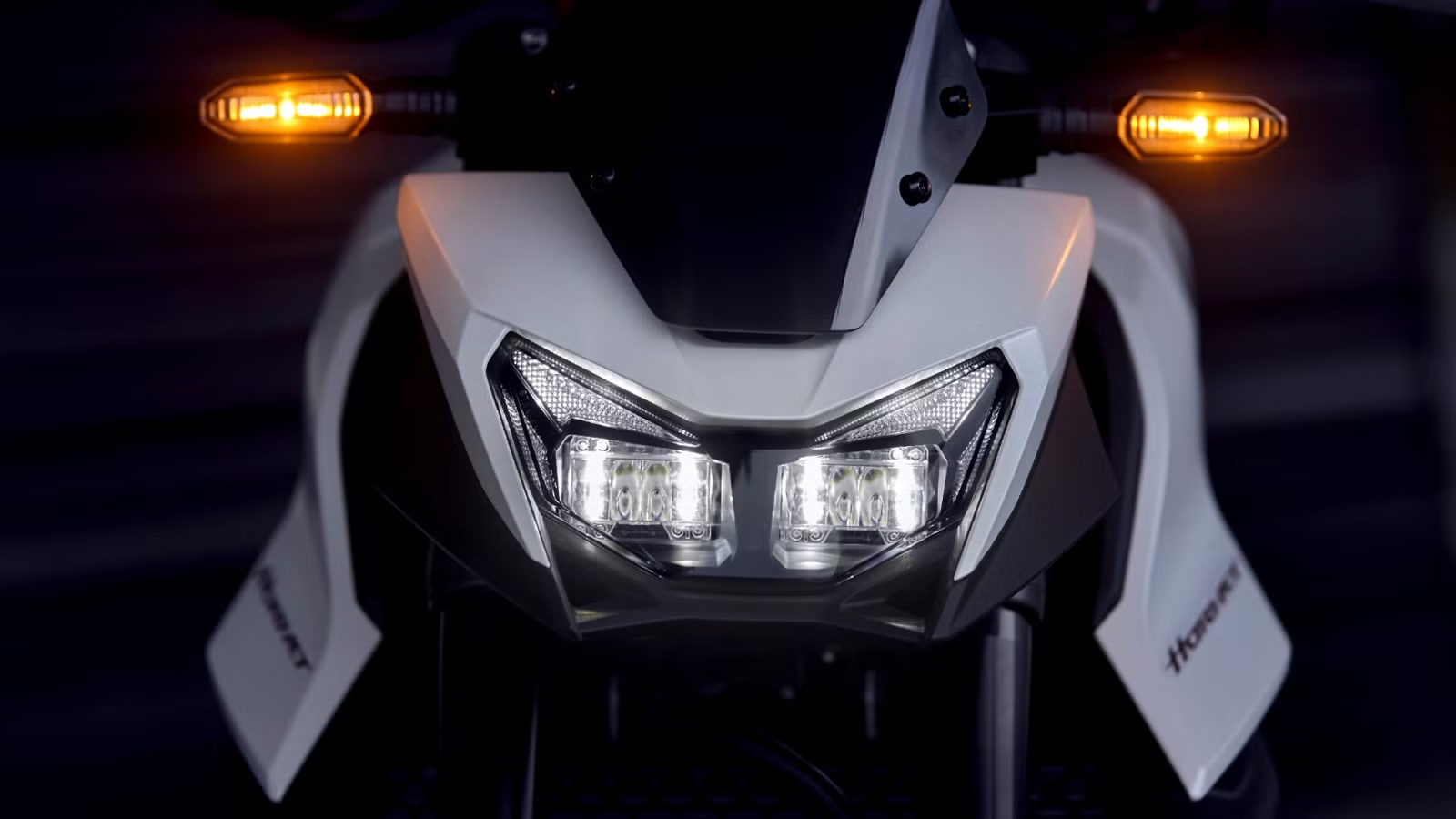
Premium features have become increasingly common across the U.S. motorcycle market. These range from sophisticated ride modes and IMU-based rider aids to quick-shifters, advanced suspension, and smartphone-connected TFT displays. The catch is that many of these technologies still come with a significant price premium. That becomes especially noticeable in the middleweight naked bike segment.

Manufacturers often have to choose between keeping MSRP accessible and adding the electronics riders increasingly expect. In some rare cases, though, manufacturers figure out a way to blend both of these contrasting things, giving you a premium feature list without a premium price. Here’s a Honda that proves that.
The Electronics Tax Every Middleweight Naked Buyer Pays
There is a familiar pattern in the naked-bike segment. The closer you get to flagship territory, the more manufacturers are willing to throw into the electronics package. The Triumph Street Triple 765, the Ducati Monster, and the KTM 890 Duke all come loaded with full ride-mode suites, wheelie control, and bi-directional quick-shifters that blip on both ends of a shift. The catch is the price of admission — all three start somewhere between $2,000 and $4,000 above the sub-$9K tier most riders are actually shopping in.


Drop down into that more affordable bracket and the picture changes fast. The Kawasaki Z650RS, Suzuki GSX-8S, and Yamaha MT-07 all give you a TFT dash and some flavor of traction control. That’s all fine and functional, with nothing to complain about. But there are still big misses, particularly the above-mentioned quickshifter and a six-axis IMU. Heck, even the suspension can be really basic. The question then arises: is there something in this budget that does hit the nail on the head feature-wise?
The Honda CB750 Hornet E-Clutch Is A True Disruptor In The Naked Middleweight Segment
Base Price: $7,999

Yes, and it’s the 2026 Honda CB750 Hornet E-Clutch. This starts at $7,999 in the United States, with a $600 destination charge listed separately by Honda. Honda has recently added its E-Clutch technology here, while the 755cc engine, Showa SFF-BP fork, customizable riding modes, and Honda RoadSync connectivity are carried forward. In other words, the headline feature here — the E-Clutch — isn’t an expensive option box that has to be ticked after you’ve already bought the motorcycle, but it is part of the package.
The 755cc Parallel-Twin Delivers Real Middleweight Punch

The Hornet’s engine is a 755cc liquid-cooled parallel-twin, breathing through an 8-valve Unicam SOHC head with a 270-degree crank. This is the same firing order that gives V-twins their characterful pulse, minus the extra weight and complexity of an actual V-twin. Output lands at 90.5 hp at 9,500 rpm and 55.3 lb-ft of torque at 7,250 rpm, which puts it solidly ahead of most twins in its price class.
The Unicam design isn’t some marketing buzzword, either. It’s the same head architecture Honda uses on the Africa Twin, the CRF450R, and the Transalp — bikes built for very different jobs, but all leaning on Unicam’s compact cylinder head to keep weight low and the package tight. Borrowing from that lineage says something about how seriously Honda engineered this motor, rather than just building something cheap to hit a price point.
Honda E-Clutch Blips Eliminates Left Hand Usage

This is the feature that actually earns the “premium” label. Honda’s E-Clutch system does away with the handlebar clutch lever for everyday riding — no more clutch-in, clutch-out at every stoplight — but it’s what happens on the downshift that’s genuinely impressive. Inside the right engine cover sits an actuator unit with two small motors, managing a half-clutch position that smooths every gear change. Combine that with the ride-by-wire throttle, and E-Clutch blips the revs on downshifts automatically, matching engine speed to road speed the way a skilled rider would with the throttle and clutch working in concert.
The clever part is that it works at any rpm. A traditional quick-shifter usually wants you somewhere near the meat of the powerband to feel seamless; E-Clutch doesn’t care. Click the lever, up or down, and it sorts the rest out. It adds barely 4 kg to the bike’s curb weight and, crucially, doesn’t lock out the option of using the clutch lever manually if a rider wants it.
Showa Suspension And Radial Brakes Usually Cost Extra On Bikes This Size

Up front, a 41mm inverted Showa SFF-BP fork handles 4.7 inches of travel, while a Pro-Link rear shock manages 5.1 inches out back. Stopping power comes from dual 296mm front discs clamped by radial-mounted four-piston calipers. Such mounted calipers matter because of how they handle braking forces: the caliper bolts directly in line with the fork leg rather than at an angle, which reduces flex under hard braking and gives a firmer, more predictable lever feel.

Wrapping around all of that is a steel diamond frame, engineered with attention to wall thickness and stiffness rather than just being built as cheaply as possible. At a claimed wet weight of around 432 lb, with a 25-degree rake and 3.9 inches of trail, the Hornet is set up to change direction quickly without feeling nervous doing it. The only caveat, though, is that this isn’t a fully adjustable suspension setup. Preload, compression, and rebound adjustability across the board are still reserved for pricier machines further up the segment.
A Five-Mode Rider Aid Suite That Rivals Cost Thousands More To Match

Thanks to its throttle-by-wire system, the bike offers five distinct ride modes — Standard, Sport, Rain, and two rider-programmable User modes — each adjusting how the engine responds to throttle input. Layered on top of that is three-level Honda Selectable Torque Control, three-level wheelie control, and adjustable engine power and engine-braking settings, also in three stages each.
Stack that list up against the segment, and it starts to look almost unfair. Wheelie control and adjustable engine braking are the kind of features that usually only show up once you’re spending flagship money — the Street Triples and 890 Dukes of the world. Finding them as standard equipment on a sub-$8,000 naked bike is, frankly, unusual.
The 5-Inch TFT And RoadSync Round Out The Package

Tying it all together is a 5-inch TFT display with six selectable layouts, giving riders a clean way to keep tabs on which ride mode, torque control level, or wheelie control setting is active without digging through menus mid-ride. The dash also interfaces with Honda RoadSync, pairing with a rider’s phone for turn-by-turn navigation prompts, call notifications, and music controls, routed through the display rather than forcing riders to glance at a phone mount.
None of these features are individually revolutionary — TFT dashes and phone connectivity are close to standard fare in 2026. What’s notable is seeing all of it bundled together, alongside the E-Clutch system and the full electronics suite, on a motorcycle that still costs less than $8,000. That combination, more than any single spec, is what makes the Hornet feel like it’s playing a different game than everything else at this price.
Source: Honda Powersports

Related posts
Latest Post


No Comments