
The 4×4 With Land Cruiser Capability At Half The Collector Price
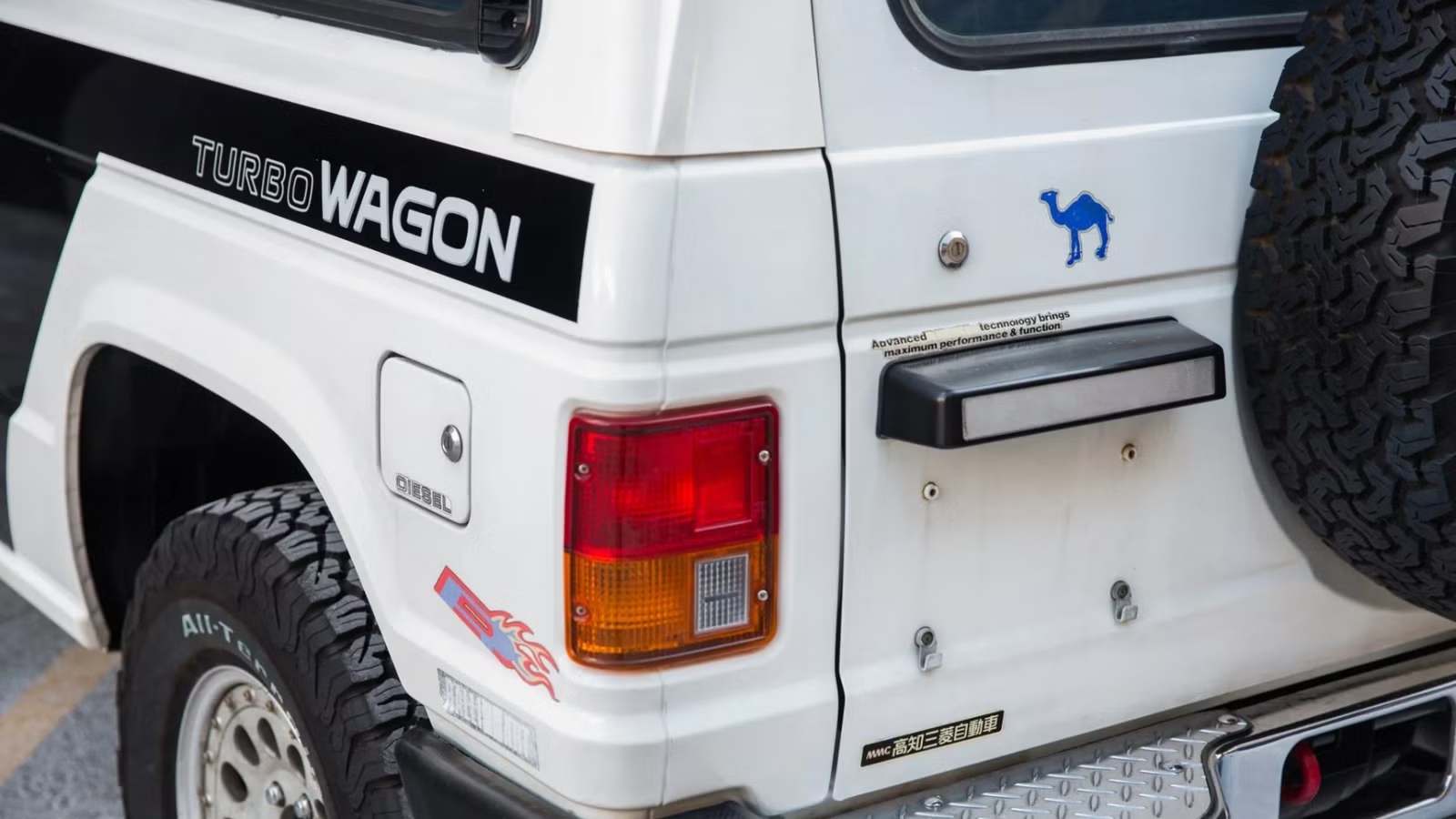
Vintage Japanese off-roaders stopped being cheap trucks a while ago. The 60-series Toyota Land Cruiser shows how far the shift has gone: a clean example could be found for around $12,000 in 2020, and a well-preserved one now trades between $35,000 and $50,000.

Another 1980s 4×4 was built to the same brief, carries a deeper competition record than the Toyota, and still sells for a fraction of that money. Americans could once buy it new from a Dodge dealer, wearing a badge that gave nothing away. Almost none of them understood what was parked on the lot.
It Won The World’s Cruelest Race Before America Knew Its Name
The Dakar Rally in the 1980s ran from Paris to Dakar, Senegal, and the 1985 edition covered roughly 6,300 miles over 22 days. Attrition decided most of it, and finishing intact was itself a result worth advertising. A Japanese newcomer entered in 1983 and won the unmodified production class on its first attempt. It took the modified class the following year. In 1985, barely three years after the road-going version reached showrooms, it won the rally outright. The 1983 entry ran in near-showroom specification, which made that class win a statement about the standard truck.

Patrick Zaniroli and Jean Da Silva took the 1985 overall win, with Andrew Cowan bringing a sister car home second, and third place arriving more than five and a half hours later. It was the first Dakar victory for any Japanese manufacturer, and it came from a company that had entered two years earlier hoping mainly to finish.
The same nameplate kept winning as the machinery grew more specialized, taking overall victories in 1997 and 1998 before running off seven straight from 2001 through 2007. Twelve overall Dakar wins is more than any other manufacturer has managed. Those later cars were purpose-built prototypes rather than showroom trucks, but the dynasty they extended started with a 4×4 anyone could buy. North American buyers had three chances to own that starting point, because the truck was sold here under three different names across the 1980s. One of those names belonged to Dodge, and it lasted barely three years.
The Dakar Champion Dodge Dealers Sold As The Raider

The Mitsubishi Pajero appeared at the Tokyo Motor Show in October 1981 and reached showrooms in May 1982 as a three-door, short-wheelbase 4×4 offered with a metal or canvas top. Buyers outside Japan knew it by other names. It was the Montero in North America and Spain, and the Shogun in the United Kingdom.
Chrysler had agreed to import the Pajero to grab a share of the booming small-SUV market, and from 1987 it sold the three-door version through Dodge dealers as the Raider. The run covered model years 1987, 1988 and 1989, and nothing else.

Period Dodge sales material pointed straight at the rally record, promoting engineering features that had helped customized Raiders win the Paris-Dakar Rally. American buyers were told exactly what the truck had done and largely shrugged, choosing Wranglers and Cherokees instead.
Roughly 8,000 Raiders left Dodge lots, which was solid without being spectacular. Chrysler then bought AMC in the spring of 1987 and inherited Jeep, which made selling a rebadged Mitsubishi alongside the Wrangler and Cherokee pointless. The Raider was canceled after 1989.

The constant renaming is part of why the truck never registered with American enthusiasts, even as it became a household name abroad. A vehicle sold as a Pajero, a Montero and a Raider never built one identity here, and the Dodge version had the shortest run and the smallest audience of the three.
The Raider was only ever a two-door with a rear hatch, while Mitsubishi sold the Montero in both two- and four-door form. When the four-door Montero arrived for 1989, Dodge never received it. Every Raider on the market today is therefore a short-wheelbase truck, which is the version collectors now want.
No Japanese 4×4 Had Ever Carried This Equipment List

Mitsubishi fitted the Pajero with equipment no Japanese four-wheel-drive vehicle had offered before, including a turbocharged diesel option, power steering, suspension seats, and an independent front end using double wishbones and torsion bar springs. The body bolted to a separate ladder chassis. The rear axle was a solid unit on semi-elliptical leaf springs.
Part-time four-wheel drive ran through a transfer case integrated with the transmission, with low range for slow going and manually locking free-wheeling hubs at the front. Skid plates came standard rather than as an accessory-catalog upgrade.
The Pajero was also the first off-road vehicle fitted with ventilated front disc brakes, and its dashboard carried a factory inclinometer for reading pitch and roll angles. Neither feature makes sense on a truck expected to spend its life on pavement.

That double-wishbone front end gave the Pajero ride quality most off-roaders of the era could not match, which is exactly the trait that pays across 22 days of desert stages. In 1982, comfort and durability rarely came in the same package.
The base 2.6-liter Astron four is quoted at either 109 hp or 110 hp depending on the source, with 142 lb-ft of torque, and the optional 3.0-liter V6 lands somewhere between 139 hp and 143 hp. Curbside Classic lists that V6 as a $1,727 option that added 32 hp and 29 lb-ft over the four.
The 1987 Jeep Wrangler made 105 hp from its 2.5-liter four and the Suzuki Samurai managed 63 hp, so the Raider’s output was normal for its class rather than weak. It weighed a little over 3,000 lbs, and its 92.5-inch wheelbase was shorter than a Cherokee’s.
The Same Job As A Land Cruiser For A Fraction Of The Money

Classic.com puts the average recorded sale for a Toyota Land Cruiser FJ60 at $31,888. Well-preserved or tastefully restored examples now change hands between $35,000 and $50,000, and low-mileage survivors have pushed toward $70,000 on auction sites.
The 12-month average across recorded first-generation Pajero sales is $7,220, and 1991 cars, the last and best-equipped of the generation, average $10,625. Both figures come from Classic.com, and both describe money that actually changed hands.
The highest publicly recorded first-generation Pajero sale is $24,870, achieved by a 1985 example in March 2022. The highest anyone has ever paid for one at auction still sits below what an average FJ60 costs, which is the cleanest way to see the gap.
Classic Pajero listings average around $18,193 with entry points near $7,400, and The Classic Valuer puts the median classic Pajero auction result at roughly $8,200. Those advertisement figures measure what sellers hope for rather than what buyers pay, which is why the sold data matters more.

Both trucks are body-on-frame, both use low-range transfer cases and solid rear axles, and only one of them has a Dakar overall win on the résumé. The market has priced the badge rather than the hardware.
The Pajero sold in huge numbers worldwide and the Montero stayed on the American market long after the Raider disappeared, which keeps mechanical parts easy to source. That matters more than it sounds, because the usual penalty for buying an obscure 1980s import is a parts hunt that never ends.
A $100,388 Sale Says The Market Is Waking Up

A 1997 Pajero Evolution sold for $100,388 in May 2026, which proves collectors will pay serious money for this nameplate when they focus on it. Halo models tend to pull ordinary versions up behind them.
Mitsubishi restored the actual 1985 Dakar-winning Pajero for the victory’s 40th anniversary, recovering it from the Okazaki research facility where it had sat untouched for four decades. Factory heritage projects usually arrive before the money does.

A $7,220 generational average against $10,625 for 1991 cars shows buyers already paying a real premium for the best examples. Every re-rating starts with that kind of spread opening up inside a single generation.
Dodge sold roughly 8,000 Raiders a year for three years, capping American supply somewhere near 24,000 trucks, and a significant number were exported to Central America in the early 1990s. The survivor pool is smaller than the production figure suggests.
The FJ60 sold for under $15,000 in 2020 and took about five years to reach current numbers, driven by the same appetite for analog, body-on-frame 4x4s. Land Cruiser money buys a reputation, while the same capability with a deeper competition record is still available for a fraction of the price.
Sources: Mitsubishi, Classic, Curbside Classic, Collecting Cars

Related posts

Latest Post


No Comments