
Pontiac’s Rare Muscle Car That Beat Ferraris On The Track And Then Vanished
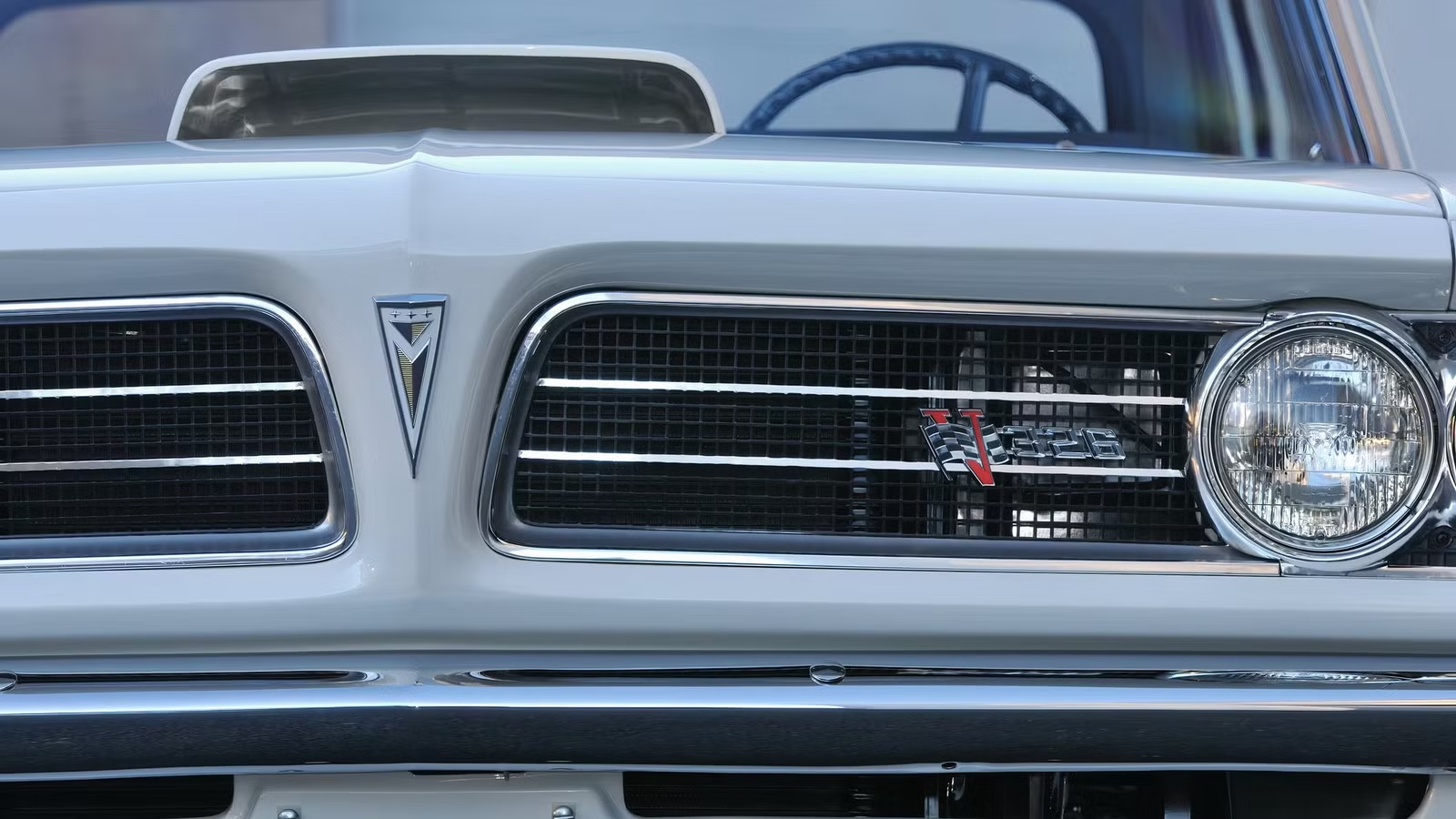
There are muscle cars that make headlines, those that dominate drag strips, those that grace magazine covers, and then, there are muscle cars that are able to launch themselves into legendary status. These legendary muscle cars don’t just compete – they shock the world and rewrite the rules. In the golden age of American performance, one Pontiac muscle car achieved these feats and then simply vanished into myth.

It arrived quietly, built not for showroom floors but for racetrack glory. It wasn’t a flashy name or a household staple. In fact, most people have never even heard of it. But when it lined up against the most revered sports cars on the planet, from Ferraris to Jaguars to Porsches, it didn’t even flinch. It conquered.
Then, just as quickly as it appeared, it disappeared. No mass production. No second chance. This is the story of a forgotten American legend. A Pontiac muscle car so rare, so fast, and so bold, it left Ferrari eating dust.
Detroit Turned Its Back On Racing — But Pontiac Didn’t Listen

In the early 1950s, the popularity of racing spread like wildfire across America, especially after the establishment of NASCAR in 1949 and the NHRA in 1951. Manufacturers soon realized that, when the teams they backed won on the weekend, their showrooms would be flooded by prospective buyers by lunchtime on Monday. However, the racing scene started facing backlash in the mid-1950s as racecars started getting dangerously fast, especially after the infamous Le Mans disaster of 1955. Consequently, the Automobile Manufacturers Association (AMA) instituted a self-imposed ban on factory-sponsored racing and speed-focused advertising in 1957.
While Detroit giants initially nodded in agreement, Pontiac had other ideas. A group of rogue engineers and visionary executives looked at the corporate decree and decided to look the other way. Under the leadership of legends like Bunkie Knudsen, Pete Estes, and a brilliant young engineer named John DeLorean, Pontiac knew that track domination was the only way to give their struggling brand the performance credentials it needed to appeal to younger, performance-oriented buyers.
The Underground Racing Program That Helped Pontiac Bend The Rules

Rather than falling in line and shutting down performance development, Pontiac quietly funneled its efforts into a loosely disguised engineering initiative that insiders would later recognize as the Super Duty program. Through the program, Pontiac developed performance parts and lightweight components and sold them to private racing teams. It wasn’t advertised, and it certainly wasn’t acknowledged as a racing effort. But the intent was clear: build lighter, stronger, and faster machines under the radar.
As the program evolved, it began to produce something far more serious than anyone outside the company realized. The Super Duty Program kicked off in 1959 with the 389 V8, but by 1961, Pontiac had unleashed the far superior 421 Super Duty V8, which powered icons like the 1962 Catalina Super Duty “Swiss Cheese”. As dominant as the Super-Duty-Equipped Catalina was, its full-size body put it at a disadvantage against smaller cars, which is why Pontiac pivoted to the lighter Tempest platform to create an unhinged monster that had Ferraris and Porsches in its sights.
How The Pontiac Tempest Super Duty Shocked Ferrari And The Racing World
In the golden era of American horsepower, the early ’60s were a playground for Detroit’s Big Three automakers (General Motors, Ford, and Chrysler) to flex their engineering muscle. However, hardly anyone could have guessed that it would be the mid-sized Pontiac Tempest, an unassuming family car from GM’s performance division, that would roll onto a world-class track and humiliate Ferraris. But yet, it was.
The story unfolds at the Daytona American Challenge Cup. It was 1963. The Pontiac Tempest Super Duty was up against the likes of giants from Ferraris to Stingrays to Jags to Porsches. Driven by Paul Goldsmith, the 1963 Tempest Super Duty put on quite the show at the Challenge Cup, rewriting the rules of what a muscle car could do. Per Hot Rod, sitting behind the Tempest’s wheel, Goldsmith was able to leap to the front of the pack that fateful day in 1963. The duo was able to outrun the European exotics, including the legendary Ferrari GTO.

Along with Goldsmith’s superior driving skills, what truly allowed this dynamic duo to achieve such a feat was the Tempest Super Duty’s superior engineering. The Pontiac Tempest Super Duty was simply innovation wrapped in rebellion. Engineers gutted the stock drivetrain and dropped in a 421 cubic-inch Super Duty V8 engine, which was essentially a race-ready NASCAR engine that had been locked out of competition by strict homologation rules. In addition, the transmission was rear-mounted, linked by a flexible torque tube, which provided the car with near-perfect weight distribution. This American engineering suddenly provided international recognition for a little ole’ muscle car built in Michigan. A muscle car with sports car DNA, the Pontiac Tempest Super Duty illustrated how American performance could be surgical, not just brutal.
The Upgrades That Turned This Tempest Super Duty Into A Ferrari Killer

Pontiac is widely believed to have built around 12 Tempest Super Duty cars in 1963, including six coupes and six wagons. While all of them were stripped-down monsters with the brutal 421 Super Duty engine under the hood and an incredible power-to-weight-ratio, the model that eventually lined up against Ferraris and Corvettes at Daytona operated on another level entirely. Pontiac handed the car over to Ray Nichels Engineering in Merrillville, Illinois, where it was extensively reworked to survive a brutal 250-mile race.
Hot Rod notes that the race-prepped car featured a dual-quad 421 Super Duty V8 producing around 500 horsepower, oil coolers, a reinforced suspension, and a full roll cage. Most notably, engineers paired two two-speed Powerglide transmissions back-to-back and adapted them to the rear-mounted transaxle. It was a bold solution that gave the Tempest both balance and durability.
The Sudden Death Of Pontiac’s Fastest ’60s Muscle Car
Sadly, just as quickly as it had appeared, the Pontiac Tempest Super Duty vanished into thin air. You see, Pontiac only built a handful of these racing legends. There were no more than a dozen ever made. Unfortunately, GM never made the leap to mass-produce the Super Duty Tempest. The reason was that the car was simply too fast, too wild, and too niche. Here today, gone the next. The 1963 Pontiac Tempest Super Duty suddenly became a myth almost overnight. It embarrassed Europe’s best and then disappeared into legend.
While the Tempest lives on in legacy, there are deeper reasons as to why GM never gave this one-of-a-kind muscle car the production numbers. In 1963, General Motors quietly enacted a company-wide racing ban, pulling official support for factory race cars across its divisions. Insurance concerns, legal pressures, and a desire to avoid public backlash made cars like the Tempest Super Duty a corporate liability. Not even its impressive specs could make up for the racing uproar of the early ’60s.

While it was the right time and place for the Tempest at the Challenge Cup, it was certainly the wrong time and place when it came to its production year. That’s because, just a year later, Pontiac would launch the GTO, a tamer but still thrilling muscle car that ignited a performance revolution. While the GTO became a sales juggernaut, the Tempest Super Duty remained a whispered legend, primarily remembered only by insiders and historians. Oh, to think, what could have been for the Tempest had it come along just a few years later?
Today, surviving examples are virtually priceless. With only a handful left in existence, the Super Duty Tempest is one of the rarest muscle cars ever made. It’s more of a one-hit wonder if you will, that simply burned too hot and too fast for its own good.
1963 Pontiac Tempest Super Duty Specs

|
Engine |
6.9L (421 Cu.In.) Super Duty V8 |
|
Horsepower |
405 HP |
|
Torque |
425 lb-ft |
|
Transmission |
Rear-mounted 3-speed manual |
|
0-60 MPH |
~6 seconds |
|
Top Speed |
140+ MPH |
|
Production |
12 units (approximate) |
(Source: Hemmings)
The 1963 Pontiac Tempest Super Duty was a technical marvel cloaked in muscle. Its 6.9L Super Duty V8 produced a monstrous 405 horsepower and 425 lb-ft of torque, paired with a rear-mounted 3-speed manual transmission that gave it near-perfect balance. It launched from 0 to 60 mph in around six seconds and topped 140+ mph.
The Tempest’s specs rivaled or surpassed the likes of Ferrari’s 250 GTO and Jaguar E-Types at Daytona. While European racers relied on finesse and high-revving engines, the Tempest delivered brute force with balance, shattering expectations and outperforming sports car royalty on their own turf.
Other Super Duty 421 Machines Collectors Still Chase

The Tempest Super Duty was the wildest race car to come out of the Super Duty 421 program, but it wasn’t the only one. The 421 SD engine debuted in late 1961 as a race-spec package supplied to racers, but Pontiac had to make it a factory-installed production option after the NHRA changed eligibility rules.
The 421 SD was never meant for mass production. You couldn’t just walk into a Pontiac dealership and buy one unless you were qualified, and most buyers never even knew it existed in the first place. Pontiac also instructed dealers to discourage regular customers who wanted to buy one, emphasizing that it was strictly a competition-only machine that was noisy, temperamental, and best kept at high idle. For this reason, 421 SD-equipped cars are some of the rarest Pontiacs in history, with only about 179 built in 1962 and roughly 88 built in 1963. Other than the Tempest, these are the Pontiacs that ultimately got the wild race engine:
1962-1963 Catalina Super Duty

When Pontiac launched the Super Duty 421, the Catalina was Pontiac’s designated race car. At the time, most race cars were built on full-size platforms, and the Catalina was the lightest and most affordable full-size model in Pontiac’s lineup. The 421 SD turned the Pontiac Catalina into an absolute animal, but what gave it an edge on the track was the crazy measures Pontiac took to reduce weight. The Catalina shed weight by using aluminum body panels and deleting radios, heaters, and sound deadening materials, but Pontiac engineers took the diet even further by drilling about 130 holes into the steel frames of a handful of Catalinas to create the mythical Catalina “Swiss Cheese.” These Catalinas painted drag strips with rubber with passes in the low-12-second range, forcing rivals to shift to lighter midsize platforms.
The Catalina became the most common home for the 421 Super Duty engine, with roughly 229 units equipped with the engine between 1962 and 1963. Since many were driven to their limits on the track, survivor rates are extremely low, which explains why one of the Swiss Cheese versions sold for an eye-watering $742,500 at an auction last year.
1962 Grand Prix Super Duty

While the Catalina Super Duty was a stripped-down monster built with absolute track dominance in mind, the Grand Prix aimed to combine the brutal power of the 421 SD with a plush, sophisticated interior where drivers could enjoy the might of the engine while still remaining comfortable. The Grand Prix Super Duty retained its dignity and upscale features, including a padded dash, bucket seats, and high-end Morrokide upholstery.
Despite weighing around 4,000 pounds, the Super Duty-equipped Grand Prix was still one of the fastest factory-built cars of its time, capable of 0-60 mph sprints in 6.0 seconds and quarter mile passes in 14.3 seconds at 103 mph. With only 16 units built, the Grand Prix SD is almost as rare as the Tempest SD, which explains why someone paid $181,500 the last time it came up for public auction, as far as we know.
A Rare Legend: Why The 1963 Pontiac Tempest Super Duty Is A Collector’s Dream Today
Today, the 1963 Pontiac Tempest Super Duty is more than just a muscle car. It’s a crown jewel in muscle car history. With only around 12 ever built, authentic examples are virtually extinct in the open market. That rarity has turned the Super Duty into a high-stakes collector’s fantasy, with prices to match.
However, back in 2010, there was a genuine 1963 Pontiac Tempest Super Duty coupe that stunned the auction world when it crossed the Mecum block. Per Hagerty, the authentic racer sold for a jaw-dropping $482,300. As an original factory race car restored to perfection, its sale proved that the Tempest isn’t just rare. It’s revered.

While owning a genuine 1963 Pontiac Tempest Super Duty is likely a pretty far-fetched dream, not all hope is lost. While original Super Duty cars are museum-grade unicorns, other 1963 Tempest variants, like the wagon, Le Mans coupe, or convertible, were produced in higher numbers and still show up on the collector market.
Just take a look at this stunning 1963 Pontiac Tempest Convertible with a gorgeous blue finish. This Tempest variant sold for $11,000 on the auction block with just 23,974 miles on the odometer.

Another eye-catching variant is this vibrant 1963 Pontiac Pro Street finished in a captivating yellow finish. The variant currently sits at just over 43,000 miles and is being offered at just $22,995 on Streetside Classics.
Whether it’s an authentic survivor or a well-loved variant, the 1963 Pontiac Tempest Super Duty remains a symbol of what happens when American ingenuity dares to chase Ferrari and wins.
Sources: Classic.com, Hagerty, Hemmings., Mecum Auctions, RM Sotheby’s

Related posts



Latest Post


No Comments