
Norton’s Manx R Art Build Is the Latest in a Growing Trend of Brands Commissioning One-Offs They’ll Never Sell
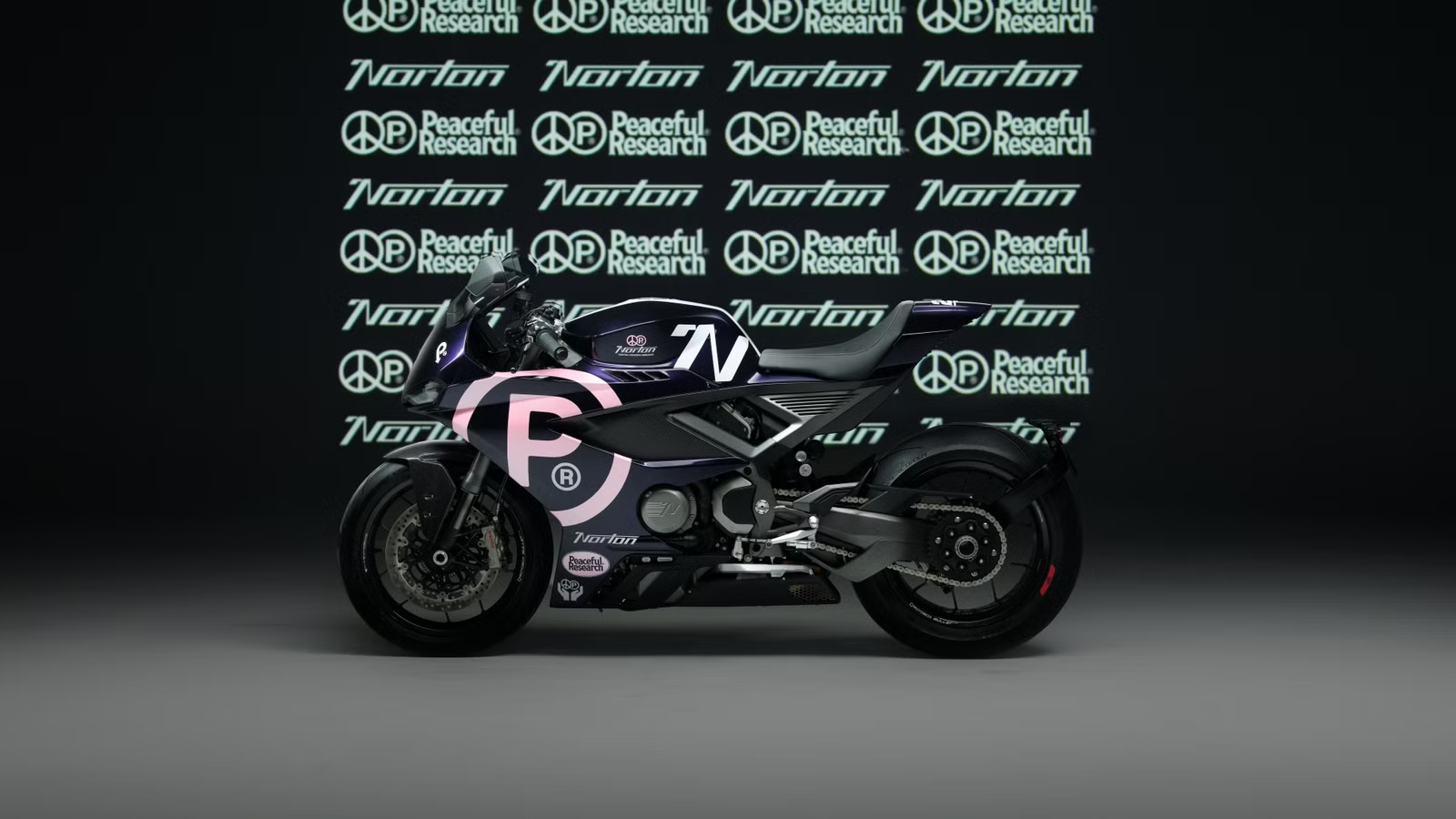
Norton unveiled a one-of-one Manx R this week at the British MotoGP weekend at Silverstone, and the bike’s most striking feature isn’t the 206bhp V4 underneath — it’s the asymmetrical metallic pink, deep purple, and light grey livery that makes no attempt to look like anything a customer could buy. Created in collaboration with Peaceful Research, a British studio known for reworking automotive references and reclaimed components into contemporary art, the build carries no price tag and no production intent. Norton has simply said it will tour selected exhibits.

That decision is deliberate, and it’s part of a pattern. Motorcycle manufacturers are increasingly commissioning bespoke, non-commercial art builds — pieces designed not to move units but to establish design credibility and cultural positioning that a spec sheet cannot convey. Norton’s Manx [P]R, as the collaboration is officially called, is the latest and most visible example of that shift.
What Peaceful Research Brought to the Manx R
Peaceful Research was founded by graphic designer Matthew Varker and spatial designer Ryan Bale. The studio’s work typically sits at the intersection of motorsport heritage, industrial design, and contemporary culture — think sculptural objects built from reclaimed car parts, or limited-edition goods that treat racing iconography as raw visual material. The Norton collaboration marks the studio’s first venture onto two wheels.
Rather than treating the Manx R as a flat canvas, Peaceful Research let the bike’s own shape and construction drive the composition. Enlarged versions of the studio’s “P” and “R” symbols wrap across the sculptural bodywork, and the design is deliberately asymmetrical — it reads differently depending on which side you’re standing on. A “26” on the tail marks the year. The finish layers paint and vinyl beneath a pearlescent lacquer with a purple fleck, and the entire build — color trials, disassembly, painting, vinyl application, lacquering, and reassembly — took ten days to complete after several months of creative development.
Ryan Bale explained the choice of Norton as the first two-wheeled platform: “Norton has the heritage to give the project meaning, but also the confidence to let us challenge convention. That made it the ideal brand for our first move onto two wheels.” Norton CMO Christoph Hohmann was equally direct about why the pink and purple palette made sense: “Peaceful Research makes intelligent, beautifully executed work, and we have admired the way Matt and Ryan take the visual language of racing and make it relevant to contemporary culture. Norton fans are individual and creative. Like us, they care about craftsmanship and self-expression. The Manx [P]R feels unmistakably like Peaceful Research, and that uniqueness is exactly what we wanted.”
A Pattern Taking Shape Across the Industry

Norton isn’t alone in pursuing this kind of cultural investment. Ducati has been building a formal relationship with the art world for several years, most recently commissioning Italian artist Andrea Crespi to create a 1:1 scale canvas inspired by the Panigale V4 Tricolore Italia. Crespi’s work — fluid lines, optical illusions, and trajectories in motion reinterpreting the bike’s iconic blue livery — now sits in Ducati’s permanent corporate art collection at Borgo Panigale, alongside an Acquabianca marble sculpture inspired by the Panigale’s aesthetics. Ducati has also participated in Arte Fiera 2024 and 2025 and runs the Officina Arte Ducati Award for emerging artists aligned with the brand’s values. These aren’t marketing stunts — they’re acquisitions.
The logic behind commissioning work that will never be sold is straightforward, even if it runs counter to how manufacturers typically think about product investment. A gallery-grade one-off communicates something a brochure cannot: that the brand has a genuine point of view on design, not just on engineering. It attracts an audience — design professionals, cultural tastemakers, press — who might never have engaged with the brand through a traditional launch. And it creates images and objects that circulate in spaces where advertising doesn’t reach.
For Norton specifically, the timing matters. The Manx R is the first major product of the brand’s TVS-backed resurgence, built after more than £200 million of investment. Its standard color options — Trophy Silver, Matrix Black, Celestial Grey, Aqua Green — are handsome but conventional. The Peaceful Research collaboration signals that Norton sees itself as something more than a revived British superbike brand. It’s a positioning move as much as a creative one.
What Comes Next for the Build
The Manx [P]R will continue to appear at selected exhibits following its Silverstone debut; Norton has not announced specific dates beyond directing followers to its social channels. Peaceful Research, meanwhile, is planning to open a physical shop in Ancoats, Manchester, later this year — a move that suggests the studio is growing beyond its digital-first presence. A limited apparel capsule released alongside the bike’s debut closed on August 14.
Whether Norton eventually sells the bike remains an open question. The brand has given no indication either way, and the deliberate ambiguity is itself part of the strategy — keeping the object in cultural circulation without reducing it to a transaction.
For enthusiasts, the Manx [P]R is worth watching not because it will ever appear in a showroom, but because of what it says about where Norton is headed creatively. Brands that invest in work they’ll never sell are making a statement about identity. Right now, Norton is making that statement loudly.

Related posts



Latest Post



No Comments