
Why Toyota Chose A 641-HP Twin-Turbo V8 Over An Electric Supercar
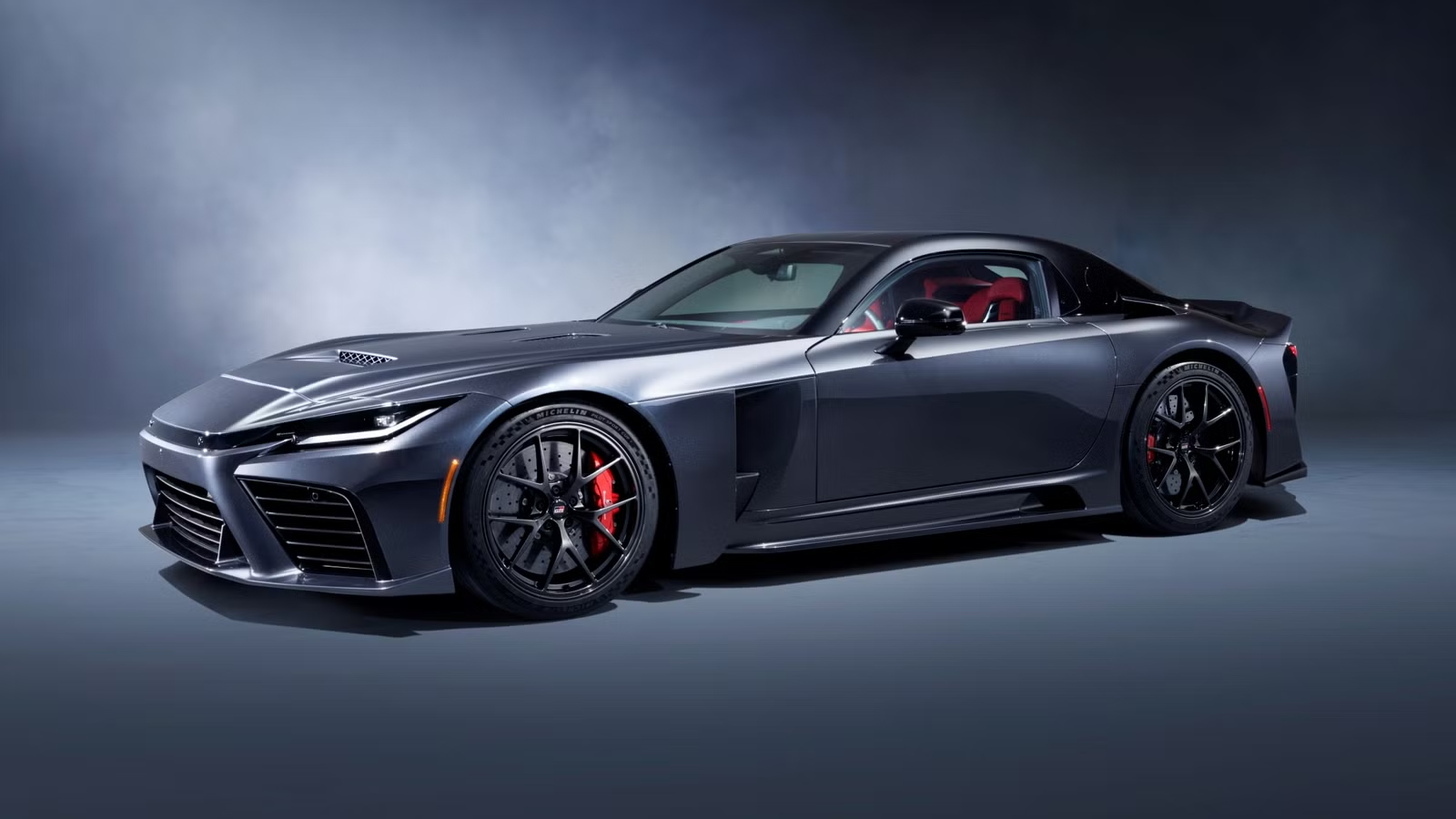
While the rest of the performance world sprints toward fully electric supercars, Toyota just dropped a 641-horsepower twin-turbo hybrid V8 into its upcoming GR GT halo car — and the enthusiast community is paying close attention. At a moment when rivals are measuring success in kilowatt-hours and charging speeds, Toyota is asking a fundamentally different question: can a hybrid powertrain preserve everything drivers love about combustion performance while still pointing toward the future? It’s a bold stance, and the GR GT is the clearest statement yet of where Toyota believes sports cars should go.

Toyota isn’t taking a foolish approach by completely abandoning the idea of an EV supercar; instead, it is splitting its efforts between the Gazoo Racing team and Lexus. In true old-school fashion, EV and hybrid performance development will fall under the luxury brand, while the GR team will continue to develop gas-powered performance machines meant to tease the senses and appeal to the emotional aspects of racing and performance.
Most Automakers Are Treating EV Performance Cars As The Future Of Enthusiast Driving
Brands Like Porsche And BMW Are Rapidly Electrifying Their Performance Lineups

Highly respected brands are leaning heavily into electrification for performance models. BMW has added electric models to its M Division, signaling its commitment to the future, and Porsche continues to develop electric and hybrid powertrains to squeeze more power and speed out of its lineup. Other brands are following their lead, pushing electrified performance over gas-powered alternatives.

Despite hesitation from driving enthusiasts, automakers are feeling pressured to electrify flagship sports cars rather than taking a more cautious approach. Considering that electric vehicles are gaining traction and growing rapidly in most parts of the world, this makes some sense — but is it the right approach?
Notable Performance EV Leading The Charge

The 2026 Porsche Taycan has an incredible performance ceiling, with the top model, the Taycan Turbo GT, pushing out 777 horsepower in regular driving and a whopping 1,019 horsepower when launch control is engaged. The story is similar when we look at the high-performance Cayenne Electric, producing over 1,030 horsepower in its top trim. Throw in AWD and Porsche’s superb driving dynamics, and you’ve got an EV that can reach 60 mph in under two seconds while cornering hard enough to make you toss your lunch.
Other models, like the Audi e-tron GT Performance, are capable of high horsepower and sub-2.0-second 0–60 mph sprints, while delivering the kind of road ability often reserved for non-street-legal vehicles. BMW is venturing further into this space with its Neue Klasse platform, which is set to introduce new electric models — one of which is rumored to be an electric M3. The i4 M50 has already demonstrated strong performance credentials, and reports point to the 1,000-horsepower ballpark for the electric M3, which would put it in the same conversation as the Taycan and e-tron GT Performance.
Many Enthusiasts Still Question Whether EVs Deliver The Same Emotional Experience

Electric racing series are growing, but will they ever command the same attention and crowds as cars powered primarily by combustion engines? Many enthusiasts would argue that EV racing can’t replicate the emotional experience of gas-powered race cars — the sounds, the smells, the raw mechanical feel.
When you attend a NASCAR or Formula 1 race, the sounds the cars make are real and a huge part of the experience. Although Formula E can be entertaining, the sounds aren’t produced by the cars themselves; they’re recorded and programmed to mimic gas-powered vehicles. Imagine an electric race without artificial sound — it would be the quietest circuit in existence.
Toyota’s 641-HP Hybrid V8 Proves The Company Isn’t Rejecting Electrification
The Upcoming GR GT Uses Hybrid Power To Enhance Performance Rather Than Replace Emotion

Toyota leans heavily into what it does extremely well for its new halo sports car. The upcoming GR GT features a 4.0-liter twin-turbocharged V8 engine paired with a hybrid electric motor, producing 641 horsepower and 627 pound-feet of torque. This system sends power through an eight-speed automatic transmission to the rear wheels, giving this new halo performance machine a genuinely engaging character. Rather than a mid-engine layout like many modern supercars, Toyota positions the engine up front, lending the GR GT a more traditional driving feel on track.

Although full performance figures haven’t been released yet, the GR GT is also engineered for comfortable daily driving — built for owners who want to take a road trip and stop to run fast laps at circuits along the way. Front and rear double-wishbone suspensions with forged aluminum arms keep weight in check. Add Brembo carbon-ceramic brakes and specially developed Michelin Pilot Sport Cup 2 tires, and you have the formula for a serious supercar from Toyota.
Toyota’s New Twin-Turbo V8 Was Engineered Around Motorsport Durability

Toyota understands how to build durable engines, and its Chairman, Akio Toyoda, has been openly critical of the short-term performance limitations of fully electrified sports cars. Although it might seem like the GR GT is heading in a completely different direction, that’s not the case. The new supercar’s hybrid setup emphasizes intelligent use of electrified assistance, paired with a new V8 designed for endurance racing rather than the short stints that currently define EV motorsport — a limitation unlikely to change until solid-state batteries are genuinely production-ready.
Could the new Toyota GR GT become a contender at the 24 Hours of Le Mans? That hasn’t been confirmed, but the car’s architecture points in that direction. Even outside of Le Mans, any major endurance race would serve as a proving ground for its long-distance credentials.
Toyota Quietly Built A Two-Brand Performance Strategy That Actually Makes Sense
Gazoo Racing Will Continue Focusing On ICE And Hybrid Enthusiast Cars

While many critics have published attention-grabbing pieces claiming Toyota is “anti-EV,” that simply isn’t the case. Historically, Toyota has taken a careful, measured approach to vehicle development — and there’s no reason to expect its performance strategy to be any different.
Rather than diving headfirst into the EV pool while abandoning what has made it successful, Toyota is pursuing a two-pronged approach to performance. The Gazoo Racing team will focus on the new hybrid GR GT alongside its current lineup of combustion-powered cars, including the GR Yaris, GR Corolla, GR86, and GR Supra. This keeps the smell of gasoline, the sound of a revving engine, and the emotional connection associated with motorsport alive and well under the Toyota name.
Lexus Will Carry Toyota’s High-Performance EV Ambitions

The other side of Toyota’s performance strategy belongs to Lexus. The luxury brand is tasked with developing new high-performance EVs, including the LFA successor, which is expected to feature a fully electric powertrain. This allows next-generation performance EVs to wear the Lexus badge — a brand that competes directly with BMW and Porsche in the luxury space, making the positioning a natural fit.
Details surrounding the LFA successor remain scarce in terms of confirmed specifications, though what we do know is that it will match the GR GT in size and visual impact. In Lexus’s own words, the design aims for a “universal” sports car shape intended to resonate with enthusiasts regardless of age or region. At 184.6 inches long, it’s roughly 10 inches longer than the GR Supra, about seven inches wider, and rides on a wheelbase approximately 10 inches longer. The LFA successor is also reported to sit around three inches lower, reinforcing its sleek, low-slung silhouette — the physical embodiment of that “universal” sports car ideal.

For now, this approach demonstrates Toyota’s commitment to developing sports cars with combustion engines, turbocharging, and hybrid systems rather than pivoting to an EV-only strategy — a plan that aligns perfectly with the company’s historically deliberate approach to vehicle development.
Toyota Believes Hybrids Are The More Realistic Path Forward Right Now
Toyota’s Massive Hybrid Sales Give The Company Confidence In Its Strategy

Toyota is the first name in hybrid power. The company has refined the technology as thoroughly as anyone, starting with the Prius and expanding to nearly every vehicle in its current lineup. The new Toyota GR GT represents a significant leap forward for Toyota hybrid performance, with power figures that command serious attention.
Toyota has sold more than 27 million hybrid vehicles worldwide throughout its history. That saturation has offset vehicle emissions equivalent to roughly nine million EVs, delivering meaningful air-quality improvements across every market. This long-term commitment to hybrid powertrains illustrates what happens when an automaker plays the long game rather than chasing every new technology before it’s proven viable.
Toyota Is Playing A Longer Game Rather Than The “EV Or Bust” Narrative

Toyota relies on a formula for success that has served it well for decades. The current GR Corolla is proof of Toyota’s combustion commitment, featuring a 1.6-liter turbocharged three-cylinder engine producing 300 horsepower. A 300-horsepower Corolla would have seemed unthinkable not long ago — yet here we are.
Toyota’s formula avoids hasty decisions, trend-chasing, and going all-in on unproven technology. Although some have framed this as being anti-EV, that’s simply not accurate. Toyota is developing electric vehicles — just not at the breakneck pace of some rivals, and that may prove to be the smarter play. Several automakers that rushed into EVs are now grappling with softening demand, insufficient charging infrastructure, and range limitations that new battery technology has yet to fully solve.
Toyota May Be Building The Sports Cars Enthusiasts Actually Want To Keep Forever
Emotional Attachment Still Matters More Than Spec-Sheet Dominance

If you want to keep driving enthusiasts engaged, you have to give them what they actually want. That means sports cars with visceral sound, mechanical feel, reliability, and emotional connection — not just the fastest 0–60 mph time on a spec sheet. This is Toyota’s bet in the near term, and it could easily become a long-term winning position.
The new Toyota GR GT posts power numbers that immediately grab your attention, and if the car drives as good as it looks, enthusiasts will likely be putting down reservations within hours of order books opening. By combining Toyota’s proven hybrid strategy with the emotional pull of a gas-powered engine, the GR GT is shaping up to be the kind of sports car owners will want to keep and eventually pass down to the next generation.
The Real Risk May Be Building EV Supercars Nobody Wants Long-Term

Electric cars have a legitimate place in the market, and they may eventually make compelling halo sports cars — but that case hasn’t been made convincingly yet. Toyota has never been the brand that rushes to prove new concepts; that role typically falls to others. EVs still face real-world practical challenges that are difficult to dismiss. Most lack the driving range, charging speed, and charging infrastructure that drivers take for granted with gas-powered vehicles. And no automaker has yet cracked the problem of building an electric truck capable of towing a heavy trailer without a dramatic range penalty.
Toyota has not rejected electrification. What it has refused to do is abandon the emotional core of performance cars. The upcoming Toyota GR GT reinforces that vision — using a hybrid system to enhance performance rather than replace it. While rivals chase high-performance EV spec-sheet numbers, Toyota may ultimately be building the sports car that enthusiasts still dream of owning decades from now.
Sources: Toyota

Related posts





Latest Post


No Comments